Odoo vs A3: which to choose for your SME and when each one fits
If your company is weighing up its management software, you have probably run into the Odoo vs A3 question. They are different tools designed for different needs. In this comparison we explain, without jargon, what each one excels at and how to decide with good judgement.
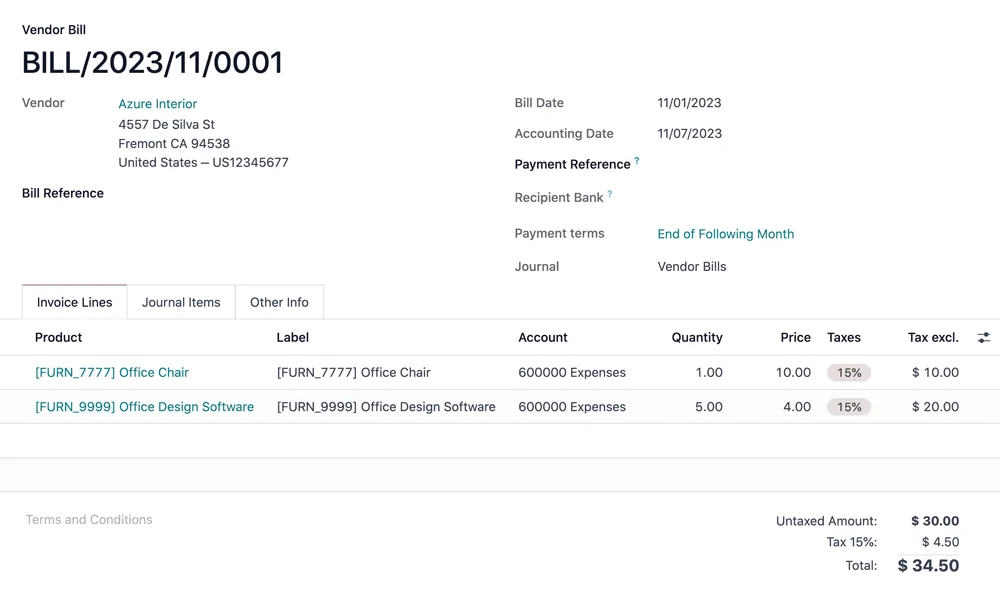
Vendor bill in Odoo Accounting · Nextdoo, Odoo Silver Partner
What A3 (Wolters Kluwer) is and who it is designed for
A3 is Wolters Kluwer's software family, widely used in Spain, especially among accounting firms, advisory practices and professional offices. Its best-known modules cover accounting, payroll, labour and tax, and are finely tuned to Spanish regulations: tax filing, social security contributions, collective bargaining agreements and accounting closes.
Its great strength is that specialisation. For an accounting firm handling the bookkeeping and payroll of dozens of clients, A3 is a proven tool, with solid support and up-to-date legal updates. It is not a bad product: it leads its niche for good reasons.
What Odoo is and how it differs
Odoo is not just an accounting programme: it is a full-featured ERP. With a single platform you manage sales, purchasing, inventory, invoicing, projects, CRM, e-commerce, point of sale and, also, accounting. Everything connected, with no information silos and no exporting and re-importing data between programmes.
Here lies the fundamental difference in the Odoo vs A3 debate. A3 handles the accounting and labour side of an advisory practice very well. Odoo is designed so that a company manages all of its daily operations in a single place. If you want to dig deeper, you can see how the financial side works on our Odoo Accounting page.
Odoo vs A3: when each one is the right fit
Choose A3 if your business is an accounting or advisory firm that makes its living handling the bookkeeping, payroll and taxes of many clients. That is its natural terrain, and you will hardly find anything better suited to such a specific and regulated workflow.
Choose Odoo if you are an SME (retail, distribution, services, manufacturing) that needs to connect sales, stock, purchasing and finance in a single tool. When the problem is not just bookkeeping but coordinating the whole business, a full-featured ERP delivers far more than a standalone accounting programme.
How Odoo and A3 coexist in many companies
In practice, Odoo and A3 are not always rivals: they often coexist. A very common case is the company that runs its day-to-day in Odoo (orders, invoices, warehouse) while its external accounting firm keeps using A3 for the tax close and payroll.
In that scenario, Odoo generates the business information and the accounting is passed on to the advisory firm in an orderly way. It is a reasonable coexistence for a long time. The decision to unify everything into a single system depends on the size of the company and how much accounting autonomy it wants to keep in-house.
Migrating to Odoo: what the process looks like
When a company decides to centralise its management, the step is usually to move operations to Odoo and decide whether to keep A3 only for the advisory side or migrate the accounting as well. A well-planned migration respects your history, your accounts and your master data so you do not start from scratch.
The approach is similar to other software changes: analyse processes, map data and train the team. If you are coming from another accounting system, our guide to migrating from Sage to Odoo gives you a clear idea of the method, which we apply with the same logic in any migration.
Cost and decision: how to approach it wisely
Comparing prices directly, Odoo vs A3, is misleading because they do not cover the same ground. A3 is usually contracted by modules and users, and Odoo by applications and active users. As a very general guide, both start from affordable monthly fees for an SME that grow according to modules and volume (reference estimate, not binding).
The real cost is not just the licence, but the time and errors you save by not duplicating work between programmes. The best decision is made after analysing your specific operations. In an Odoo Consulting session we review your case and tell you honestly whether Odoo suits you, whether to stay with A3 or to combine the two.
Frequently asked questions
Odoo vs A3: are they the same?
No. Wolters Kluwer's A3 is software specialised in accounting, payroll and taxation, widely used by accounting firms. Odoo is a full-featured ERP that, besides accounting, manages sales, purchasing, inventory and more. A3 dominates its niche; Odoo covers all of a company's operations in a single platform.
Is A3 better than Odoo for running payroll?
A3 is finely tuned to payroll and Spanish labour regulations, and it is a benchmark among accounting firms. Odoo also handles payroll, though it usually requires localisation and adjustments. If your business is an advisory firm focused on labour matters, A3 is a very solid option in that specific area.
Can I use Odoo and A3 at the same time?
Yes, it is very common. Many companies run their day-to-day in Odoo (sales, stock, invoices) while their external accounting firm keeps A3 for the tax close and payroll. It is a perfectly valid and orderly coexistence for as long as the company deems necessary.
When is it worth migrating from A3 to Odoo?
It is worth it when the problem stops being purely accounting and becomes one of coordinating the business: sales, warehouse, purchasing and finance out of sync. If you duplicate work between programmes or lose information between silos, centralising in a full-featured ERP like Odoo usually pays off.
How much does Odoo cost compared to A3?
It is not a direct comparison because they do not cover the same ground. Both start from affordable monthly fees for an SME that grow according to modules and users (reference estimate, not binding). What matters is weighing the time and errors saved, not just the licence. It is worth analysing your specific case.
Related resources
Official information: Official Odoo documentation.
Explore Odoo by sector and by module
Choose your sector, discover Odoo modules or compare with other solutions. Everything connected, in a single system.