Odoo vs SAP Business One: an honest comparison for SMEs in 2026
Choosing your company's ERP is one of those decisions that shape the years ahead. In this Odoo vs SAP comparison we go over cost, complexity, timelines and flexibility with business judgement and no fluff, so an SME manager can truly understand which one fits their reality best.
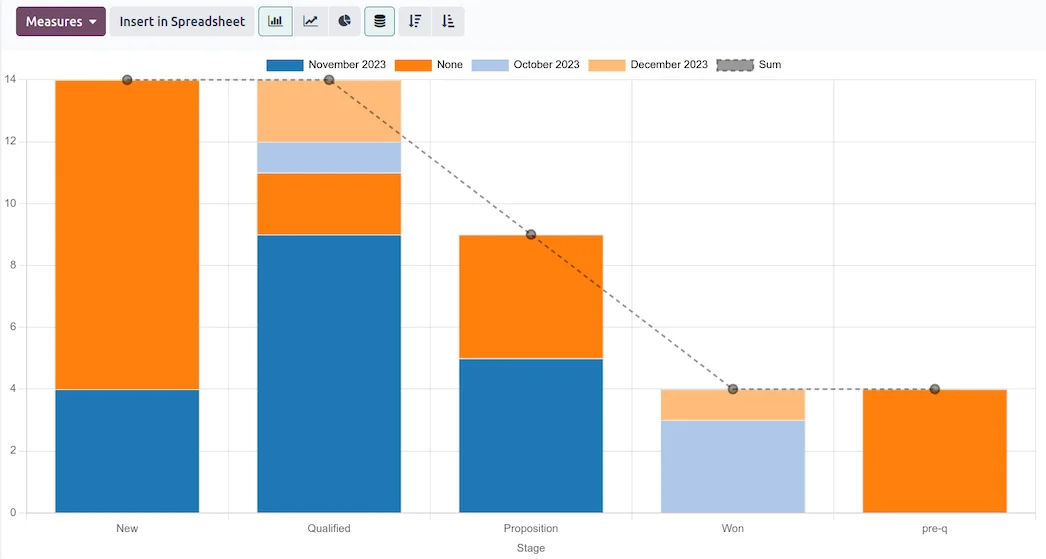
Reports and sales dashboard in Odoo's CRM · Nextdoo, Odoo Silver Partner
What Odoo and SAP Business One are, in a nutshell
Both are management systems (ERP) that bring accounting, sales, purchasing, inventory and other areas of your business together in a single place. The underlying idea is the same: stop working with scattered spreadsheets and keep your information connected and up to date.
SAP Business One is the offering from German giant SAP designed for small and medium-sized businesses, backed by a hugely prestigious brand and decades of experience in the corporate world. Odoo is a modular platform of Belgian origin, widely adopted among SMEs, that grows module by module according to what you need at any given moment. In the Odoo vs SAP comparison there is no universal winner: there is simply a better or worse fit depending on your size, your sector and the way you work.
Implementation cost: where the money really goes
Here it pays to be honest: the price of the licences is only one part. The real cost of an ERP includes the rollout, data migration, team training and ongoing maintenance. On this front Odoo tends to be more affordable for an SME, above all thanks to its modular model, which lets you start with just the essentials and expand later.
SAP Business One tends to involve a larger upfront investment and usually fits better with companies that have very well-established processes and a comfortable budget. We don't give fixed figures because they depend on each project (number of users, modules, integrations): any amount you may see out there is, at most, a reference estimate, not binding. The sensible thing is to request a proposal tailored to your case. On our Odoo implementation page (/implementacion-odoo) we explain how we work out the scope before giving a number.
Complexity and learning curve
SAP carries a reputation as a powerful but demanding system. It is a very robust tool, capable of running complex operations, and that comes at a price in the form of a longer learning curve and a greater reliance on specialised profiles. For a large organisation it's an advantage; for an SME it can feel like using a sledgehammer to crack a nut.
Odoo bets on a more approachable, visual interface, closer to the applications your team already uses every day. That doesn't mean it's trivial (an ERP always requires method and support), but in practice staff tend to adapt sooner. In the Odoo vs SAP comparison, if your priority is for your workforce to adopt it without friction, Odoo starts with an advantage.
Time to go live
Time is money, and with ERPs it shows. SAP Business One projects tend to be longer, especially when there are many processes to document and adapt. That's not a flaw: it reflects ambitious implementations where it's worth getting the details right.
Odoo, thanks to its modular nature, lets you get started in phases: first the most urgent needs (sales and inventory, for example) and the rest afterwards. That shortens the time to see results and reduces the risk of a never-ending project. Real speed, in any case, depends more on the partner supporting you than on the software itself; that's why good Odoo consulting (/consultoria-odoo) is often the difference between an agile deployment and one that gets stuck.
Flexibility and future growth
Odoo stands out for its flexibility: being open source and modular, it adapts with relative ease to specific processes and expands whenever the business calls for it. This makes it very attractive for SMEs that grow and change, or that have particular use cases the standards don't fully cover.
SAP, for its part, brings the solidity and backing of a multinational, with a huge ecosystem and a reputation that opens doors, especially if you work with large clients or within demanding supply chains. If you foresee a major jump in size or you need that corporate seal of assurance, it's a legitimate argument in its favour in the Odoo vs SAP comparison.
So, which one should I choose for my SME
The honest answer is: it depends on your starting point. If you're looking for a flexible system, with a more contained investment, quick to launch and easy for the team to adopt, Odoo is usually the natural choice for most SMEs. If your company runs very complex operations, has a large budget and needs the brand backing of a multinational, SAP Business One deserves a place on the table.
At Nextdoo we are an Official Odoo Partner, so we have a clear and honest preference, but we'd rather you decide based on data and not marketing. The best approach is to see it working with your own use cases before committing. You can start with a free trial of Odoo (/prueba-gratis) and check whether the system fits the way you work.
Frequently asked questions
Is Odoo cheaper than SAP Business One?
In most SME projects, Odoo tends to mean a lower total investment, above all thanks to its modular model and its shorter adoption curve. Even so, the real cost depends on users, modules and integrations, so any general figure is a reference estimate, not binding. The right approach is a tailored proposal.
Which is faster to implement?
Generally, Odoo lets you get started sooner, since it can be deployed in phases and you can begin with the most urgent needs. SAP Business One tends toward longer projects, tied to complex operations. In both cases, the real timeline depends as much on the scope as on the partner carrying out the implementation.
Is SAP better than Odoo just because it's a bigger brand?
Being a multinational brings solidity, ecosystem and prestige, which is valuable if you work with large clients or demanding supply chains. But bigger doesn't always mean better for an SME. For many mid-sized companies, Odoo's flexibility and agility fit better with their day-to-day and their budget.
Can I migrate from SAP to Odoo later on?
Yes, it's a common scenario. Many SMEs that started out with other systems later migrate to Odoo in search of more flexibility and lower maintenance costs. The key is to plan the data migration and team training well, something we handle case by case in every implementation project.
What happens if my company grows a lot, will I outgrow Odoo?
Odoo is built to grow with you: being modular, new areas are activated as the business demands them. Sizeable companies use it every day. If you foresee a very large jump toward complex corporate operations, it's worth reviewing the fit with a consultant before deciding.
Related resources
Official information: Official Odoo documentation.
Explore Odoo by sector and by module
Choose your sector, discover Odoo modules or compare with other solutions. Everything connected, in a single system.