Odoo B2B e-commerce: the wholesale store connected to your ERP
Selling to other businesses is not like selling to the end consumer. You need different prices per customer, catalogues where each one only sees what is relevant to them, orders that are repeated every month, and all that information reaching your accounting and warehouse without errors. An Odoo B2B e-commerce gives you exactly that: a store for businesses built on the same system that already manages your operation. At Nextdoo, an Official Odoo Partner based in Cunit (Tarragona) with a presence throughout Spain, we help wholesalers and distributors launch a B2B sales channel that works autonomously, without double data entry and without spreadsheets getting in the way.
Prices per customer: each business sees its own price
In B2B, there's almost never a single price. A customer who buys in volume pays differently from one who is just starting out, and a distributor has conditions that a retailer doesn't. With Odoo B2B e-commerce, you define price lists by customer or by customer group, and each one, when entering the store with their user account, sees exactly their own conditions. Without public prices that they shouldn't see, and without negotiating over the phone what has already been agreed upon.
These price lists can be based on volume, product category, campaign date, or the specific commercial agreement for each account. As everything resides within Odoo, the price the customer sees on the website is the same as applied in the quote, order, and invoice. There are no discrepancies between what is shown and what is charged.
Restricted catalogue: each customer only sees what is theirs
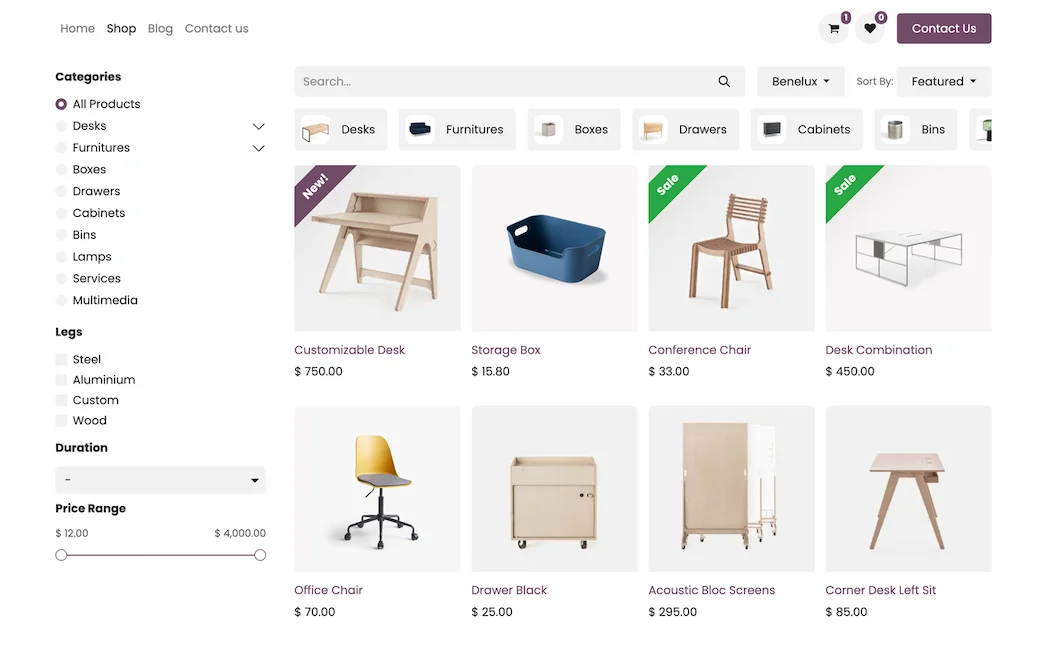
Not all your customers should see your entire catalogue. Sometimes there are products reserved for a specific channel, brands with territorial exclusivity agreements, or references that are only supplied to certain accounts. Odoo allows you to restrict the catalogue by customer or by group, so that each business only navigates through what they are entitled to buy.
This also helps you protect margins and agreements. A customer doesn't see another's conditions, nor products that aren't for them, nor references you haven't yet launched. And when you want to open a new product to a group of customers, you do it from within Odoo itself, without having to redo anything on the website.
Customer portal: real self-service
The customer portal is where B2B truly makes a difference. Each business logs in with their account and finds their order history, downloadable invoices, shipment status, quotes pending approval, and their account documents. Many calls and emails like "can you resend me the March invoice?" or "where is my order?" disappear, because the customer resolves it themselves, at any time.
This self-service not only improves the experience of the professional buyer, who values resolving issues quickly without depending on your schedule. It also frees up your sales and administration team from repetitive tasks so they can dedicate their time to what adds value: acquiring new accounts and nurturing the ones you already have.
Recurring orders and quick reordering
In many B2B businesses, the customer orders the same thing, or almost the same thing, every week or every month. Forcing them to recreate the order from scratch every time is unnecessary friction. Odoo allows you to repeat a previous order in a couple of clicks, maintain habitual shopping lists, and speed up order repetition, so the customer takes seconds to place their replenishment order.
For large or repetitive orders, you can also enable quick entry by reference or quantity, instead of going product by product. The easier you make it for the professional buyer, the more orders come through the digital channel and the less you rely on them calling or sending the order by email, with the risk of error that this entails.
ERP integration: a single system, zero double work
The big difference of an Odoo B2B e-commerce compared to setting up a separate store is that the website and the ERP are the same. When an order comes in, stock is updated, the sales document is generated, logistics are triggered, and information reaches accounting without anyone copying data from one place to another. That is exactly where SMEs usually gain or lose hours every day.
This foundation naturally connects you with the rest of the business components. You can rely on our work for Odoo Ecommerce for the store part and Odoo CRM so that the sales team can see and act upon each account's activity. All under the same system, with the same data, and without fragile integrations that break every time there's an update.
How we configure it at Nextdoo
We start by understanding how you sell today: what customers you have, what prices you work with, which products go to which channel, and where your hours are spent. With that, we configure the catalogue, price lists, customer groups, and the portal, and connect everything with your management system so that it functions as a single system instead of loose parts.
Regarding the cost, each project depends on the number of products, customer volume, and necessary integrations, so we don't work with a fixed price without reviewing your case; any figure we mention is a reference estimate, non-binding, and the official Odoo licence conditions should be consulted on the official Odoo website. If you want to see the system from the inside before deciding, you can request your free trial and we'll evaluate it with you, without obligation.
Frequently Asked Questions
How does Odoo B2B e-commerce differ from a regular online store?
A B2C store shows a single public price to everyone. An Odoo B2B e-commerce applies different prices per customer, restricts the catalogue according to whom you sell, includes a customer portal with their history and invoices, and facilitates recurring orders. Furthermore, as it is within Odoo, the order goes directly to your ERP without re-entering data.
Can I have different prices for each customer?
Yes. With Odoo's price lists, you define conditions per customer or per customer group, according to volume, product category, or commercial agreement. Each business, when logging in with their user account, sees only their prices, and those same prices are then applied in the order and invoice without discrepancies.
Will customers be able to consult their invoices and orders without calling me?
Yes. The customer portal gives each business access to their order history, downloadable invoices, shipment status, and pending quotes. It's real self-service, available at any time, and reduces a good portion of the repetitive queries your team currently resolves by phone or email.
Does it integrate with my current management system and accounting?
Odoo B2B e-commerce is part of Odoo itself, so the website, stock, sales, and accounting share the same data. If you already work with Odoo, it's a natural extension. If you come from another system, at Nextdoo we evaluate the migration so that everything ends up connected without duplicating administrative work.
How much does it cost and how long does it take to get it up and running?
It depends on the number of products, customer volume, and the integrations you need, which is why we don't provide a fixed price without analysing your case; any figure would be a reference estimate, non-binding. The official licence conditions are best seen on the Odoo website. The usual approach is to start with a requirements gathering and a demonstration based on your own scenario.
Related resources
Official information: Official Odoo documentation.
A single Odoo, all modules connected
Each module fits with the rest. Explore the other Odoo components and the sectors where we implement them.