Odoo vs Holded: an honest comparison for SMEs in 2026
If you are choosing management software for your SME, the Odoo vs Holded question comes up early. Both are good, but they solve different needs. In this comparison we explain, with no hype and a business mindset, where each one stands out and how to decide with confidence.
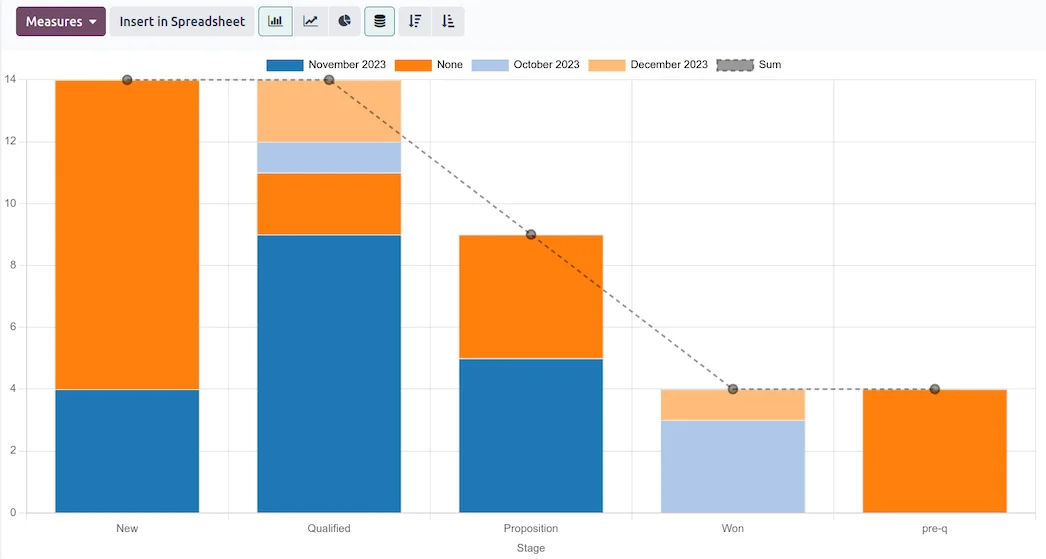
Reports and sales dashboard in Odoo CRM · Nextdoo, Odoo Silver Partner
What each one is and who it is designed for
Holded is a cloud-based management tool born in Spain, heavily focused on the financial side of the business: invoicing, accounting, expenses, treasury and some CRM and projects. Its great strength is that it gets up and running fast and is convenient for accounting firms and SMEs that want their numbers in order without complications.
Odoo is a comprehensive management system (an ERP) that goes far beyond finances. It covers sales, purchases, warehouse, manufacturing, online store, point of sale, human resources, customer support and dozens of other areas, all connected to each other. In the Odoo vs Holded debate, this is the fundamental difference: financial scope versus complete management of the company.
Functional scope: how far each platform reaches
Holded reliably covers the administrative and accounting side. If your priority is to invoice well, control expenses and keep the accounting up to date, it more than delivers. When the business needs more specific things (manufacturing, lot traceability, multiple warehouses or custom workflows), you start to notice the limits.
Odoo is built as a set of applications that you activate as you need them. You can start with just invoicing and sales, and later add warehouse, ecommerce or manufacturing without switching tools. Everything shares the same data, so a sale updates the stock and generates the invoice without duplicating work. That all-in-one approach is Odoo's great argument over Holded.
Customisation and adaptation to your way of working
Holded offers simple configuration options and a very polished experience, designed to work well out of the box. In exchange, you have less room to adapt unusual processes or fit very specific workflows from your industry.
Odoo is open source and highly flexible. It can be tailored to specific processes, you can create your own fields and reports and connect it to other tools you already use. That power is a real advantage, but it is worth being honest: getting the most out of it usually requires the support of a partner. At Nextdoo we do this with an Odoo Consulting process that starts from your operations before touching anything.
Scalability: thinking about the business three years from now
A growing SME changes its needs. Holded keeps up well as long as the focus remains financial and administrative management, and it is a sensible choice for teams that do not foresee complicating their operations much.
Odoo is designed to scale by area and by volume. You can add modules, users, stores or warehouses as the business moves forward, and it grows with you without forcing you to migrate systems later on. That is why, in Odoo vs Holded, many companies with expansion plans lean toward Odoo even if at first it asks for a bit more ramp-up.
Pricing model: how to compare without any surprises
Both work on a subscription basis and the cost depends on the features and users you need. Holded is usually perceived as an affordable, predictable entry point for financial management. Odoo has a modular model: you pay for what you activate, with options ranging from a very basic free version to plans with all the applications.
What matters is not just the monthly fee, but the total cost: setup, training, integrations and, in Odoo's case, the implementation with a partner. To get a realistic idea, you can check our Odoo 2026 pricing guide. Any figure you see out there should be treated as a reference estimate, not binding, until you have a proposal tailored to your case.
When each one is the right fit and when to migrate from Holded to Odoo
Holded is a fit if you want an agile, convenient solution focused on invoicing and accounting, with a small team and no highly specialised processes. Odoo is a fit if you want to unify the entire company into a single system, need warehouse, manufacturing, ecommerce or custom workflows, and prefer a platform that grows with you.
La señal para plantearte la migración suele ser esta: usas Holded para las finanzas pero llevas el resto en hojas de calculo o herramientas sueltas, y esa dispersion te hace perder tiempo y cometer errores. Ahí Odoo aporta orden real. Si estas en ese punto, puedes probar Odoo para verlo con tus propios datos, y desde Nextdoo, Partner Oficial Odoo en Valencia y toda España, te ayudamos a decidir sin presión.
Frequently asked questions
Is Odoo or Holded better for an SME?
It depends on your needs. Holded is ideal if you focus on invoicing and accounting and want something agile. Odoo is better if you want to manage the entire company (sales, warehouse, manufacturing, ecommerce) in a single system that grows with you. There is no absolute winner: there is a right choice for each business.
Can I migrate my data from Holded to Odoo?
Yes. Customers, products, invoices and accounting can be transferred from Holded to Odoo through an orderly migration process. It is advisable to plan it with a partner to preserve the history and avoid errors. At Nextdoo we support that migration step by step so the change does not disrupt your daily operations.
Which is cheaper, Odoo or Holded?
Both are subscription-based and the price depends on features and users. Holded is usually seen as an affordable entry point for finances; Odoo is modular and you pay for what you activate. More than the fee, compare the total cost including setup and integrations. Any figure is a reference estimate, not binding.
Is Odoo too complex for a small company?
It does not have to be. Odoo lets you start with just the applications you need and add more when the business calls for it. Complexity arises when you try to activate everything at once without support. With an implementation well planned by a partner, an SME uses it comfortably from day one.
When is it worth switching from Holded to Odoo?
When Holded covers your finances but you handle sales, stock or manufacturing in spreadsheets and scattered tools. That fragmentation costs time and creates errors. If you need to unify the entire company into a single system and plan for growth, it is a good time to calmly consider switching to Odoo.
Related resources
Official information: Official Odoo documentation.
Explore Odoo by sector and by module
Choose your sector, discover Odoo modules or compare with other solutions. Everything connected, in a single system.