Omnichannel retail with Odoo: unite your physical store, your ecommerce and your stock
If you sell in store and online, you are probably keeping two separate worlds: one stock for the shop and another for the web, with customers that go unrecognised across channels. An omnichannel retail approach with Odoo unites everything into a single system. At Nextdoo we set it up for retailers all across Spain.
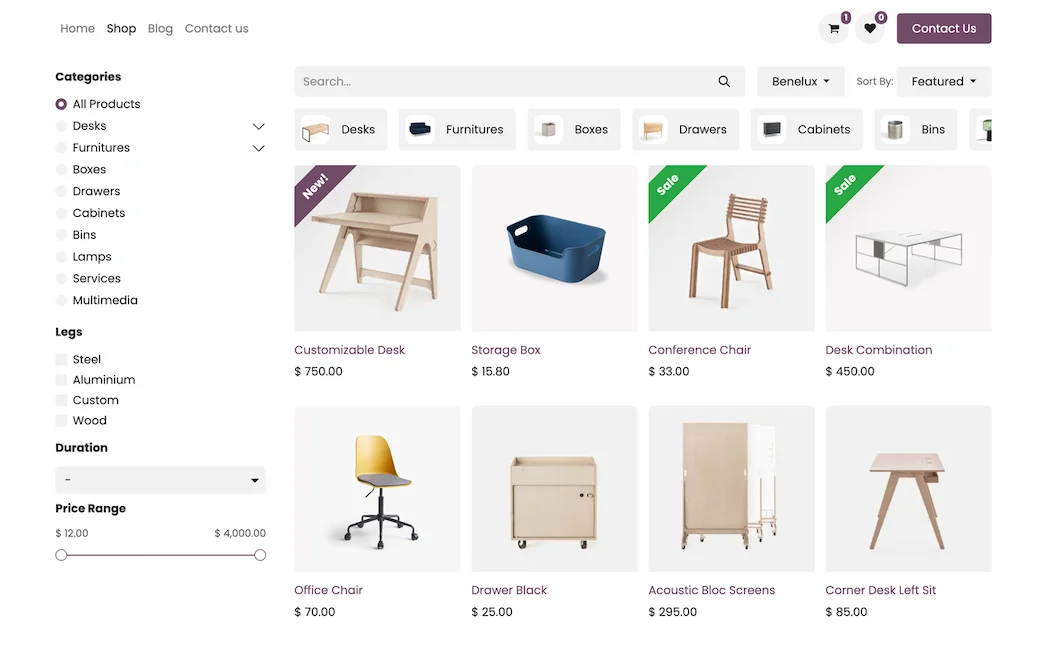
Odoo online store catalogue with products and filters · Nextdoo, Odoo Silver Partner
What omnichannel means for a retail business
Omnichannel is not just having a physical store and a website at the same time. Many businesses already have that. True omnichannel means both channels share the same information in real time: the same inventory, the same record for each customer, the same prices and the same promotions. The customer experiences a single brand, not two different businesses that happen to share a name.
In practice this translates into very concrete things. A customer buys online and picks up in store. They return at the shop something they ordered online. They start paying at the checkout and finish with home delivery because the colour they want is in another branch. All of that only works frictionlessly if there is a single system coordinating it behind the scenes, and that is the role a well-configured omnichannel retail setup with Odoo plays.
The real problem: two stocks and two different customers
The most common pain point in small and mid-sized retail is a lack of coordination. The web says there are three units of a product that were actually sold yesterday at the counter. Or the other way around: you turn down an online sale because the system says there is none left, when you have five in the back room. Every one of these mistakes is a lost sale or an angry customer.
The same happens with the customer record. The person who buys from you every week in store is a stranger to your website, and the one who orders online does not exist for whoever is at the checkout. That makes it impossible to build loyalty, apply a consistent discount or truly understand how much each customer is worth. Omnichannel tackles exactly these two problems: a single stock and a single record per person.
How Odoo solves it: a single stock for every channel
The centrepiece is shared inventory. Instead of keeping the warehouse in a spreadsheet, the ecommerce on its own and the checkout on another, everything draws from the same database. When you sell a unit at the counter, the web knows instantly. When an online order comes in, the stock available in store adjusts by itself. You can go deeper into how this part works on our Odoo inventory management page.
In addition, if you have several shops or a central warehouse, Odoo works with multiple locations. You know at all times how much there is and where each product sits, and you can decide from where each order is fulfilled. This reduces stockouts, avoids over-purchasing and gives a true picture of your inventory without having to reconcile anything by hand at the end of the day.
A single customer record across store and online
The second pillar is the unified customer. In Odoo, the person who buys at the point-of-sale terminal and the one who buys on the web are the same record. You see their full history: what they bought in the shop and what they ordered online, together. That lets you serve them better, recommend with judgement and run loyalty programmes that work equally across both channels.
Odoo's point of sale connects directly to that record and to the inventory, just as we explain on our Odoo POS for retail page. And the online store relies on the same foundation, as we detail in the ecommerce with Odoo section. There is nothing to synchronise between systems because it is, quite simply, a single system.
Practical benefits for your retail business
The first is time. You stop reconciling inventories by hand, exporting and importing customers, and answering availability questions the system could resolve on its own. That time goes back to what matters: selling and serving well. The second is money: fewer lost sales due to miscounted stock and fewer unnecessary purchases because you have reliable figures.
The third is customer experience. Offering in-store pickup, flexible returns across channels or personalised service based on real history are things any shopper expects today. You do not need large investments to get started: you can begin with what is most urgent (unifying stock, for example) and add channels later, at your own pace.
How we implement it at Nextdoo
We are an Official Odoo Partner specialised in retail, based in Valencia and serving all of Spain. We do not show up with a generic template: first we understand how you sell today, what channels you have and where your bottlenecks are. From there we set up the system, migrate your product and customer data, and train your team so they use it confidently from day one.
As for the investment, each project depends on the number of stores, the size of the catalogue and whether you need a new ecommerce or to integrate the one you already have. We work with phased budgets so you can start without committing a large figure all at once. Any amount you see in initial proposals is a reference estimate, non-binding, until the scope is finalised with you.
Frequently asked questions
Do I need to shut down my current online store to move to Odoo?
Not always. In many cases your current ecommerce can be integrated with Odoo so they share stock and customers, or migrated entirely if it makes sense for you. It depends on the platform you use today. We analyse it before recommending a path and clearly explain the advantages of each option.
Is Odoo useful if I only have a small physical store?
Yes. Omnichannel also brings value to a single-location business: you unify the point of sale with your future website and have an inventory and a customer database organised from the start. Beginning with a well-built foundation saves you costly overhauls when the business grows and you want to sell online.
How long does an omnichannel retail implementation with Odoo take?
It varies depending on the size of the catalogue, the number of stores and the data to be migrated. A scoped project can be up and running in a few weeks, while one with several branches and ecommerce takes longer. After learning about your case we give you a realistic phased timeline, without promising deadlines we cannot meet.
Is the stock really kept up to date in real time?
Yes. Since it is a single system, every sale in store or on the web deducts from the same inventory instantly. There are no two stocks to synchronise and no hours-long lags. This reduces stockouts and avoids turning down sales because of outdated information, which is one of retail's most expensive mistakes.
What happens to my customers and historical sales when I migrate?
They are migrated to Odoo so you do not lose information. We move over your customer database, your product catalogue and, when feasible, the relevant sales history. That way you start with your business already reflected in the system, not from scratch. We define with you which data are a priority before starting the migration.
Related resources
Official information: Official Odoo documentation.
One Odoo, all modules connected
Each module fits with the rest. Explore the other parts of Odoo and the sectors where we implement them.