In summary. Nextdoo has 24 verified references on the official Odoo Partners profile, concentrated in retail and B2B distribution. These ten anonymous profiles reflect the type of projects implemented in Spain: physical shops, ecommerce, wholesale distributors and sectors with specific tax considerations such as REBU or VeriFactu. The names are anonymous due to privacy policy, not a lack of real experience.
Are you wondering if Odoo really fits a Spanish physical shop, with its tax considerations, its mix of channels and its small team? This article gathers ten representative profiles of retail projects implemented by Nextdoo in Spain. The names are anonymous out of respect for commercial privacy, but the contexts are real.
Ten anonymous profiles of Spanish SMEs show how Odoo solves integral management in retail, ecommerce and distribution with specific tax compliance.
Why do we publish anonymous profiles and not client names?
Nextdoo does not publish any client's name without explicit written authorisation. It is a decision of respect for the business of those who trust us, not an evasion. In the Spanish retail sector, information about tools, margins and internal processes is sensitive.
If you want to verify Nextdoo's real track record, the starting point is the official profile on Odoo Partners, where the 24 declared references are listed with their sector and project type. That is what Odoo certifies. Nothing more, nothing less.
The profiles you will read below reflect the type of work we do. They are not fictitious or invented. They are representative of the real portfolio, described with enough detail for you to recognise your own business if you fit into any of them.
If after reading the article you want to speak with a client willing to give direct references, we can facilitate it. Always with their prior permission and after a first discovery call.
What do the ten profiles have in common before starting?
Before delving into each case, there is a recurring pattern in almost all of them: they arrived with dispersed data. A spreadsheet for stock, another programme for accounting, the bank's POS for payments and an email for managing online orders. The first job is not to install Odoo. It is to put the house in order.
They also coincide in the fiscal urgency. In 2026, VeriFactu and TicketBAI are not optional for most Spanish retail. Starting up without that configured is a real problem. In all projects, the fiscal part was worked on before the first sales ticket.
That said, each profile has its particularity. Here are the ten.
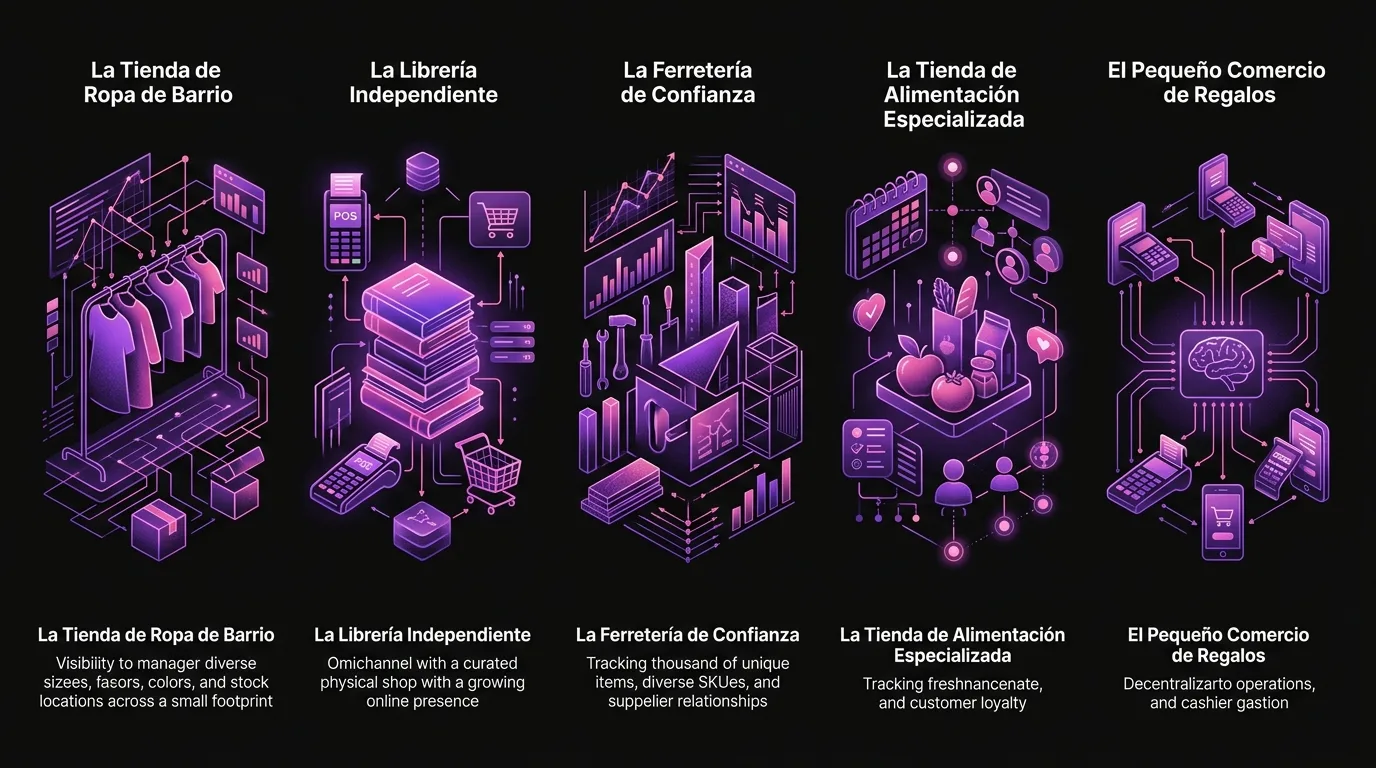
Profiles 1 to 5: physical shops with specific challenges
Profile 1 · Motorcycle outlet with national ecommerce
Outlet dealership in Valencia with a physical shop and online sales nationwide. They arrived with separate tools for each channel: a basic POS for the shop, an independent ecommerce platform and accounting with Sage at the tax advisor's office. Catalogue of around three thousand references including motorcycles, spare parts and accessories.
The main challenge was to unify stock in real time between the shop and the website. When a motorcycle was sold online, the shop team had to know instantly. With separate tools, that didn't happen. Availability errors generated returns and loss of trust.
After implementation, the point of sale, ecommerce and warehouse share the same inventory. Any movement in the shop automatically updates the website. The tax advisor receives accounting information without manual re-entry.
This profile is the core of the motodoo speciality: motorcycle retail with Odoo adapted to the Spanish specificities of vehicle sales.
Profile 2 · Stationery chain with three shops
Three establishments in the same province, a large catalogue of several thousand references, mixed sales between end consumers and schools as recurring B2B clients. The classic problem of the small chain: each shop operated as an island, with no visibility of the stock of the others.
The implementation solved three specific things: unified stock with real-time visibility between the three shops, differentiated rates for schools (special price by volume and by client), and the possibility for a client to pick up at any establishment regardless of where they placed the order.
The fiscal start-up was coordinated with the tax advisor to ensure that VeriFactu was active in all three points of sale before the first day of real use.
Profile 3 · Wholesale distributor of mobile accessories
Wholesaler supplying neighbourhood shops. Five-figure catalogue of references, clients with recurring orders every week and presence on some marketplaces. The model is pure B2B: there is no end consumer, there are small businesses that buy every Monday.
Here the focus was not on the point of sale but on the commercial CRM and the management of recurring orders. Sales representatives needed to see each client's history, launch quick quotes from their mobile and manage integration with marketplaces without duplicating work.
Odoo also resolved bank reconciliation, which was previously manual and took hours each week. The tax advisor significantly reduced the monthly closing time.
Profile 4 · Gourmet food shop
Delicatessen products imported from various European countries. Here the complexity is not the volume but traceability: batches, expiry dates, EU 1169/2011 labelling regulations and sales by weight with a connected scale.
The critical point was FEFO (first expiry, first out) rotation. Without that logic applied automatically, the team wasted time manually checking dates, and the risk of spoilage due to expiry was high.
Odoo also managed backward batch traceability: if there is a health alert about a supplier, it is possible to identify in seconds which affected units remain in store and which customers bought them.
Profile 5 · Independent Women's Fashion Boutique
Fashion shop with a physical presence and its own e-commerce. The catalogue has complex variants: each model in various sizes and colours creates dozens of references to manage. Seasonal sales and omnichannel returns were the two biggest headaches.
With separate tools, applying sale prices required updating two different systems, and there were frequent discrepancies between what the in-store label showed and what the website displayed. Returns purchased online and brought into the store had no clear process.
After implementation, seasonal prices are automatically activated by date on both channels. Omnichannel returns follow a single process regardless of the original purchase channel.
Profiles 6 to 10: distribution, perishables and sectors with special tax considerations
Profile 6 · Neighbourhood Greengrocer with Regular Customers
Local business with specific tax challenges: super-reduced 4% VAT on most products, selling by weight, perishable products with daily rotation. Many customers are neighbourhood residents who shop several times a week.
The previous POS did not properly differentiate VAT types, and cash register closings did not reconcile with accounting. Furthermore, the owner wanted to offer digital receipts via email or WhatsApp to regular customers to reduce paper.
Odoo applied the correct VAT types by product family, automated FEFO for perishables, and enabled digital receipt sending. The daily cash register closing now takes half the time.
Profile 7 · Outdoor Shop with Equipment Rental
Camping and hiking equipment with an unusual retail business line: seasonal rental of tents and backpacks. Two clear peaks in demand per year: skiing in winter and hiking in summer. Different rates for each season and for each type of customer.
Rental adds accounting complexity that most standard POS systems do not manage: loaned equipment, its return condition, and billing by days or weeks must be controlled. Odoo resolved this management without the need for specific external rental software.
Seasonal rates were programmed months in advance. The team does not have to remember to manually change prices.
Profile 8 · Wholesale Hardware Distributor
B2B distributor supplying local hardware stores within a regional radius. Very extensive catalogue, multi-supplier, different payment terms per client, and need for automatic replenishment to avoid stockouts on critical references.
The biggest operational problem was the time it took the sales team to prepare quotes. With the catalogue scattered across spreadsheets and no real-time stock visibility, a quote took hours. Customers called to ask about availability before placing an order.
After implementation, stock is visible in real-time, quotes are generated in minutes from any device, and automatic replenishment triggers purchase orders when stock falls below the configured minimum per reference.
Profile 9 · Classic and Second-Hand Motorbike Dealership
Sale of second-hand motorbikes under the special REBU scheme (Special Scheme for Used Goods). Each motorbike is unique: it has its own serial number, technical history, individual acquisition price, and sale price. In addition, this dealership has a small repair workshop for tuning up.
REBU implies specific accounting where the margin is taxed differently from the sale of new products. Without a system that understands this distinction, the tax risk is real. The Tax Agency demands clear traceability of the margin per unit.
Odoo managed the serial number per unit, the technical history of each motorbike, and REBU accounting. Workshop repair orders are linked to each vehicle. This is another case within Nextdoo's motodoo specialisation.
Profile 10 · Local Artisan Products Shop
Business with many small suppliers (local artisans), e-commerce with a click and collect option, and digital gift cards. The challenge was the diversity of suppliers: each with their own conditions, deadlines, and way of working.
The digital gift card, although seemingly a minor detail, has accounting implications: the amount collected is not revenue until it is redeemed. Without a system that manages this well, accounting becomes complicated.
Odoo centralised supplier relationships, enabled e-commerce with click and collect, and managed the correct accounting cycle for gift cards.
What learnings are repeated across all projects?
After reviewing these ten profiles, there are five lessons that appear in almost all of them. These are not opinions: they are patterns observed in practice.
The quality of the starting data conditions everything. If the Sage or spreadsheet catalogue has duplicate references, inconsistent descriptions, or stocks that do not match the reality of the warehouse, Odoo will start with those same problems. Data cleansing is not an implementation detail; it is half the project.
Early team training reduces rejection. A new POS system generates uncertainty. If the store team sees it for the first time on launch day, errors in the first few days are inevitable. When training is done with real advance notice, the launch is smoother.
VeriFactu and TicketBAI must be ready before the first receipt. This is not something that can be left until later. Tax configuration requires coordination with the tax consultancy and, in some cases, with the AEAT. Doing it with time avoids last-minute rushes and possible incidents in invoice communication.
Initial stock must reflect physical reality, not the previous system. If the previous ERP said there were a hundred units of an item and there are eighty in the warehouse, Odoo starts with a hundred. No one self-corrects. A physical count before migration is not optional if you want reliable data from day one.
The post-launch support period is where most operational details are resolved. The first days of real use bring to light situations that did not appear in the initial configuration. Having active support during this period makes the difference between an implementation that works and one that generates frustration.
How to read these profiles if you are evaluating Odoo for your business?
If your business resembles any of these ten profiles, the relevant question is not whether Odoo can fit, but which part of your current process is most critical and where to start.
Nextdoo works with a discovery process prior to quoting. It's not about selling a standard implementation, but about understanding what specific problem you have today and what needs to work well on day one. From there, the scope, the order of functionalities, and the implementation pace suitable for your team are defined.
Nextdoo's official profile on Odoo Partners is the external verification point. The 24 references listed there are those certified by Odoo. Nothing you read in this blog replaces that verification.
If you wish to speak with a client who has gone through a similar process to yours, we can facilitate this after an initial conversation. Always with the client's permission and without compromising their commercial information.
FAQ
Why are the profiles anonymous and no company names appear?
Nextdoo does not publish the name of any client without written authorisation. This is a policy of respect towards those who entrust us with their internal information. A company's processes, its tools, and its operations are sensitive data. If a client expressly authorises their name to be used, we do so. If not, the profile remains anonymous. This does not detract from the veracity of the cases; it simply protects them.
Where can I verify that Nextdoo has real retail experience?
Nextdoo's official profile on Odoo Partners, accessible from Odoo's public directory, lists the 24 declared references with their sector and typology. It is the external verification source that does not depend on what we write. Additionally, after a discovery call we can provide contact direct with clients willing to provide references.
Does Odoo correctly manage VeriFactu and TicketBAI for retail in 2026?
Yes, Odoo Enterprise includes support for VeriFactu (mandatory for companies in common territory according to the AEAT calendar) and TicketBAI (mandatory in the Basque Country and Navarre). The configuration must be done before start-up and requires coordination with the accountancy firm so that the certificates and fiscal data are correctly configured. It is not automatic: it must be activated and validated before the first ticket.
Does Nextdoo work only with large retailers or also with small shops?
Nextdoo works mainly with Spanish SMEs. The profiles described in this article include everything from a neighbourhood greengrocer to a wholesale distributor with catalogues of tens of thousands of references. Size is not the entry criterion: the criterion is that the business has an operational complexity that justifies Odoo over a basic POS.
What happens if my current stock in Sage or another tool is not reliable?
It is more common than it seems. The solution is not technical but operational: perform a real physical count before migrating. Odoo will import the data you provide. If the initial data has errors, those errors travel with the migration. The discovery process prior to implementation includes a review of the data's status to anticipate this type of problem.
How long does it take to implement Odoo in a small shop?
It depends on the scope, the state of the initial data, and the availability of the client's team for training and validation. In general, an implementation for a simple shop has a reasonable and adjustable timeframe. Projects with multiple shops, e-commerce integrations, or special fiscal circumstances require more configuration and testing time. The actual timeframe is defined after the personalised analysis, not before.
Conclusion: recognise your profile and take the next step
Retail in Spain in 2026 is not a homogeneous sector. A neighbourhood greengrocer and a wholesale hardware distributor have radically different problems, although both sell physical products. What they have in common is that separate tools generate friction that costs time and money every week.
Odoo unifies these processes on a single platform. It's not a marketing promise, it's what these ten profiles show: point of sale, stock, e-commerce, purchases, accounting, and fiscal compliance in the same system.
If you have recognised yourself in any of the above profiles, the next step is a discovery call. Without commitment, without prior pricing. The objective is to understand your real situation and tell you honestly if Odoo fits and where to start.
Indicative information. Actual timeframes, costs and scopes are confirmed after a personalised analysis. JLM Business Solutions SL · B16842831.
Frequently asked questions
Why are the profiles anonymous and company names not shown?
Nextdoo does not publish the name of any client without written authorisation. This is a policy of respect towards those who entrust us with their internal information. A company's processes, its tools, and its operations are sensitive data. If a client expressly authorises their name to be used, we do so. If not, the profile remains anonymous. This does not detract from the veracity of the cases; it simply protects them.
Where can I verify that Nextdoo has real retail experience?
Nextdoo's official profile on Odoo Partners, accessible from Odoo's public directory, lists the 24 declared references with their sector and typology. It is the external verification source that does not depend on what we write. Additionally, after a discovery call we can provide direct contact with clients willing to provide references.
Does Odoo correctly manage VeriFactu and TicketBAI for retail in 2026?
Yes, Odoo Enterprise includes support for VeriFactu and TicketBAI. The configuration must be done before start-up and requires coordination with the accountancy firm so that the certificates and fiscal data are correctly configured. It is not automatic: it must be activated and validated before the first sales ticket.
Does Nextdoo work only with large retailers or also with small shops?
Nextdoo works mainly with Spanish SMEs. The profiles in this article include everything from a neighbourhood greengrocer to a wholesale distributor with catalogues of tens of thousands of references. The entry criterion is not size, but that the business has an operational complexity that justifies Odoo over a basic POS.
What happens if my current stock in Sage or another tool is not reliable?
It is more common than it seems. The solution is not technical but operational: perform a real physical count before migrating. Odoo will import the data you provide, and if those data have errors, the errors travel with the migration. The discovery process prior to implementation includes a review of the data's status to anticipate this type of problem.
Can I request direct client references from Nextdoo?
Yes. After a first discovery call, we can provide contact with clients willing to talk about their experience, always with their prior permission. We do not provide contacts without that express consent, for the same reason that the profiles in this article are anonymous.
Frequently asked questions
Why are the success stories anonymous and company names not shown?
Nextdoo respects the commercial privacy of its clients and does not publish names without explicit written authorisation. In retail, information about tools, margins, and internal processes is sensitive, so anonymous profiles protect the business of those who trust the company.
What types of retail businesses appear in these ten profiles?
The profiles cover physical shops, e-commerce shops, wholesale distributors, and sectors with specific fiscal circumstances such as REBU or VeriFactu. They represent the variety of challenges faced by Spanish retail and distribution SMEs.
How can I verify that Nextdoo has real experience in Odoo implementations?
Nextdoo has 24 verified references on the official Odoo Partners profile, with a strong concentration in retail, e-commerce and B2B distribution. These references are documented on the official Odoo platform.
What are the most common challenges that Odoo solves in Spanish stores according to these cases?
The most common challenges are multi-store management, product traceability, compliance with VeriFactu and TicketBAI taxation, and omnichannel. These problems recur in most implemented projects.
Do these profiles help to know if Odoo fits my retail business?
Yes, the ten profiles are designed for you to recognise your situation as a Spanish physical store, with your specific tax situation, channel mix and small team. The article helps to identify the profile most similar to yours and take the next step.