In summary. For the vast majority of Spanish SMEs, Odoo Enterprise is the best option compared to SAP Business One: significantly lower cost, more agile implementation, full Spanish fiscal localisation with VeriFactu and TicketBAI, and native e-commerce and CRM functionalities that SAP does not include without additional developments. SAP Business One retains an advantage in highly regulated process manufacturing and environments with more than two hundred users with specific industrial needs.
SAP Business One and Odoo Enterprise have been disputing the same territory for years: SMEs and the mid-market with between ten and two hundred employees who need a complete ERP. In 2026, the gap between both proposals has widened. This comparison has no marketing. It has real questions and direct answers.
Odoo Enterprise outperforms SAP Business One in cost-benefit for most Spanish SMEs thanks to its agile implementation and native fiscal compliance.
Why this comparison matters right now
In Spain, there are thousands of SMEs that continue to pay for SAP Business One licences because someone implemented it for them years ago and no one has reviewed the equation since. The market has changed. Odoo has matured. And SAP's maintenance costs have not exactly decreased.
At the same time, there are companies that are evaluating their first ERP and wonder if SAP is more serious, more robust or more secure. The short answer is that it depends on what you mean by serious. The long answer is what follows.
This comparison is made from the practical experience of implementing Odoo in Spanish SMEs. We are not a generic blog. We are Nextdoo, an official Odoo Enterprise partner in Spain, and we have seen many migrations from SAP Business One. We know where the change hurts and where it relieves.
Who uses each tool and why
SAP Business One was born for industrial SMEs with complex accounting and inventory needs. For years it was a benchmark because there were not many alternatives with that level of maturity. Today the ecosystem has changed radically.
Odoo Enterprise is a modern ERP of Belgian origin, with more than seven million users worldwide and a Spanish version with full fiscal localisation: VeriFactu, TicketBAI, AEAT models such as 303, 390 and 347, all natively integrated. For a Spanish SME, this is not a minor detail, it is a real competitive advantage.
The typical profile that chooses Odoo is an SME with between five and one hundred users that needs commercial management, accounting, warehouse, e-commerce or points of sale, and that values agility above extreme industrial robustness. The profile that continues to choose SAP Business One usually has very specific process manufacturing needs, or a direct dependence on a broader SAP ecosystem.
Functionalities: what each one actually does
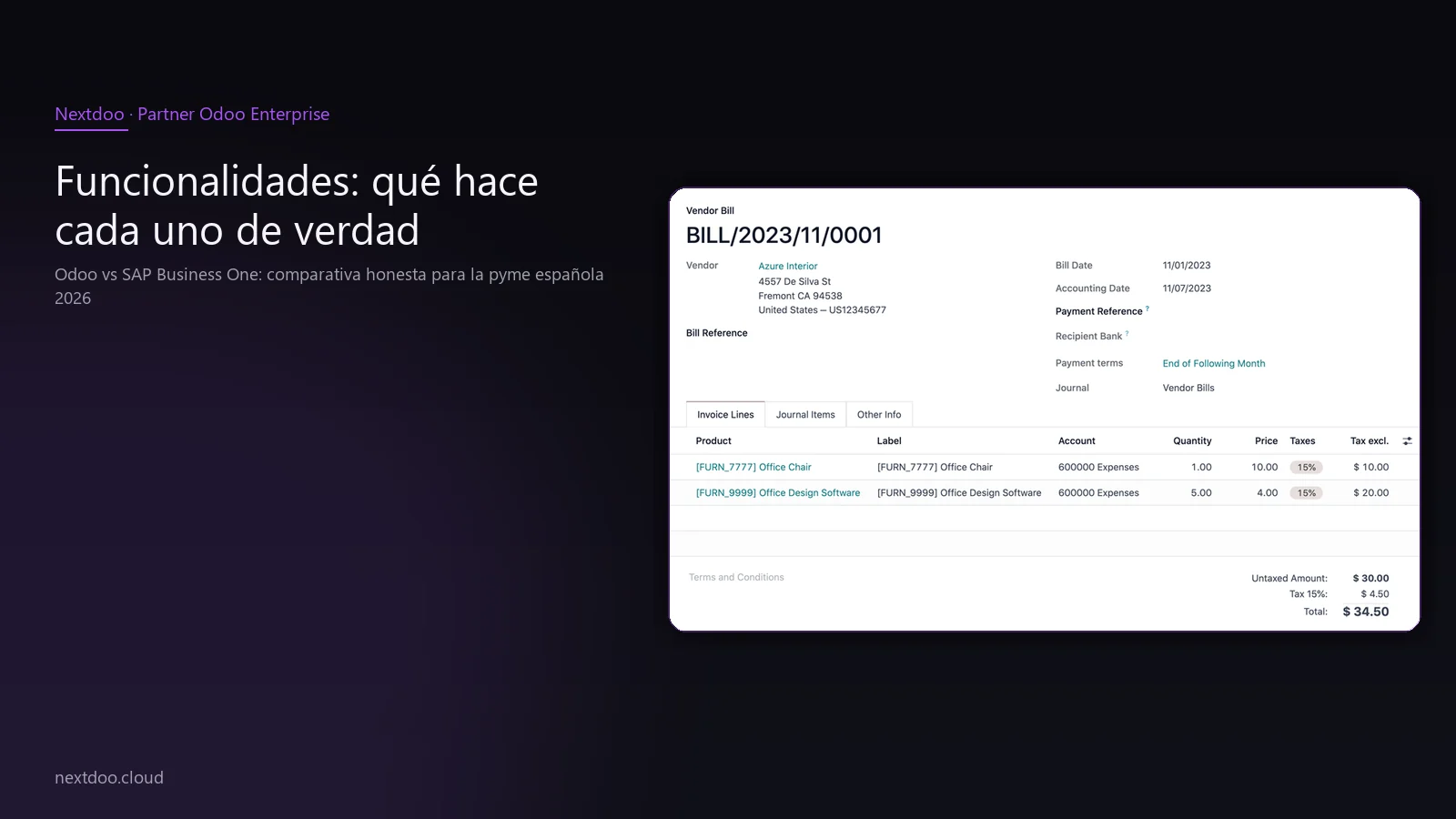
Odoo Enterprise natively includes a number of functionalities that SAP Business One does not cover without adding third-party solutions. Some concrete examples:
- Integrated e-commerce: Odoo has a native online store connected to inventory in real time. SAP Business One does not have its own e-commerce; it needs SAP Commerce or external integration.
- Complete CRM: Odoo includes opportunity management, email, calendar and commercial automations. SAP Business One has limited CRM and in many implementations it is complemented with external tools.
- Point of sale: Odoo has native POS, ideal for retail and hospitality. SAP Business One requires additional solutions.
- Marketing and automation: Odoo includes email marketing, SMS and commercial workflow automations natively. In SAP this requires integrations or additional products from the SAP ecosystem.
- Artificial intelligence: Odoo includes AI integration in its latest version for tasks such as email classification, demand prediction or writing assistance. In SAP Business One, AI comes through SAP AI Core, which is a separate service with an additional cost.
Where SAP Business One does have an advantage is in complex process manufacturing (chemical, pharmaceutical, food with heavy traceability), in environments with more than two hundred users demanding performance, and in companies that are already part of a larger SAP ecosystem and need direct integration with S/4HANA.
Spanish fiscal localisation: a determining factor
In 2026, the obligation of electronic invoicing with VeriFactu and the extension of TicketBAI to more territories is not an optional technical issue. It is a legal obligation. Odoo Enterprise includes these localisations natively and is updated with every regulatory change. SAP Business One covers them through its local partners, which implies dependence on that partner's roadmap and sometimes additional update costs.
For a Spanish SME that has to present the quarterly VAT Model 303, the annual summary Model 390 or the Model 347 for third-party operations, having this integrated into the ERP without additional developments is a very relevant practical difference.
The real cost: licences, implementation and maintenance
This is where the comparison becomes more striking. The cost of Odoo Enterprise for a Spanish SME is significantly lower than that of SAP Business One. The differences are not marginal.
In indicative terms, for a company of twenty users with standard accounting, warehouse and CRM needs:
- The annual Odoo Enterprise licence is notably lower than that of SAP Business One, which has a considerably higher cost per user.
- The implementation of Odoo in a standard SME project is considerably shorter and less costly than that of SAP Business One, whose configuration complexity is reflected in the consulting budget.
- The annual maintenance of an Odoo installation is more economical than that of SAP Business One, where support and updates have a high recurring cost.
The differences in total cost of ownership between both solutions are very significant in favour of Odoo in almost any standard SME scenario. We do not give exact figures because each project is different, but the magnitude of the difference is relevant and consistent.
Is it worth paying more for SAP?
It depends solely on whether your company has needs that Odoo cannot cover. If you have regulated process manufacturing, many international subsidiaries with very complex separate accounting, or a mandatory integration with a central SAP system, then SAP Business One may justify that additional cost. In any other case, the price difference does not translate into a better product for the average Spanish SME.
Implementation speed: time is money
One of the factors that companies most undervalue when choosing an ERP is the time it will take for implementation. A long project is not just a higher consultancy cost. It's time your team is distracted, parallel processes, transition errors, and organisational stress.
Odoo Enterprise allows for relatively agile implementations in standard SME projects. A well-defined scope with an experienced partner can go into production within a reasonable timeframe for most companies with up to fifty users. In more complex mid-market projects, the timeframe extends, but it is still shorter than that of SAP Business One.
SAP Business One requires longer timeframes due to the system's own architecture, the configuration of its core modules, and the team's training needs. It is not a product quality problem; it is the nature of a tool designed for more complex environments.
For an SME that needs to get up and running soon, this difference in start-up speed can be decisive.
Team learning curve
Odoo has a modern, intuitive, and consistent web interface with the applications that users already know in their daily lives. An employee experienced with current web applications gets oriented relatively quickly. Administrative and configuration profiles need more time, but the community of training resources is very extensive.
SAP Business One historically has a Windows client interface that many users find less intuitive than modern web solutions. SAP has been incorporating web access, but the desktop client remains the main option in many implementations. The learning curve for users and especially for administrators is steeper.
This has a real impact on training costs and the speed at which the team gains productivity after implementation.
E-commerce and multichannel retail: where Odoo has a clear advantage
If your company sells online, has physical stores, or combines both channels, Odoo has an integrated proposal that SAP Business One cannot match without significant developments.
Odoo's ecommerce is natively connected to inventory, accounting, CRM, and point of sale. An online order updates stock in real time, generates the corresponding accounting entry, and can trigger automatic after-sales actions. All within the same system.
In SAP Business One, that level of multichannel integration requires third-party connectors, specific integration projects, and additional maintenance. For a retail SME or a hospitality company, that is unnecessary complexity and an avoidable cost.
At Nextdoo, we specialise in Odoo implementations for retail, hospitality, and motorcycles (with our sectoral solution Nextdoo SM). We know the needs of these sectors well and understand which functionalities are critical in the day-to-day.
When it makes sense to migrate from SAP Business One to Odoo
The migration from SAP Business One to Odoo is a project we undertake with some regularity. The reasons that lead companies to take this step are quite consistent:
- The cost of SAP maintenance and licences has become difficult to justify for the actual use made of the system.
- SAP's interface and rigidity hinder internal adoption, and the team works outside the system using spreadsheets or parallel tools.
- The company has grown in its digital channel, and SAP does not cover those needs without costly integrations.
- Spanish fiscal localisation in SAP depends on updates from the local partner that arrive late or incur additional cost.
- The company wants to scale, and SAP licensing costs grow disproportionately with each new user.
The migration involves exporting master data (customers, suppliers, items, accounting history), cleansing them, and loading them into Odoo. It is a project that requires rigour and experience, but with a suitable partner, it is perfectly manageable for the vast majority of SMEs. The scope and cost depend on the volume of data and the complexity of the processes; each project requires prior analysis.
Scalability: how far does Odoo go?
A frequent question is whether Odoo can grow with the company in the long term. The answer is yes, with nuances.
Odoo scales well for the vast majority of Spanish SMEs and mid-market companies. With appropriate cloud architecture and a well-executed implementation, it perfectly supports hundreds of simultaneous users. With very high volumes, the architecture requires more attention, but that is something the partner resolves in the project design.
SAP Business One has a recognised advantage in environments with more than two hundred users with very intense transactional loads, especially in manufacturing. But that profile is not the average Spanish SME. It is a large company with enterprise needs, and for that case, there are other options within the SAP ecosystem itself (S/4HANA) that are above Business One.
For ninety percent of Spanish SMEs, Odoo scales perfectly for many years of growth.
Conclusion: choose wisely, not by brand
SAP is a brand with decades of history, and many large companies use it. That does not mean it is the best option for your fifty-employee Spanish SME that sells through a physical store and online, or that manufactures discreet parts, or that provides professional services.
Odoo Enterprise in 2026 is a mature ERP, with full Spanish localisation, agile implementation, adjusted cost, and the capacity to grow with you. For the vast majority of Spanish SMEs, it is the correct option.
SAP Business One still has its place in specific industrial niches: process manufacturing with heavy regulation, environments with more than two hundred intensive users, mandatory integration with the SAP ecosystem. If you are in that niche, it makes sense to evaluate it. If not, you are probably paying more than you need.
If you have been using SAP Business One for a while and are unsure if it is still the right tool, the initial conversation costs nothing. We analyse your situation and honestly tell you whether the change makes sense or not.
Indicative information. Actual timeframes, costs, and scopes are confirmed after a personalised analysis. JLM Business Solutions SL · B16842831.
Frequently asked questions
Is SAP Business One more serious or reliable than Odoo?
SAP has fifty years of history and is a benchmark in large corporations. Odoo has been around for over twenty years, has millions of users worldwide, and is the reference ERP for SMEs globally. Both are serious and reliable solutions. The relevant question is not which is more serious, but which better fits your company's actual needs. For most Spanish SMEs, Odoo perfectly covers those needs with less complexity and lower cost.
Can I migrate my data from SAP Business One to Odoo without losing information?
Yes. Data migration from SAP Business One to Odoo is a technical process with defined phases: extraction, cleansing, transformation, and loading. Customers, suppliers, items, movement history, and accounting balance are migrated. The exact scope depends on the volume of data and the years of history you need to retain in active status. With an experienced partner in migrations, the process is controllable and without loss of critical information.
Does Odoo comply with Spanish fiscal obligations in 2026?
Yes. Odoo Enterprise includes Spanish localisation with native support for VeriFactu, TicketBAI, VAT Model 303, Model 390, and Model 347, among others. Regulatory updates from the AEAT are incorporated into system maintenance. This is a real practical advantage compared to solutions where fiscal localisation depends on developments or updates from the local partner with additional cost.
How long does it take to switch from SAP Business One to Odoo?
It depends on the project's scope: number of users, processes to cover, volume of historical data, and level of customisation required. In indicative terms, a migration project for a standard SME is shorter than a greenfield implementation of SAP Business One. We do not provide exact timeframes without prior analysis, but Odoo's implementation speed is a recognised advantage over SAP.
Can Odoo cover manufacturing or production?
Yes, Odoo has production planning and discrete manufacturing management functionality. It is a solid option for companies that manufacture products with bills of materials, work orders, and quality control. Where SAP Business One maintains an advantage is in highly regulated process manufacturing (chemistry, pharmacy, food with strict traceability). If your manufacturing is discrete or moderately complex, Odoo perfectly covers the needs of most SMEs.
Can Nextdoo help me if I currently use SAP Business One?
Yes. We are an official Odoo Enterprise partner in Spain and have experience in migration projects from SAP Business One. The first step is an analysis consultation where we review your current situation, your company's critical processes, and whether the change makes sense or not. We work with honesty: if SAP is the right tool for your case, we will tell you. If Odoo can offer you more value, we will show you how.
Frequently asked questions
Is SAP Business One more serious or reliable than Odoo?
Both are mature and reliable solutions. SAP has decades of history in large corporations. Odoo has over twenty years and millions of global users, being the benchmark ERP for SMEs. The correct question is not which is more serious, but which fits your company's real needs. For most Spanish SMEs, Odoo covers these needs with lower cost and less complexity.
Can I migrate my data from SAP Business One to Odoo without losing information?
Yes. The migration from SAP Business One to Odoo is a technical process with defined phases: extraction, cleansing, transformation, and loading. Customers, suppliers, items, transaction history, and accounting balance are migrated. The exact scope depends on the volume of data and the years of historical data required. With an experienced partner, the process is controllable and without loss of critical information.
Does Odoo comply with Spanish fiscal obligations in 2026?
Yes. Odoo Enterprise includes Spanish localisation with native support for VeriFactu, TicketBAI, Modelo 303 for VAT, Modelo 390, and Modelo 347, among other AEAT requirements. Regulatory updates are incorporated into system maintenance, without additional developments or reliance on third parties for tax localisation.
How long does it take to switch from SAP Business One to Odoo?
It depends on the project scope: number of users, processes to cover, volume of historical data, and level of customisation required. In indicative terms, Odoo implementation is more agile than SAP Business One in comparable projects. Exact timelines cannot be provided without prior analysis, but the speed of deployment is a consistent advantage of Odoo over SAP.
Can Odoo cover manufacturing or production?
Yes. Odoo has production planning and discrete manufacturing management functionality, with bills of materials, work orders, and quality control. Where SAP Business One maintains an advantage is in highly regulated process manufacturing, such as chemistry or pharmacy with strict traceability. For discrete or moderately complex manufacturing, Odoo perfectly covers the needs of most SMEs.
Can Nextdoo help me if I currently use SAP Business One?
Yes. We are an official Odoo Enterprise partner in Spain with experience in migrations from SAP Business One. The first step is an analysis consultation where we review your current situation and evaluate if the change makes sense for your company. We work with honesty: if SAP is the right tool for your specific case, we will tell you.