Odoo and Microsoft Dynamics 365 Business Central are two highly capable ERPs, but they don't operate on the same playing field nor target the same type of company. If you're deciding between the two, the question isn't which is «better» in abstract terms, but rather which one fits the size, budget, and working practices of your SME. This comparison makes it clear, honestly and without fluff.
En 30 segundos. Odoo vs Microsoft Dynamics 365 Business Central: cost, flexibility, Spanish taxation, and for whom each is. Honest partner comparison.
How each one positions itself
Dynamics 365 Business Central comes from the Navision tradition and relies on the Microsoft ecosystem (Office, Teams, Azure). It is robust and comprehensive, and excels in companies already operating within that environment and having demanding processes. Odoo starts from a different philosophy: a modular and open system, with many areas integrated as standard, a modern interface, and the possibility of activating only what you need. It's not «one big and one small»: it's a distinct approach for distinct needs.
Cost: per user vs. per phase
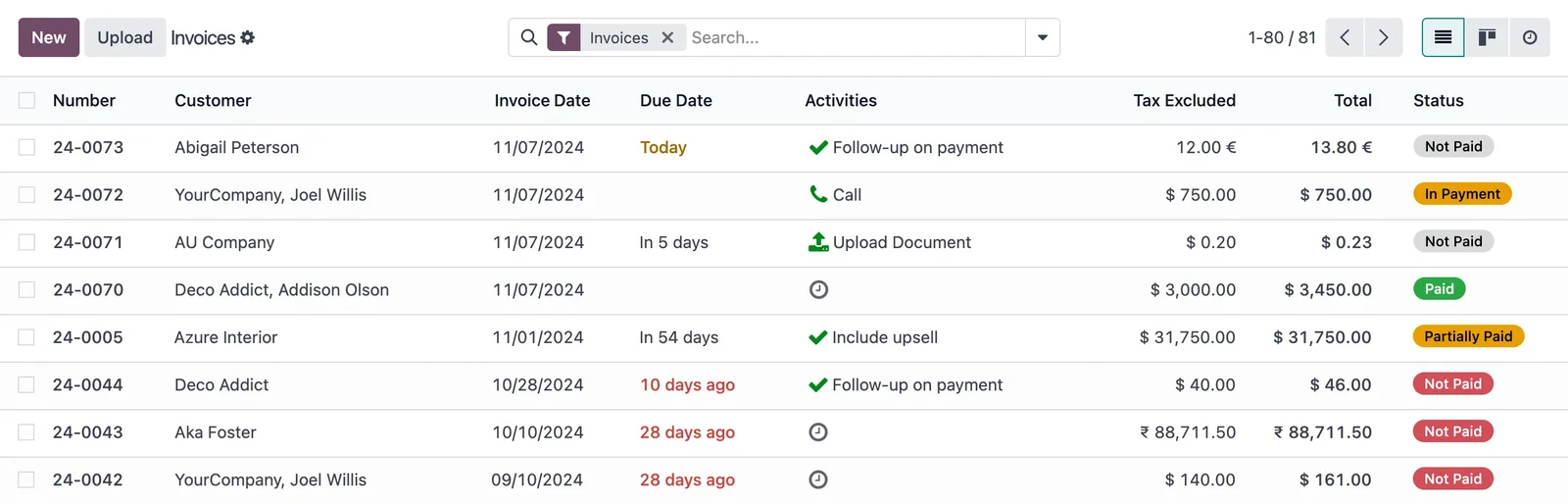
Here lies one of the biggest differences. Dynamics 365 bills per user and per license type, and to that, partner and customisation costs are usually added, which are not cheap in the Microsoft ecosystem. In an SME with several users, that bill quickly grows. Odoo presents a more contained, phase-based model: you activate what you use and expand when the business demands it, without paying for capabilities you don't utilise. The detailed cost of Odoo, without invented figures, can be found in how much Odoo costs.
Flexibility and customisation
Both can be adapted, but with different costs. In Dynamics, changes and developments usually go through a partner and are billed by the hour, turning minor adjustments into small projects. Odoo is more open: a good portion of the configuration is accessible to an advanced user on your team, and what requires a partner is usually simpler and more economical to modify. For an SME that wants to move quickly and not depend on third parties for every change, that difference is noticeable.
Spanish Taxation and VeriFactu
Both cover Spanish localisation, including VeriFactu, which becomes mandatory in 2026. The difference isn't so much in compliance as in the overall package: with Odoo, that taxation comes with a modular system at an SME-friendly cost; you can see the details in VeriFactu and Odoo.
Ease of use and adoption
Dynamics 365 is familiar to those who operate within the Microsoft world, but its learning curve can be demanding. Odoo opts for a modern and simple interface that teams usually adopt with less friction, which is key in an SME where there isn't a dedicated systems department. Real adoption —people actually using it— is half the success of an ERP.
Who each one is for
- Dynamics 365 suits medium-to-large enterprises, with complex processes, a generous budget, and a
clear commitment to the Microsoft ecosystem.
- Odoo suits most SMEs that want to integrate their departments, adapt with agility, and grow
in phases without skyrocketing in cost.
Indicative comparison
| Criterion | Odoo | Dynamics 365 Business Central |
|---|---|---|
| Company profile | SME growing in phases | Medium-to-large, Microsoft ecosystem |
| Cost model | Modular, phase-based | Per user and license |
| Flexibility | High, autonomous | Medium, via partner |
| Spanish Taxation / VeriFactu | Yes (Enterprise) | Sí |
| Adoption curve | Gentle | More demanding |
| Integrated areas | Yes, as standard | Sí |
Qualitative and indicative comparison; it is advisable to validate it against your actual operations with a demo.
If you already use Dynamics and are considering a switch
If you're coming from Dynamics and are considering Odoo, the change is manageable and without data loss: we cover it in the guide on migrating from Dynamics 365 to Odoo. The general framework of the project can be found in Odoo implementation.
Beyond the software: support and community
When comparing two ERPs, you're not just comparing the product, but also what's behind it. Dynamics 365 relies on Microsoft's partner network and its corporate support, which is robust but tailored for the large account model. Odoo, in addition to partners, has a huge and open community: thousands of modules, active forums, and a public knowledge base that means almost any query has already been resolved by someone. For an SME, that means less dependence on a single provider and more resources at hand. And locally, what matters most is having a partner who understands your business and is available; that's why it's advisable to look at both the software and who will accompany you, as we explain in how to choose a partner.
What to look for in a demo before deciding
The best way to settle the Odoo or Dynamics debate isn't by reading comparisons, but by seeing both in action with your actual operations. In a useful demo, bring your own scenarios: how you place an order, how you invoice, how you close the month. Pay attention to how many clicks your daily tasks require, whether Spanish taxation is ready out-of-the-box or needs configuration, and how much of what you see you could modify yourself without relying on a third party. Also ask about the total cost over three years with your actual number of users, not the brochure price. An honest demo based on your specific case clears up more doubts than any table, and usually makes it clear which one fits your working style.
A quick look: when to choose each one
If we had to summarise it in a few lines: choose Dynamics 365 if you are a medium-to-large company, already operate within the Microsoft ecosystem, have very complex processes and a budget for a high-end ERP with a dedicated partner. Choose Odoo if you are an SME looking to integrate its areas, move with agility, have your Spanish tax compliance sorted, and grow in phases without the cost skyrocketing per user. Most Spanish SMEs fit the second profile, and that's why, for that audience, Odoo is usually the answer. But 'most' isn't you: that's why the final step is always a demo based on your real operations, where these differences stop being theoretical and become apparent in your day-to-day. If Odoo fits after that trial, migrating from Dynamics is a perfectly manageable project.
Frequently asked questions
Is Odoo or Dynamics 365 better for an SME?
For most SMEs, Odoo better balances cost, flexibility, and ease of use. Dynamics makes sense for medium-to-large businesses with complex processes and a commitment to the Microsoft ecosystem.
Which is cheaper?
It depends on the scope, but Dynamics' per-user model usually gets more expensive faster for an SME than Odoo's phase-based model, where you only pay for what you use.
Do both comply with VeriFactu?
Yes, both with Spanish localisation cover VeriFactu, which is mandatory in 2026. It's advisable to confirm this in the specific edition and configuration.
Which is easier to use?
Odoo usually has a smoother adoption curve due to its modern interface; Dynamics is familiar to those already working within the Microsoft environment.
Can I migrate from Dynamics to Odoo without losing data?
Yes, with a plan that preserves historical data, balances, and fiscal numbering. It's a manageable project for an SME.
Does Odoo integrate with Microsoft tools?
Yes, Odoo connects via API with other applications; the difference is that it doesn't rely on the Microsoft ecosystem to function.
Which is suitable for a large company?
The larger and more complex the case, the more Dynamics' capabilities can be justified; for the SME profile, Odoo is usually sufficient and more cost-effective.
Undecided between Odoo and Dynamics 365 for your SME?
At Nextdoo, an official Odoo partner, we help you decide with a demo based on your real operations, without bias. Start by Odoo implementation or request a diagnosis of your case.
Source: Odoo official documentation. Qualitative and indicative comparison; the best option depends on each case.
Sources
Official sources consulted: Odoo official documentation y Spanish Tax Agency's e-office (VeriFactu). Cost and timeframe figures are indicative and non-binding, subject to variations depending on the project.