In summary. By 2026, Odoo is the most comprehensive ERP for retail in Spain because it unifies POS, inventory, accounting, e-commerce, and CRM into a single platform, with native tax compliance for VeriFactu, Modelo 303, and 347. Niche POS solutions like Lightspeed, Shopify POS, or Square handle transactions well, but they don't manage the business. If your store needs to grow without accumulating disconnected tools, Odoo is the most robust option available.
If you have a store in Spain, whether physical, online, or both, you've probably already tried or at least looked at solutions like Lightspeed, Shopify POS, Square, or Holded. They all promise the same thing: simplicity, speed, and control. And they all fall short on the same point: the real integration of your entire business.
This article is not a feature catalogue. It's an honest guide to help you understand why Odoo wins in value proposition against the most popular retail alternatives, and also when it might not be the right choice.
What is the real problem with specialised POS systems?
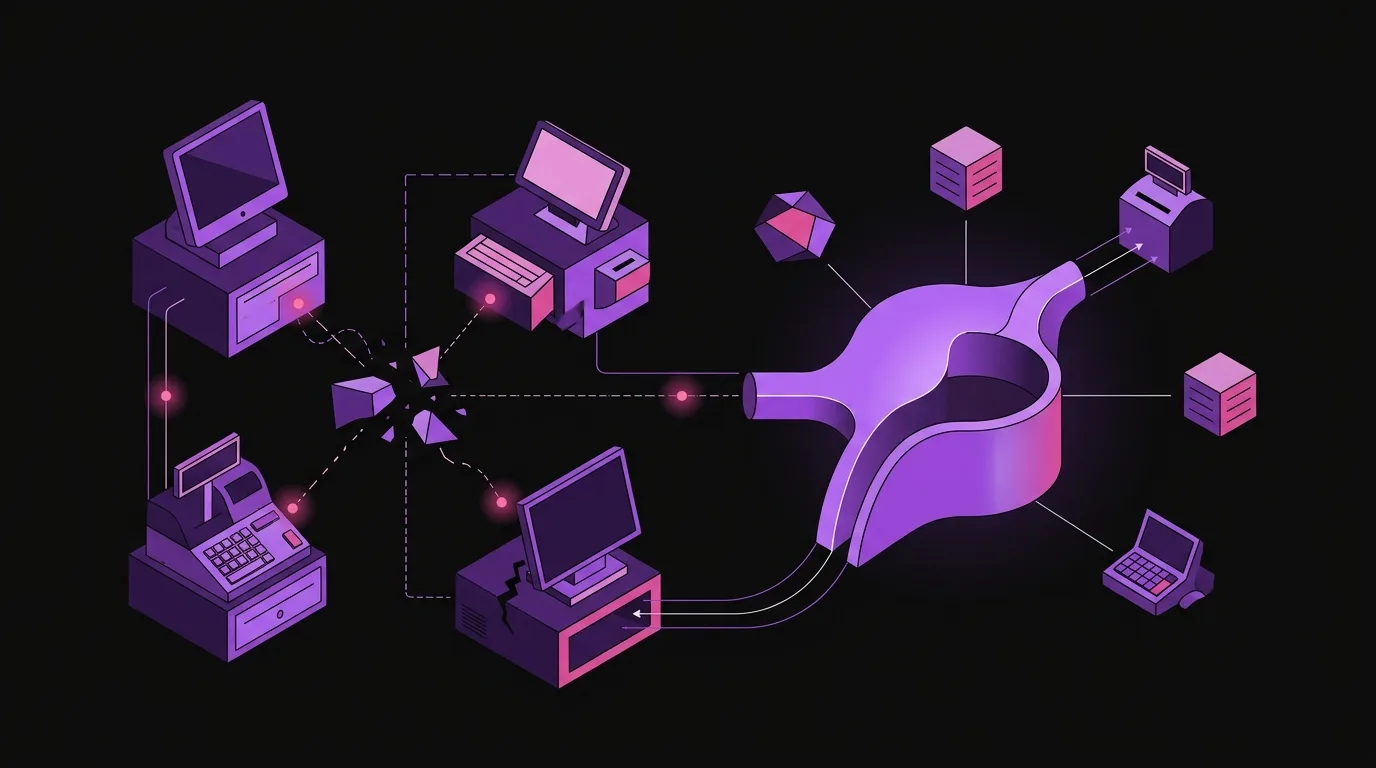
Most solutions designed for retail commerce originated as point-of-sale systems and gradually added layers over time. The result is a tool that handles transactions well, but carries structural limitations in everything else.
Think of it this way: Lightspeed is a POS with some inventory. Shopify POS is Shopify's payment handler, designed for everything to go through its e-commerce ecosystem. Square is a payment gateway that has gradually added extras. They are good tools for what they do. The problem arises when your business grows and you need more.
Retail commerce in Spain is not just about taking payments. It's about managing stock in multiple warehouses or points of sale, complying with the Tax Agency, tracking recurring customers, coordinating loyalty campaigns, reconciling accounts, and, if you have an online channel, synchronising catalogue, prices, and availability in real time.
When you try to solve that with five different tools, you end up paying five licences, wasting time exporting and importing data between platforms, and, most dangerously, making decisions with outdated information. That is the real cost that nobody calculates when comparing licence prices.
What “all-in-one” truly means
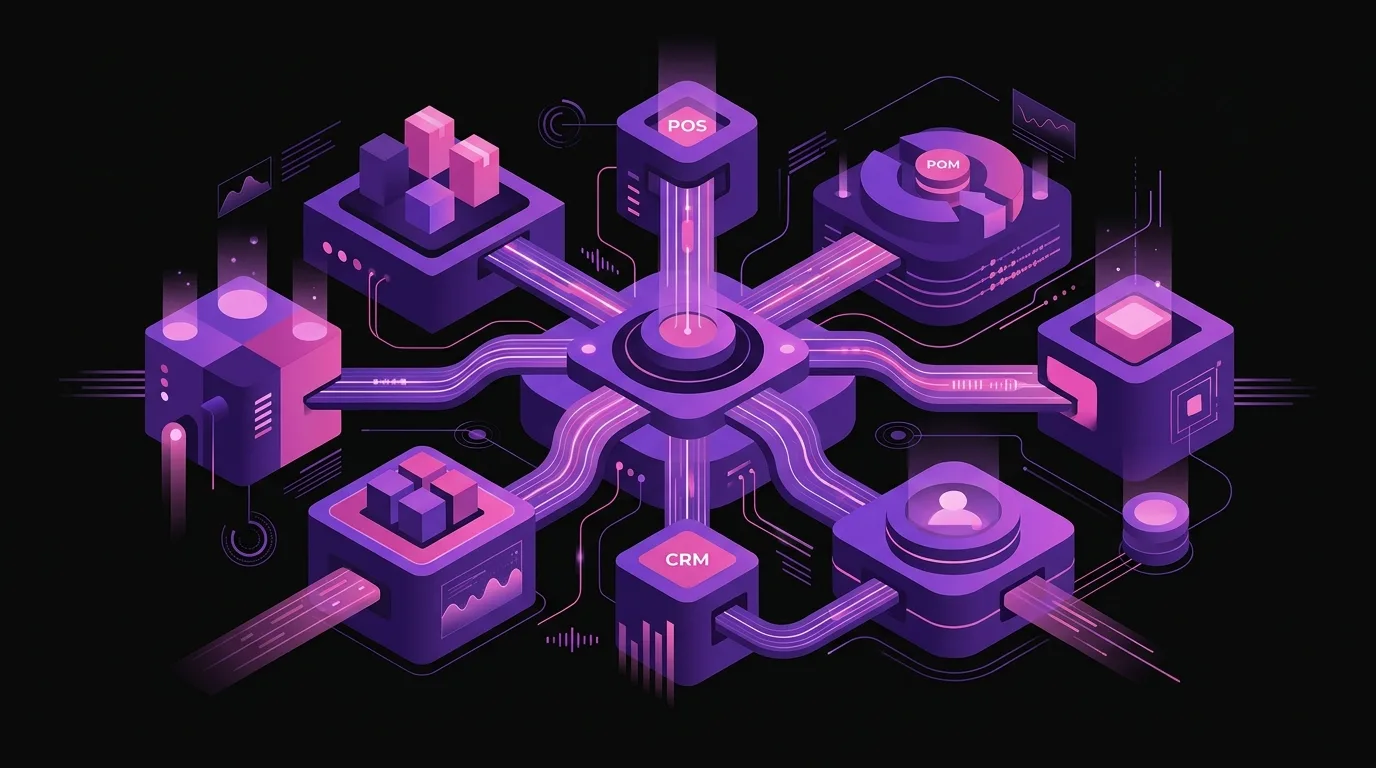
Odoo is not a POS to which accounting has been added. It is a complete ERP that includes a POS as another piece of a unified system. The difference is not marketing: it is architectural.
When you sell through Odoo's POS, stock movement is updated in real time. The invoice is generated automatically. The accounting is recorded automatically. The customer is registered in the CRM. If you have an online store, the catalogue instantly reflects the new availability. None of that requires manual intervention from you, nor for any system to pass data to another via a third-party integration.
That is what real integration means: not that two tools communicate via API, but that they are the same tool.
What Odoo includes for a Spanish retailer
- Touch POS with offline functionality
- Inventory management with multi-warehouse and automatic replenishment
- Complete accounting adapted to the Spanish General Accounting Plan
- Own e-commerce synchronised with the physical store
- CRM for managing customers and loyalty programmes
- Email marketing and communication automations
- Human resources and shift management for the store team
- Native tax compliance: VeriFactu, Modelo 303, Modelo 347, SII
None of the niche alternatives for retail offer this set natively. Some can connect with external tools, but that again presents the same problem: different systems, fragmented data, risk of desynchronisation.
Why do foreign alternatives fail in tax compliance in Spain?
This is one of the least discussed aspects in retail tool comparisons, and it is precisely where the differences are greatest for a Spanish SME.
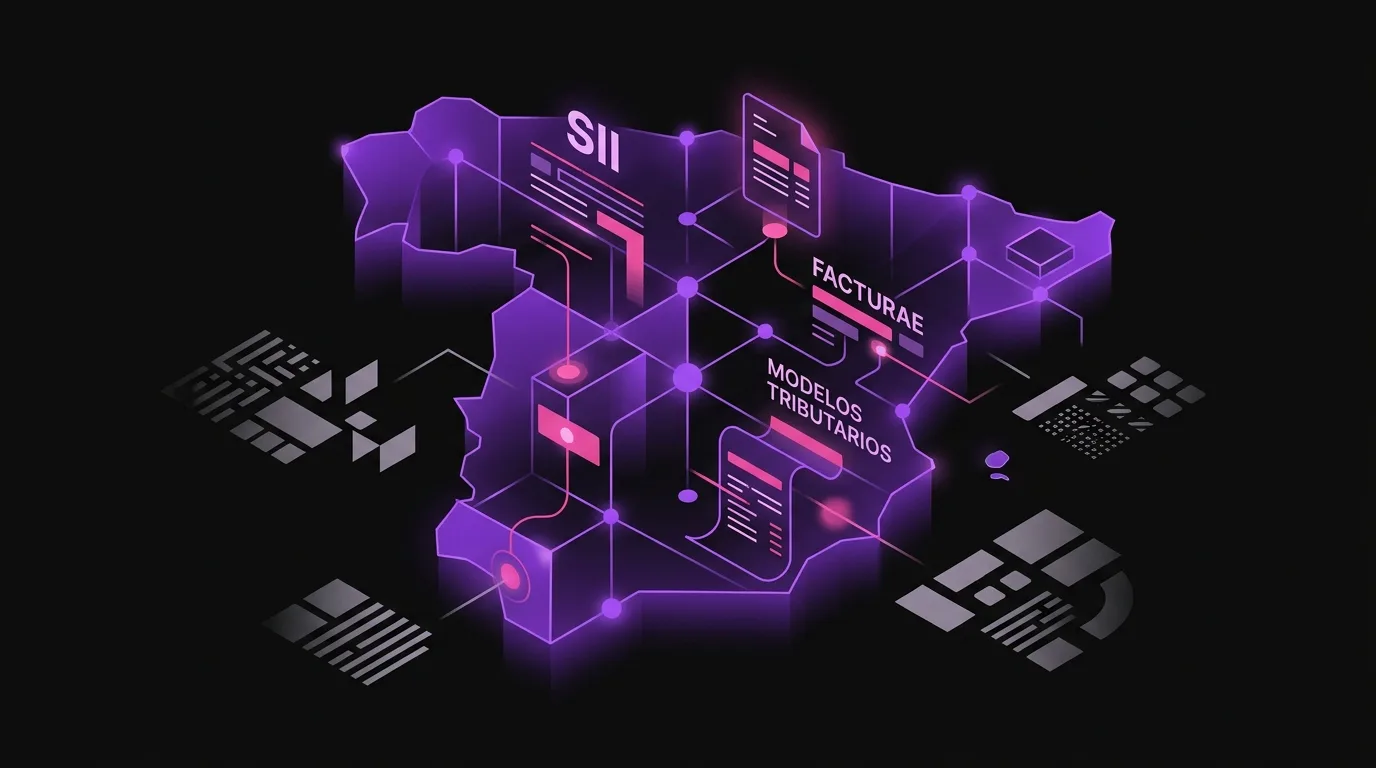
VeriFactu is the new obligation from the Tax Agency for verifiable invoicing. Since its entry into force, invoicing systems must generate records with a unique identifier code that guarantees the integrity and immutability of each invoice. It is not optional. It is not something that can be patched with a plugin.
Lightspeed, Square, or Shopify POS are tools designed for Anglo-Saxon markets. Their tax development is oriented towards the regulations of the United States, the United Kingdom, or Canada. Adapting them to VeriFactu is not a minor adjustment: it requires changes to the invoice generation architecture that, in practice, these platforms have not natively implemented for the Spanish market.
Odoo, with the Spanish localisation maintained by the official ecosystem, natively incorporates VeriFactu. The same applies to Modelo 303 for VAT, Modelo 347 for third-party operations, and the Immediate Supply of Information (SII) for obligated companies.
TicketBAI for the Basque Country and Navarra
If your business operates in the Basque Country or Navarre, the tax obligation is TicketBAI, a system unique to the regional tax authorities. Odoo has a localisation compatible with TicketBAI, which avoids the need to resort to intermediate solutions or costly adaptations.
For a retail business with a presence in these communities, this detail can be decisive in choosing the system.
What is the difference between a product list and actual inventory management?
One of the points where Odoo most outdistances its competitors in retail is stock management. It's not a question of whether they have 'inventory' or not, because all platforms claim to have it. The question is how deep that inventory is.
A retailer with multiple references, several suppliers, and potentially multiple points of sale needs more than a unit counter. They need batch or serial number traceability, automatic reorder point rules, management of goods receipts with quality control capability, real-time accounting valuation of inventory, and coordination between warehouse and point of sale without manual intervention.
Odoo offers all of that natively. Lightspeed has reasonable inventory for what it is, but without the accounting depth or advanced traceability. Shopify POS relies on Shopify's inventory module, which is designed for pure e-commerce and has significant limitations in complex physical environments. Square is simply not designed for serious stock management.
Seamless omnichannel synchronisation
When you have a physical shop and an online store, the inventory challenge multiplies. If you sell a unit in-store, the website must reflect it immediately to avoid selling non-existent stock. If you receive goods, the online catalogue should update itself.
In Odoo, the physical shop and e-commerce are the same system. There's no synchronisation because it's not needed: it's the same database. This eradicates one of the most frequent problems in omnichannel retail: apparent overstock and sales of out-of-stock products.
CRM and loyalty: from selling to having customers
Modern retail isn't just about selling. It's about building a customer base that returns, recommends, and has a higher lifetime value. For that, you need to know your customers: what they buy, how frequently, how much they spend, what channels they use.
Niche POS solutions, at best, have a purchase history per customer. Odoo has a complete CRM integrated with the POS and e-commerce. Every time a customer makes a purchase, whether in-store or online, their profile is automatically updated.
From that profile, you can launch segmented email marketing campaigns, create points programmes or personalised discounts, track incidents or returns, and measure the real return of each marketing action. All without leaving the system and without paying additional licences to external CRM or email marketing platforms.
For a Spanish SME that wants to compete with large chains on customer experience, this integrated capability makes a significant practical difference.
Is it possible to scale without migrations? The long-term argument
One of the most invisible costs in technology for SMEs is the cost of migration. You choose a tool that fits well at the current moment, but two years later your business has grown and that tool becomes too small. Then you have to migrate data, retrain the team, lose weeks of productivity, and pay for another implementation.
Odoo is designed to grow with you. You can start with the essentials: POS, inventory, and accounting. When you need e-commerce, you activate it on the same system. When you want to manage your shop team with shifts and absences, you add it. When you expand to a second point of sale, you configure it within the same platform.
There's no migration because you don't change systems. You simply extend what you already have.
This has a direct impact on the total cost of ownership over three or five years. A cheap tool that needs to be replaced in two years turns out to be more expensive than a slightly larger initial investment that lasts a decade.
The Odoo 19 factor and artificial intelligence
Odoo 19, the current version in 2026, incorporates artificial intelligence capabilities natively into several key retail processes. Demand forecasting helps to optimise supplier orders. Automatic bank reconciliation reduces manual accounting work. Customer behaviour analysis suggests loyalty actions.
These capabilities are not integrations with external AI services: they are native functionalities within the same system. That means they access all business data without the need for exports or complex configurations.
When might Odoo not be the right choice?
Honesty is part of the value a good partner provides. Odoo is not the right answer for all cases.
- If you have a single point of sale with few product lines and only need to take payments and keep a basic record, simpler tools might be sufficient for now.
- If your business is one hundred per cent online and your operations fit within Shopify, the learning curve might not be justified at this moment.
- If you don't have anyone who can dedicate time to an initial implementation, Odoo requires an initial configuration that is not trivial. Without that effort, it won't perform.
That said, as soon as the business grows beyond that initial simplicity, the tipping point towards Odoo arrives sooner than it seems. The key is to anticipate that moment and not wait until the chaos of disconnected tools becomes unsustainable.
Nextdoo: Odoo implementation for retail in Spain
Nextdoo is an official Odoo Enterprise partner in Spain, specialising in retail, hospitality, and SMEs. Our experience with retail businesses allows us to offer an implementation tailored to the operational reality of a shop: cash desk processes, stock management, supplier integration, and tax compliance are the starting point, not an add-on.
We don't implement generic Odoo. We configure it for your type of business, with the workflows your team will use from day one. The goal is for the tool to work for you, not for you to work for the tool.
If you are considering switching from Lightspeed, Holded, Shopify POS, or any other platform, we can analyse your current situation and give you a clear vision of what the transition entails, what data can be migrated, and what timelines are reasonable for your case.
Frequently asked questions
Does Odoo comply with VeriFactu in Spain?
Yes. Odoo's Spanish localisation includes native support for VeriFactu, the verifiable invoicing system required by the Tax Agency. Each generated invoice includes the unique identifier code required by the regulation, guaranteeing the integrity and immutability of the record. This applies to both POS sales and invoices issued from other system processes.
Can I migrate from Lightspeed or Shopify POS to Odoo without losing history?
In most cases, yes, it is possible to migrate relevant historical data: products, customers, and, in many cases, sales history. The exact scope depends on the data available on the source platform and the format in which it can be exported. A pre-migration analysis determines what can be recovered and how to structure it in Odoo.
Does Odoo POS work if the internet goes down?
Yes. Odoo's POS has an offline mode that allows you to continue taking payments even without a connection. Operations carried out in offline mode synchronise with the central system as soon as the connection is restored. This is especially relevant for businesses where continuity of service at the till is critical.
Is Odoo suitable for a business with a single shop and few employees?
It depends on the operational complexity. If that shop has accounting to manage, stock to control, an online channel or customers to retain, Odoo provides value from the very first moment. If the operation is minimal and there are no plans to grow, it might be over-engineered. A conversation with a specialised partner helps to make that decision with real data.
What is the difference between Odoo Community and Odoo Enterprise for retail?
Odoo Enterprise is the version with official support from Odoo S.A., guaranteed updates and advanced functionalities such as the complete POS, advanced financial reports, and actively maintained Spanish fiscal localisation. For retail in Spain, especially with the VeriFactu obligations, the Enterprise version is recommended. Nextdoo works exclusively with Odoo Enterprise.
How long does it take to implement Odoo in a shop?
The timeframe depends on the business complexity: number of points of sale, volume of references, necessary integrations with suppliers or payment gateways, and the state of current data. An implementation for a medium-sized retail business can be completed within a reasonable timeframe when the business provides organised information from the outset. The preliminary analysis defines the scope and the specific timeline.
Conclusion: the decision is business, not technology
Choosing the system for your shop is not a technical decision. It is a business decision. The question is not which tool has more features on paper, but which one allows you to manage better, grow without friction, and comply with your fiscal obligations in Spain without relying on external patches.
In 2026, with VeriFactu already in force and with Spanish retail navigating between the pressure of e-commerce and the recovery of physical commerce, a system fragmented into several tools is a burden. Odoo offers a real alternative: a single platform that grows with you, that complies with Spanish regulations natively, and that connects all your business processes without the need for external integrations.
If you want to see how Odoo would be configured for your type of shop, the next step is a no-obligation conversation with the Nextdoo team. Not a generic demo: a review of your current situation and a proposal tailored to your real business.
Indicative information. Actual timeframes, costs and scopes are confirmed after a personalised analysis. JLM Business Solutions SL · B16842831.
Frequently asked questions
Does Odoo comply with VeriFactu in Spain?
Yes. Odoo's Spanish localisation includes native support for VeriFactu, the verifiable invoicing system required by the Tax Agency. Each generated invoice includes the unique identifier code required by the regulation, guaranteeing the integrity and immutability of the record. This applies to both POS sales and invoices issued from other system processes.
Can I migrate from Lightspeed or Shopify POS to Odoo without losing history?
In most cases, yes, it is possible to migrate relevant historical data: products, customers, and, in many cases, sales history. The exact scope depends on the data available on the source platform and the format in which it can be exported. A pre-migration analysis determines what can be recovered and how to structure it in Odoo.
Does Odoo POS work if the internet goes down?
Yes. Odoo's POS has an offline mode that allows you to continue taking payments even without a connection. Operations carried out in offline mode synchronise with the central system as soon as the connection is restored. This is especially relevant for businesses where continuity of service at the till is critical.
Is Odoo suitable for a business with a single shop and few employees?
It depends on the operational complexity. If that shop has accounting to manage, stock to control, an online channel or customers to retain, Odoo provides value from the very first moment. If the operation is minimal and there are no plans to grow, it might be over-engineered. A conversation with a specialised partner helps to make that decision with real data.
What is the difference between Odoo Community and Odoo Enterprise for retail?
Odoo Enterprise is the version with official support from Odoo S.A., guaranteed updates and advanced functionalities such as the complete POS, advanced financial reports, and actively maintained Spanish fiscal localisation. For retail in Spain, especially with the VeriFactu obligations, the Enterprise version is recommended. Nextdoo works exclusively with Odoo Enterprise.
How long does it take to implement Odoo in a shop?
The timeframe depends on the business complexity: number of points of sale, volume of references, necessary integrations with suppliers or payment gateways, and the state of current data. An implementation for a medium-sized retail business can be completed within a reasonable timeframe when the business provides organised information from the outset. The preliminary analysis defines the scope and the specific timeline.