In summary. Odoo is business management software that centralises sales, accounting, inventory, CRM, online store, and more on a single platform. It's modular, growing with your business, and its Enterprise version is adapted to Spanish tax regulations: VeriFactu, form 303, and TicketBAI. Ideal for SMEs looking to eliminate disparate tools, automate processes, and comply with the AEAT without issues.
If you've come here wondering what Odoo is, you're in the right place. We explain it in Spanish, without technical jargon, and with real examples from Spanish SMEs.
Odoo is the business management platform that integrates sales, accounting, inventory, and CRM into a single modular system adapted to Spanish tax regulations.
What is Odoo and why does its definition matter?

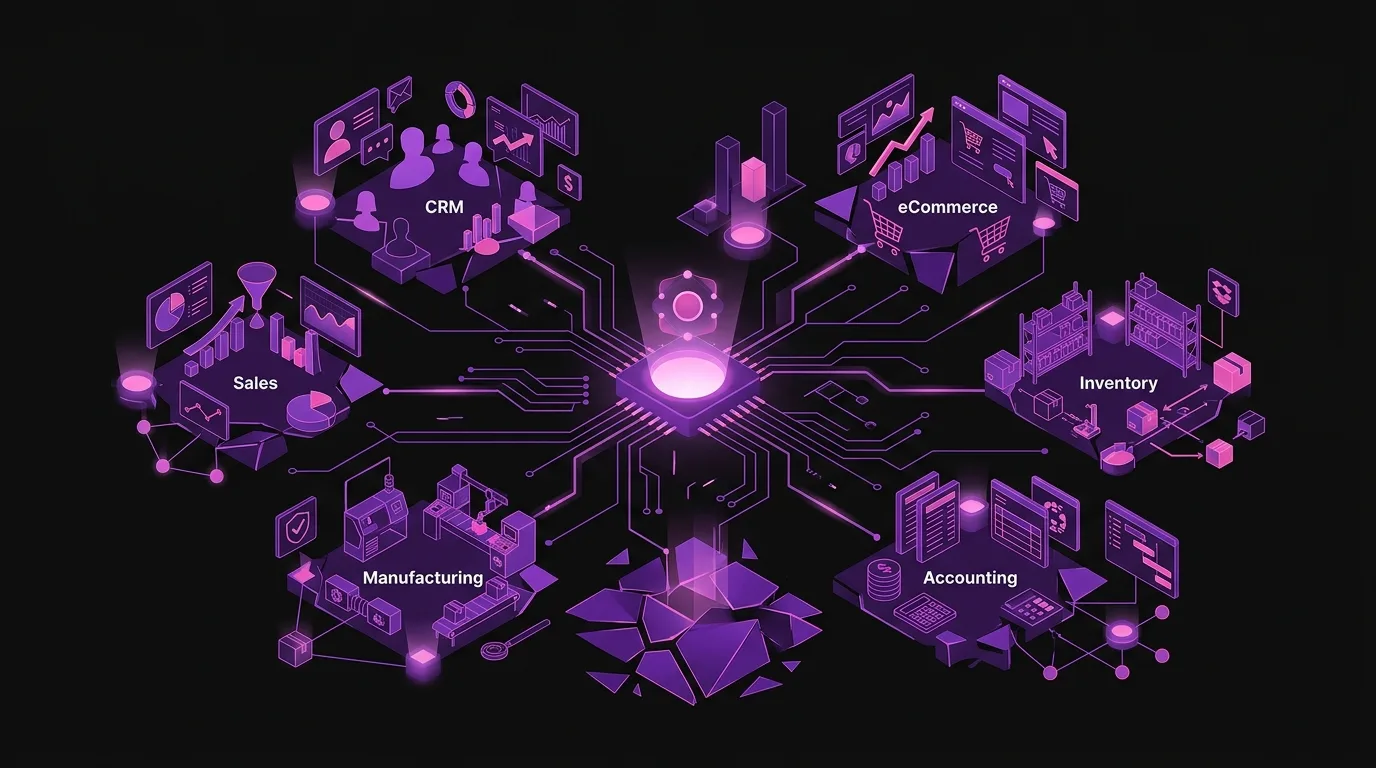
Odoo is business management software (known as ERP, by its English acronym) that integrates all key areas of a business into a single platform: sales, purchases, accounting, warehouse, customer relations, e-commerce, human resources, and much more.
It was founded in Belgium in 2005 under the name OpenERP and today, with over twelve million users worldwide, it is one of the most widely used ERPs by SMEs and medium-sized businesses. Its growth in Spain has been particularly notable in recent years, driven by mandatory digitalisation and AEAT regulatory changes.
What distinguishes Odoo from other management systems is its modular approach. It's not you who adapts to the software: the software adapts to your business. You start with what you need today and incorporate new functionalities as you grow or your needs change.
In practice, this means a small accountancy firm can start with just accounting and invoicing, while a chain of shops can also have point-of-sale management, e-commerce, and logistics active, all connected in real-time.
What Odoo is for in a Spanish SME?
The million-dollar question isn't what it is, but what it's for day-to-day. And the answer is straightforward: it serves to centralise your company's management in a single system and eliminate the chaos of having data spread across multiple programs that don't communicate with each other.
The problem it solves
Many SMEs in Spain work with one program for invoicing, another for inventory, an Excel spreadsheet for sales tracking, a different email marketing tool, and perhaps point-of-sale software that connects to nothing. The result is wasted time, stock errors, duplicated data, and decisions made with incomplete information.
Odoo eliminates this problem because everything happens in the same place. When a sale is generated, the inventory is updated. When goods are received, the stock instantly reflects reality. When a customer pays, the accounting is recorded without manual intervention.
Real-life examples of automated workflows
Here are three specific cases that illustrate how Odoo works in practice:
- A customer buys from your online store. Stock is automatically deducted, the invoice is generated, the income is accounted for, and the shipping order is prepared. All without anyone touching anything manually.
- A salesperson closes a deal in the CRM area. The quote is generated, the customer signs it digitally, that quote becomes an order, and then an invoice. Without leaving the platform or sending back-and-forth emails.
- Goods arrive at the warehouse. The logistics manager registers them using a mobile scanner. Stock is updated, and the products immediately appear available on the website.
These workflows aren't theory. They are the usual operations of Nextdoo clients in retail, hospitality, and distribution.
What management areas does Odoo cover?
Odoo isn't just an invoicing tool or an expanded CRM. It's a complete platform that covers practically all areas of a business. These are the most relevant for a Spanish SME:
Sales and customer relations
Odoo's sales area allows managing the entire sales cycle: from the first contact with a potential customer to invoice collection. It includes an opportunity tracking system, quote generation, digital signature, and automatic conversion into orders.
The integrated CRM allows you to see at all times where each customer is in the process, what actions the sales team has taken, and what the sales forecast for the month is. Useful for freelancers with few clients as well as for multi-person sales teams.
Spanish accounting and taxation
This is one of the areas where Odoo Enterprise makes a difference compared to other solutions. The version adapted for Spain includes the Spanish chart of accounts, the automatic generation of AEAT tax forms (303, 390, 347) and compatibility with VeriFactu, the new verifiable invoicing system required by the Tax Agency from 2026 onwards.
It is also compatible with TicketBAI, mandatory in the Basque Country and Navarra. For an SME operating in Spain, having an ERP that natively incorporates these requirements saves time and avoids penalties.
Inventory and logistics
Odoo allows managing one or several warehouses, controlling stock in real-time, defining automatic replenishment rules, and tracking every movement of goods. It is compatible with barcode scanners and allows working from mobile or computer without difference.
For companies in the retail or distribution sector, this integration between the warehouse and the point of sale or online store is particularly valuable: what is sold in-store is deducted from the same stock that feeds the website.
Point of sale and hospitality
Odoo includes a point of sale (POS) system designed for both physical shops and restaurants and bars. It works offline, so it doesn't stop if there's a connection outage, and it synchronises data when it regains signal.
In hospitality, it allows managing tables, orders by category, cash register shifts, and receipts in an integrated way with accounting. For chains with multiple premises, all data is consolidated into a single control panel.
E-commerce
Odoo's online store is built on the same system as the rest of the platform. This means that the product catalogue, stock, and prices are the same as those managed in the ERP. There are no external synchronisations that can fail, nor manual file updates.
The design is customisable and doesn't require technical knowledge to manage day-to-day content. For SMEs that sell both in-store and online, this native integration is a real competitive advantage.
Human Resources and internal management
Odoo also covers team management: employee records, attendance control, holiday and absence management, performance evaluations, and internal communication. For an SME with its own staff, centralising this information in the same system also reduces reliance on spreadsheets and emails.
Odoo Community or Odoo Enterprise: which one do you need?
Odoo exists in two versions with important differences that are worth understanding before making a decision.
Odoo Community is the open-source and free-to-use version. It includes basic management functionalities but lacks some advanced tools, official Odoo support, and specific tax adaptations for Spain. It is a valid option for very small projects or for companies with sufficient internal technical capacity to maintain the system.
Odoo Enterprise is the paid version, with a per-user licence. It includes full accounting adapted to Spanish regulations, VeriFactu, TicketBAI, integrated artificial intelligence tools, official support, and automatic updates. For most SMEs in Spain that want to comply with the AEAT and operate without issues, Enterprise is the recommended option.
The difference isn't just in functionalities. It's also in guarantees: with Enterprise, the software is updated with every regulatory change. With the arrival of VeriFactu or any modification to the BOE, the platform adapts without you having to worry.
Odoo compared to other management solutions

It's natural to wonder how Odoo compares to other tools you might already know or use.
The most widespread solutions among Spanish SMEs usually cover only one area well: invoicing, CRM, or accounting. The problem arises when you need these areas to communicate with each other, because then the data travels from one program to another with the risk of error or becoming outdated that this entails.
Odoo starts from a different premise: everything in the same system from the beginning. This has an initial implementation cost that can be higher than contracting a one-off tool, but the total medium-term cost is usually lower than maintaining several independent subscriptions plus the time dedicated to synchronising them.
Additionally, many SMEs coming to Nextdoo originate from solutions that have not adapted to the new Spanish tax requirements. The move to Odoo Enterprise, when properly implemented, resolves both the problem of dispersed management and compliance with the AEAT in one go.
Why does implementing Odoo with an official partner make a difference?
Odoo is a powerful platform, but its true value is only extracted if it's well-configured for your business. A generic implementation, without adaptation to your sector or processes, can lead to frustration and abandonment.
Working with an official partner like Nextdoo entails several specific guarantees:
- Sector Knowledge: Nextdoo has demonstrated experience in retail, hospitality, and distribution in Spain. We don't start from scratch with you.
- Tax Adaptation: the configuration includes AEAT forms, VeriFactu, and TicketBAI from the outset, if applicable to your case.
- Spanish Support: the team understands the reality of the Spanish SME, local accounting terminology, and day-to-day needs.
- Planned Scalability: the implementation is designed with your company's growth in mind, not just what you need today.
The goal isn't to sell licences. It's for Odoo to work in your business and help you manage better.
Frequently Asked Questions about Odoo
Does Odoo work for freelancers or only for companies with a team?
Odoo is useful for any size of business, including freelancers and micro-SMEs. The Enterprise version has a per-user licence, so you can start with a single user and grow as needed. What's important isn't the size, but whether your business benefits from having centralised management.
Does Odoo comply with AEAT tax requirements in 2026?
Yes. Odoo Enterprise includes adaptations for the VeriFactu system, mandatory for invoicing software in Spain from 2026 onwards according to AEAT regulations. It is also compatible with TicketBAI for companies operating in the Basque Country or Navarra. It is fundamental that implementation is carried out by an official partner so that this configuration is correctly activated.
How long does it take to implement Odoo in an SME?
It depends on the project scope: the number of areas to be implemented, the volume of historical data to migrate, and the complexity of the company's processes. Simple projects can have a reasonably short implementation period; more comprehensive projects require more time for analysis and configuration. In any case, at Nextdoo we conduct a prior analysis to give you a realistic estimate before starting.
Can I migrate from other software to Odoo?
Yes. Nextdoo has experience in migrations from various common management solutions in Spain. The process includes exporting and cleaning data from the previous system and its structured import into Odoo. The aim is for you not to lose relevant historical information and for the change to be as least disruptive as possible to your operations.
What's the difference between using Odoo in the cloud or on your own server?
Odoo can run in the cloud (hosted on Odoo's servers or by an external provider) or installed on the company's own server. The cloud option is the most common for SMEs because it doesn't require internal infrastructure or technical maintenance. The on-premise option may be suitable for companies with specific security requirements or those that already have their own infrastructure. At Nextdoo, we analyse the best option for each case.
Is Odoo suitable for a company with multiple shops or premises?
Yes, and it is precisely one of the scenarios where Odoo adds the most value. It allows managing several points of sale, warehouses, or premises from a single central system, with consolidated visibility of stock, sales, and accounting for all of them. It is one of the reasons why it is particularly popular in retail and hospitality with multiple establishments.
Conclusion: the next step if Odoo interests you
If you've read this far, you now have a clear vision of what Odoo is and what it's for. It's a complete, modular business management platform adapted to Spanish regulations, designed for SMEs that want to stop improvising and start managing with real-time data.
The next step isn't to download anything or blindly purchase a licence. It's to speak with someone who knows your sector and can tell you if Odoo is suitable for your business and what the project's scope would entail.
At Nextdoo, we are an official Odoo Enterprise partner in Spain, with experience in retail, hospitality, distribution, and SMEs of all types. You can request an initial, no-obligation consultation to understand what implementing Odoo in your company would entail.
Guideline information only. Actual timescales, costs, and scopes are confirmed after a personalised analysis. JLM Business Solutions SL · B16842831.
Frequently Asked Questions
Does Odoo work for freelancers or only for companies with a team?
Odoo is useful for any size of business, including freelancers and micro-SMEs. The Enterprise version is licensed per user, so you can start with a single user and expand as required. The important factor isn't the size, but whether your business benefits from having centralised management within a single system.
Does Odoo comply with AEAT tax requirements in 2026?
Yes. Odoo Enterprise includes adaptations for the VeriFactu system, which is mandatory for invoicing software in Spain from 2026, according to AEAT regulations. It is also compatible with TicketBAI for companies operating in the Basque Country or Navarra. It is crucial that the implementation is carried out by an official partner to ensure this configuration is correctly activated from the outset.
How long does it take to implement Odoo in an SME?
It depends on the project's scope: the number of areas to be implemented, the volume of historical data to be migrated, and the complexity of the company's processes. Simple projects can have a reasonably short implementation period; more comprehensive projects require more analysis and configuration time. At Nextdoo, we conduct a preliminary analysis to provide you with a realistic estimate before commencing.
Can I migrate from other software to Odoo?
Yes. Nextdoo has experience with migrations from various common management solutions in Spain. The process includes exporting and cleansing data from the previous system and its structured import into Odoo. The aim is for you not to lose relevant historical information and for the change to be as least disruptive as possible to your daily operations.
What's the difference between using Odoo in the cloud or on your own server?
Odoo can run in the cloud or be installed on the company's own server. The cloud option is the most common for SMEs because it doesn't require infrastructure or internal technical maintenance. The on-premise option may be suitable for companies with specific security requirements or those that already have their own infrastructure. At Nextdoo, we analyse the best option for each case.
Is Odoo suitable for a company with multiple shops or premises?
Yes, and it is precisely one of the scenarios where Odoo adds the most value. It allows managing several points of sale, warehouses, or premises from a single central system, with consolidated visibility of stock, sales, and accounting for all of them. It is one of the reasons why it is particularly popular in retail and hospitality with multiple establishments.