In brief. A retailer specialising in motorcycle equipment with a physical shop, e-commerce, and workshop unified all its operations in Odoo Enterprise. Before: five disconnected tools, online overselling, and manual inventory reconciliation. After: real-time stock across all channels, workshop management integrated with sales and accounting, and compliance with VeriFactu. This article details the process, decisions made, and replicable learnings for any retailer in a similar situation.
A motorcycle dealership with several physical shops and online sales decided it could no longer cope with disconnected tools. Excel, a basic POS, PrestaShop without stock synchronisation, and accounting in a separate programme. The usual chaos of a Spanish SME that has grown in layers.
A motorcycle dealership managed to synchronise its physical shop, e-commerce, and workshop by eliminating five disconnected systems using Odoo Enterprise.
This is one of those projects where, when they finish, the client tells you they can't imagine how they worked before. And they don't say it out of courtesy.
The starting point: a business that had grown through patches
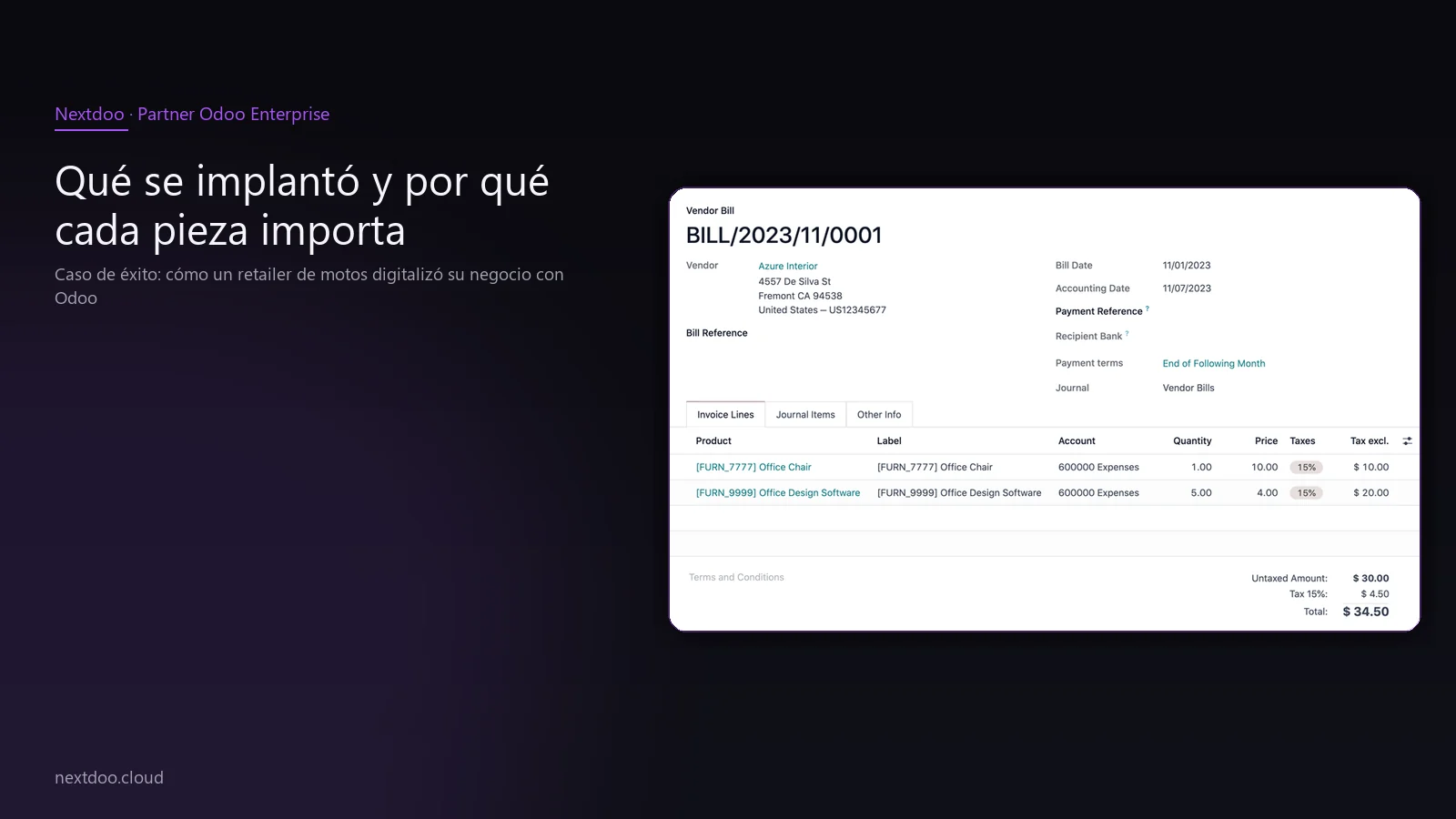
The company came to us with a technological structure that many retailers in this country will instantly recognise. Each department worked with its own tool, with none of them communicating with the others.
Inventory lived in spreadsheets. With over 5,000 references including helmets, gloves, technical clothing, spare parts, and accessories, keeping that Excel updated was a job in itself. Any small de-synchronisation between the physical shop and the online shop ended in overselling and an angry customer who had to be managed manually.
PrestaShop functioned as an online sales channel, but without a real connection to stock. Inventory updates were manual, which meant someone had to spend time each week cross-referencing data. Time that, in an SME, is always scarce.
The repair workshop was managed via WhatsApp and a paper diary. Without historical records, without the ability to see the status of each job, without links to the customer or the sale of associated spare parts.
And accounting, in an independent programme where data arrived via manual export and import. The result was that the business's real figures took weeks to become available, and always with the risk of some transcription error.
Why Odoo and not another solution?
Before discussing the project, it's worth explaining why Odoo Enterprise was chosen over other options the client had considered.
The first alternative they had on the table was to keep PrestaShop for e-commerce and complement it with some more robust management software for the internal side. The problem with that approach is that it doesn't solve the origin of the chaos: you still have different systems that need to be synchronised. You change tools but not models.
The second option was one of the best-known ERPs in Spain, aimed at SMEs. The drawback here was twofold: the licence cost was disproportionate for the size of the business, and native integration with e-commerce and physical point of sale required additional developments that drove the budget up even further.
Odoo Enterprise solved both problems. A single platform that covers physical shop sales, e-commerce, inventory, workshop, CRM, loyalty, and accounting adapted to Spanish regulations, including VeriFactu. No synchronisations between systems because everything resides in the same place. And with an implementation model that allows adjusting the scope to the actual size of the business.
For a motorcycle retailer with a workshop, this native integration between spare parts sales and repair management is especially valuable. It's not a minor detail: it's the difference between seeing the entire business or seeing watertight compartments.
What was implemented and why each piece matters?
The project covered all operational areas of the business. It's worth explaining the logic behind each block, not just listing functions.
Unified point of sale and inventory
The in-store point of sale needed to function with a barcode reader, manage different payment methods, and operate even with occasional connection drops. More importantly: each in-store sale had to update the stock in real time, the same stock seen by the online shop.
Inventory was organised into several warehouses: the physical shop, the central warehouse, and the workshop. This makes it possible to know at all times where each unit is, what is reserved for a repair, and what is available for sale. Something that was previously impossible without a manual count.
Integrated e-commerce instead of PrestaShop
Replacing PrestaShop with Odoo's native e-commerce was a decision the client initially approached with some caution. They had their online shop up and running, with its own design and some organic positioning gained.
The migration was carefully planned to preserve the most relevant product URLs and avoid SEO impact. The result was an online shop that shares a catalogue, prices, and stock with the physical shop without any synchronisation process. When a unit is sold in-store, it immediately disappears from online stock. In practice, this eliminates overselling.
Workshop management as part of the same system
This was one of the most valued aspects by the team. Before, the workshop was an island. Now, each motorcycle entry for repair generates a file linked to the customer, with a record of the work carried out, the spare parts used (automatically deducted from stock), and the time invested.
The customer can receive notifications about the status of their repair. The workshop manager sees their workload organised. And the invoicing for the repair comes from the same system as the rest of the sales, with all that implies for accounting and for VeriFactu.
Spanish accounting and tax compliance
This point is neither optional nor accessory. In Spain, any management software that issues invoices in 2025 and 2026 must be prepared for VeriFactu. The obligation to send invoicing records to the AEAT in real time affects practically all companies, and the retail sector is no exception.
Odoo Enterprise includes the Spanish chart of accounts and integration with VeriFactu. This means the customer does not need an additional module or a third-party solution to comply with regulations. The invoice is generated, recorded, and communicated to the AEAT within the same usual workflow.
CRM and loyalty for retaining motorcycle customers
A motorcyclist is a customer with high potential value over time. They don't just buy the motorcycle: they buy equipment, spare parts, accessories, bring the motorcycle to the workshop, and renew their equipment every season. Having a CRM that records this history allows for intelligent tracking and avoids missing opportunities.
The points loyalty programme complements this: it incentivises recurring purchases and gives the customer an additional reason to return to the shop or website instead of going to a competitor.
How was the implementation process organised?
An implementation of this scope in an SME requires order, clarity of priorities, and an involved client team. Both were present here.
The first phase was the base configuration of the system: company, fiscal year, chart of accounts, taxes, payment methods, and the parameterisation of VeriFactu. This phase is not visible to the end-user but ensures that everything that follows functions correctly from a legal and accounting perspective.
Data migration was the next major milestone. More than 5,000 product references with their images, categories, prices, and stock levels. The customer history. The previous year's sales record to allow for comparisons from day one. This work was done using import tools and a careful validation process to ensure data integrity.
Next came the launch of the ecommerce and the physical points of sale. The online store was configured with the complete catalogue, and URL migration was handled to protect organic SEO ranking. The in-store POS terminals were tested in real conditions before launch.
Team training was conducted in person, focused on each person's actual workflows. No one was trained on functionalities they wouldn't use. The objective was that at the time of launch, each team member would be able to perform their work in the new system with ease.
The launch took place on a Monday, with intensive support during the first few days to resolve any incidents in real-time.
What changed in daily operations
Six months after launch, the most relevant changes are not the big headlines of a results report. They are the small everyday details that, combined, transform how work is done.
The store manager starts the day knowing exactly what stock is in each location. No calls to the warehouse, no Excel spreadsheets to check. If a customer asks if a product is available, the answer is immediate and reliable.
Online overselling has disappeared. It hasn't been reduced: it has disappeared. When the last helmet of a certain size is sold in store, the website automatically marks it as out of stock.
Accounting has updated business data without waiting for someone to export and import files. The monthly close, which previously required hours of manual reconciliation, has been significantly simplified.
The workshop has its records organised. Mechanics know what work is pending and what state each motorcycle is in. Customers receive proactive communication about the status of their repair, which has reduced follow-up calls.
And the sales team has visibility of each customer's history: what they have bought, when, what motorcycles they own, what repairs they have had done. That information turns a follow-up call into a useful conversation instead of a generic interruption.
Tax compliance: VeriFactu and the standardisation of the sector
One of the aspects that generated the most questions during the project was the adaptation to VeriFactu. The client had heard about it but wasn't clear what it implied in practice nor what they had to do.
VeriFactu is the AEAT's system for real-time invoice verification. Obligated companies must send billing records as they are generated, ensuring their immutability. For a retailer with a high volume of operations —in-store sales, online sales, workshop invoices— this might seem like an additional administrative burden.
In practice, with Odoo Enterprise correctly configured, the process is transparent. The invoice is generated in the system, and the submission to the AEAT happens automatically, without the user having to do anything additional. Compliance is integrated into the usual workflow.
This is especially relevant for 2026, when the obligation extends to a wider universe of companies according to the calendar published in the BOE. Having the system prepared in advance avoids rushes and risks of non-compliance.
Project learnings: what we replicate in each retail implementation
Each project leaves lessons that apply to the next one. From this case, we learned several that are worth sharing.
Client involvement is crucial. Not the manager's involvement signing papers, but the real involvement of the team who will use the system every day. When these people participate in testing, they identify problems before launch and become internal ambassadors for change.
Data migration deserves more time than seems reasonable. Cleaning and properly structuring the data before importing it is invisible but critical work. A poorly migrated catalogue generates problems that drag on for months.
Launching on a specific and planned date, with intensive support during the first few days, is better than a gradual and prolonged launch. Prolonged uncertainty wears down the team and generates resistance to change.
And finally: it's not necessary to implement everything at once if it's not needed. The project scope should respond to the real needs of the business, not to a list of available functionalities. In this case, the scope was broad because the business required it. In other projects, starting with the core and growing afterwards is the smartest decision.
FAQ
Is Odoo suitable for a motorcycle business with a physical shop and an online store simultaneously?
Yes, and in fact, it is one of the profiles for which Odoo Enterprise offers the most value. The native integration between physical point of sale, ecommerce, and inventory solves the main problem of this type of business: stock de-synchronisation between channels. Furthermore, workshop management as part of the same system is an advantage that solutions specialised in pure retail do not offer.
What happens to the online store's SEO ranking if we migrate from PrestaShop to Odoo?
It's a legitimate concern. A poorly planned migration can damage the organic ranking achieved. The key is to preserve the most relevant product URLs, correctly configure redirects, and work on metadata from the start. With adequate planning, the impact is minimal and recoverable in a short time.
Does Odoo comply with VeriFactu and the Spanish tax regulations for 2025 and 2026?
Odoo Enterprise includes integration with VeriFactu and the Spanish chart of accounts. Correct configuration is part of the implementation work. To ensure that the system complies with your company's specific requirements according to the AEAT schedule, it is important to review the situation with an official partner before launch.
How long does an implementation like this take?
It depends on the scope, the volume of data to migrate, and the availability of the client team to participate in the process. There is no universal timeframe valid for all projects. What we can say is that a well-planned project, with an involved client team and a scope adjusted to real needs, advances significantly faster than one that starts without those conditions. The specific timeframe is defined in the initial analysis.
What happens to historical sales and customer data when migrating?
Historical data is migratable. The process requires exporting, cleaning, and transforming the data from the source system to the format Odoo expects. With a well-migrated sales history, the team can make comparisons and reports from day one. The quality of the result depends directly on the quality and order of the initial data.
Can you start with a part of the system and expand later?
Yes. In fact, in many projects, it is the most reasonable approach. You start with the core —inventory, sales, accounting— and other areas are incorporated once the team has assimilated the changes. Odoo is designed to grow with the business, not to implement everything at once if there's no need.
Conclusion: a single platform changes how the business is managed
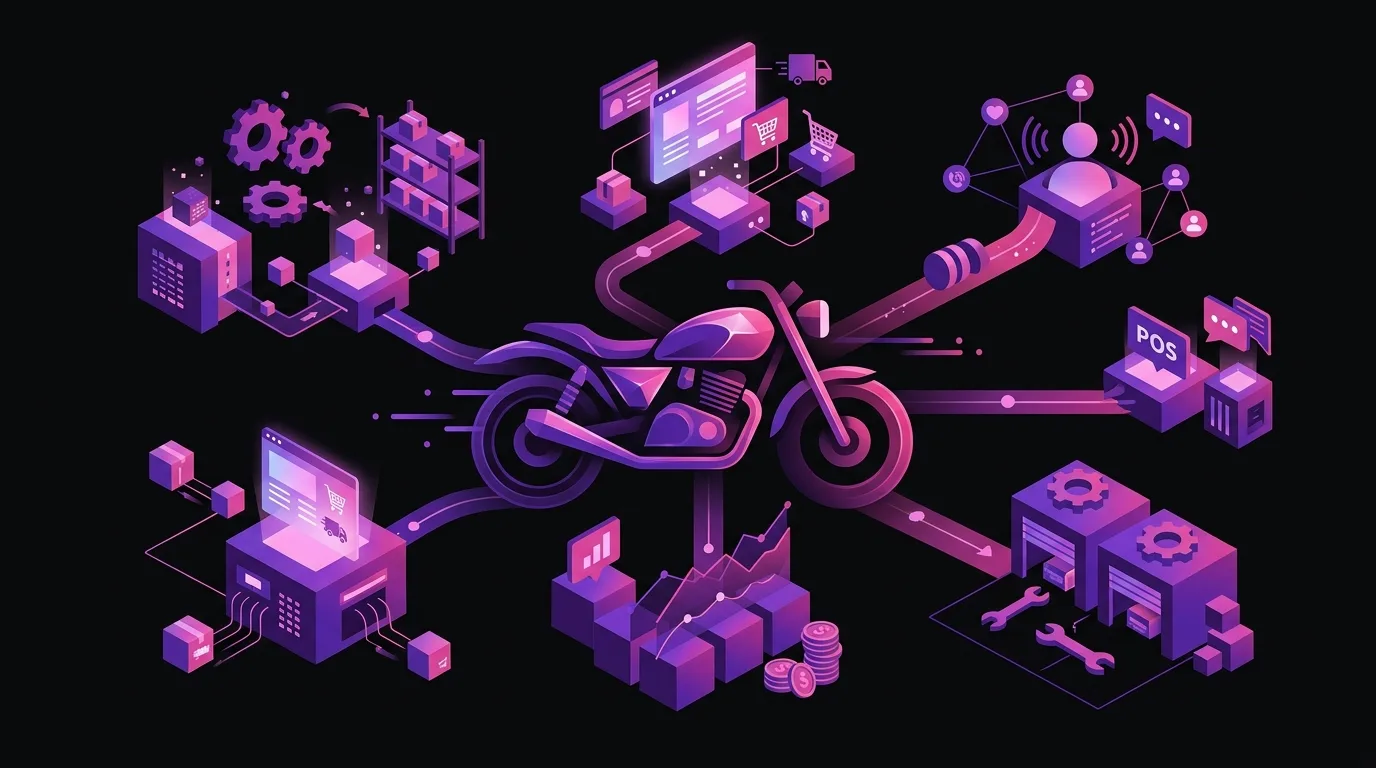
This case is not exceptional. It is the natural result of unifying into a single platform what was previously spread across five different tools. The improvement in visibility, operational efficiency, and decision-making capability doesn't come from a specific Odoo function. It comes from the fact that, for the first time, all business information is in the same place.
If you manage a retail business with a physical shop, online channel or workshop, and recognise any of the problems described in this case, the next conversation is simple: tell us how your business works today and we'll show you how it would look in Odoo.
Book a consultation with the team from Nextdoo and we'll start by understanding your actual situation before proposing anything.
Indicative information. Actual timelines, costs and scopes are confirmed after a personalised analysis. JLM Business Solutions SL · B16842831.
Frequently asked questions
Is Odoo suitable for a motorcycle business with a physical shop and an online store simultaneously?
Yes, and in fact, it is one of the profiles for which Odoo Enterprise offers the most value. The native integration between physical point of sale, ecommerce, and inventory solves the main problem of this type of business: stock de-synchronisation between channels. Furthermore, workshop management as part of the same system is an advantage that solutions specialised in pure retail do not offer.
What happens to the online store's SEO ranking if we migrate from PrestaShop to Odoo?
It's a legitimate concern. A poorly planned migration can damage the organic ranking achieved. The key is to preserve the most relevant product URLs, correctly configure redirects, and work on metadata from the start. With adequate planning, the impact is minimal and recoverable in a short time.
Does Odoo comply with VeriFactu and the Spanish tax regulations for 2025 and 2026?
Odoo Enterprise includes integration with VeriFactu and the Spanish chart of accounts. Correct configuration is part of the implementation work. To ensure that the system complies with your company's specific requirements according to the AEAT schedule, it is important to review the situation with an official partner before launch.
How long does an implementation like this take?
It depends on the scope, the volume of data to migrate and the availability of the client team to participate in the process. There is no universal timeframe valid for all projects. A well-planned project, with an involved client team and a scope adjusted to real needs, progresses significantly faster than one that starts without those conditions. The specific timeframe is defined in the initial analysis.
What happens to historical sales and customer data when migrating?
Historical data is migratable. The process requires exporting, cleaning, and transforming the data from the source system to the format Odoo expects. With a well-migrated sales history, the team can make comparisons and reports from day one. The quality of the result depends directly on the quality and order of the initial data.
Can you start with a part of the system and expand later?
Yes. In many projects, it is the most reasonable approach. It starts with the core —inventory, sales, accounting— and other areas are incorporated when the team has assimilated the changes. Odoo is designed to grow with the business, not to be implemented all at once if there is no real need.