Salesforce is the world's most renowned CRM, the benchmark for large enterprises. Odoo, on the other hand, includes a powerful CRM within a comprehensive ERP. When an SME looks to organise its sales, the two options often come up, but they adhere to very different philosophies. This comparison explains how they truly differ, what each implies in terms of cost and complexity, and when it makes sense to choose one over the other. We are an official Odoo partner, so we know that side thoroughly; even so, here you'll read a balanced comparison, because an over-specified CRM is abandoned, and an under-specified one goes unused.
En 30 segundos. Odoo vs Salesforce: real differences, cost, complexity, integrated vs isolated CRM, & when to choose each. Honest comparison from an official partner.
What each one is
Salesforce is the most widespread CRM platform in the world, with enormous power and customisation capabilities, a gigantic application marketplace and a very broad ecosystem of consultants. It is a product originally designed for large organisations with complex commercial processes and numerous sales teams, although it has editions for smaller companies.
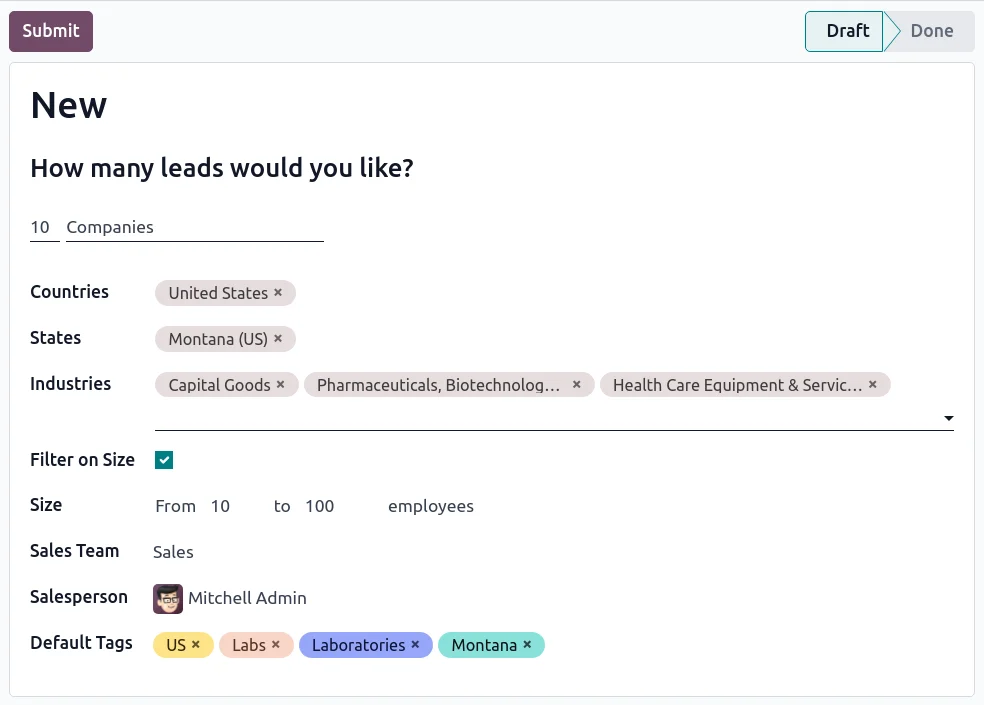
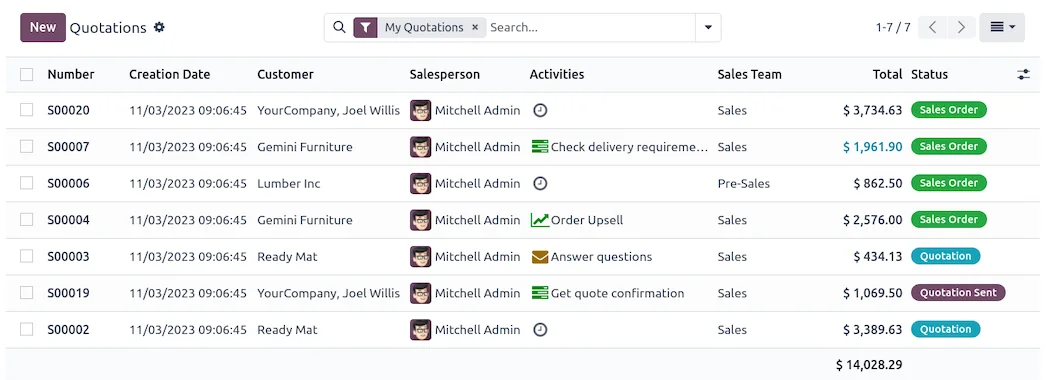
Odoo is an open-source ERP that includes a complete CRM as one of its modules, connected with sales, invoicing, inventory, and accounting. That means commercial tracking doesn't live in isolation: an opportunity becomes a quote, an order, and an invoice without re-keying data. You can see the framework of a project in Odoo implementation and the details of the Odoo CRM on their website.
How they differ
The fundamental difference is specialist versus integrated. Salesforce is a specialised CRM, taken to the extreme in terms of power and customisation. Odoo offers a very capable CRM, but its strong suit is that it's part of a system that manages the entire business.
Differences that usually decide:
- Scope. Salesforce focuses on CRM (with many extensions). Odoo integrates the CRM with sales,
invoicing, stock, and accounting as standard.
- Cost. The total cost of Salesforce is usually considerably higher, especially when adding users and
modules. Odoo has a more contained cost.
- Complexity. Salesforce is very powerful but requires serious implementation and maintenance. Odoo
is usually quicker to get started.
- Customisation. Both offer extensive customisation; Salesforce with its platform and ecosystem, Odoo due to its
open and modular nature.
- Spanish Taxation. Odoo includes Spanish localisation and invoicing compliant with VeriFactu;
Salesforce focuses on CRM, and the fiscal aspect is usually resolved with integrations.
Comparison: Odoo versus Salesforce
Indicative summary by approach; each company weighs differently according to its commercial operation.
| Odoo | Salesforce | |
|---|---|---|
| Tipo | CRM integrated into an ERP, open source | Leading specialised CRM, proprietary |
| Strong point | Integration with the entire business and cost | Power, ecosystem, and customisation |
| Ideal for | SMEs wanting CRM + integrated management | Large sales teams and complex operations |
| Total cost | More contained | Higher |
| Implementation | Quicker | More demanding |
| Spanish Taxation | Localisation + VeriFactu as standard | Via integrations |
Indicative comparison. Specific features depend on the edition and configuration; confirm this on the official websites.
Isolated CRM or integrated with the business
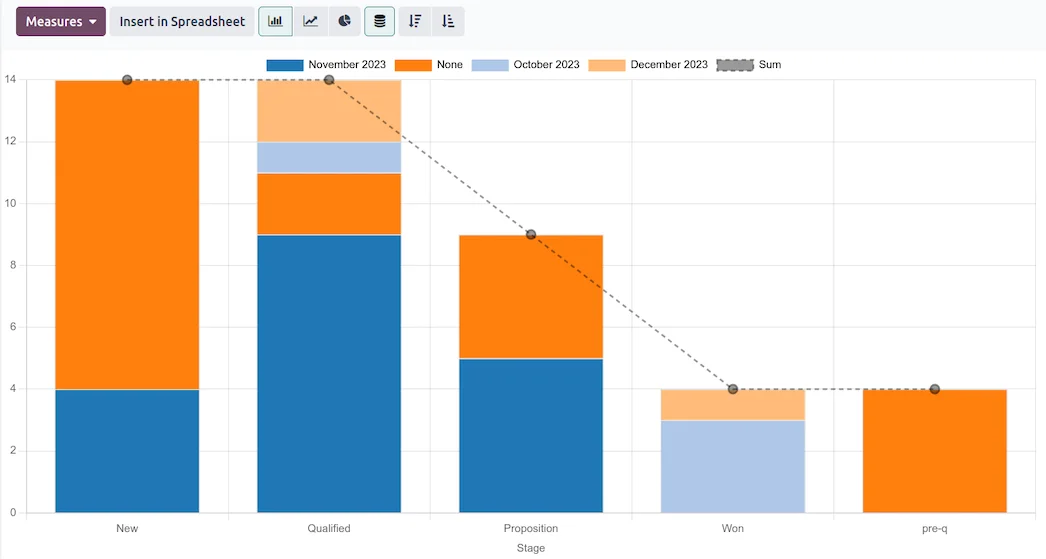
Here lies, for many SMEs, the real key to the decision. A CRM serves to organise and grow sales, but sales don't end when the deal is closed: they continue with the quote, order, invoice, collection, and stock. If the CRM is isolated from the rest, that chain breaks, and double work appears: transferring data from one system to another, manual reconciliation, losing traceability. The great advantage of Odoo is that the CRM and everything that comes after live on the same platform, so a won opportunity becomes an invoice compliant with VeriFactu seamlessly. With Salesforce, that integration with invoicing and Spanish management is usually resolved by connecting systems, which adds power but also complexity and cost.
Cost and complexity
Salesforce is a top-tier platform, and its cost is commensurate: it usually grows with the number of users and modules, and its implementation requires a serious investment in configuration and maintenance. For a large commercial operation, that investment is justified. For an SME, it might be over-specified. Odoo offers a very capable CRM at a significantly lower cost and with a quicker setup, which better fits the reality of most small and medium-sized enterprises. As always, what's important is the total cost versus value: you have an honest guide in how much Odoo costs, and it's worth remembering that success primarily depends on choosing the right partner for implementation.
When to choose Odoo and when to choose Salesforce
Salesforce makes sense if you are a company with a large sales team, complex commercial processes, very specific automation needs, and a budget to fully exploit its power. It is a solid choice for those who rely on large-scale CRM and want the most comprehensive platform on the market.
Odoo fits better if you are an SME that wants a capable CRM without excessive cost, and especially if you want that CRM to be integrated with invoicing, stock, and accounting in a single system. For the vast majority of Spanish SMEs, Odoo CRM covers what they need and, furthermore, avoids duplicate work between programmes. The useful question is an honest one: do you need the most powerful CRM platform in the world, or a good CRM integrated with your entire business at a proportionate price?
Frequently Asked Questions
Is Odoo better than Salesforce?
Not in abstract: it depends on your operation. Salesforce wins on power, ecosystem, and large-scale customisation; Odoo, on integration with the entire business and cost. For most SMEs, Odoo CRM covers what is needed at a more proportionate price.
Is Odoo CRM as powerful as Salesforce?
For the needs of most SMEs, yes: it manages leads, opportunities, pipeline, activities, and reports, integrated with sales and invoicing. Salesforce offers advantages for very large or complex operations.
Why does Salesforce usually cost more?
Due to its per-user and module model and a more demanding implementation. Even so, always compare the total cost against the value it brings to your specific case.
Can I integrate Spanish invoicing with Salesforce?
Yes, usually through integrations with other systems. In Odoo, invoicing compliant with VeriFactu is already integrated with the CRM, without connecting different programmes.
Is Odoo or Salesforce easier to implement?
Odoo is usually implemented more quickly for an SME. Salesforce, due to its power, tends towards longer and more demanding projects. The actual timeframe depends on the scope.
Salesforce or Odoo for an SME?
For an SME that wants a CRM integrated with its management at a proportionate cost, Odoo usually fits better. Salesforce excels in large sales teams with complex operations.
How much does each one cost?
It depends on the edition, users, and modules of each platform, which should be consulted on their official websites. Compare the total cost, not just the per-user fee.
Does Salesforce have an SME version?
Yes, it offers editions for smaller companies. Even so, its cost and focus remain oriented towards commercial operations with significant scope; it's worth assessing whether you will utilise its power or if an integrated option like Odoo better covers your needs for less.
Can I migrate my data from another CRM to Odoo?
Yes. A well-planned migration transfers contacts, opportunities, and commercial history. It is advisable to do it with a partner to preserve the information and have the CRM integrated with invoicing from the outset.
Are you comparing Odoo and Salesforce for your sales team?
At Nextdoo, an official Odoo partner, we frankly analyse your case and tell you if Odoo CRM covers your needs, integrated with your entire business. Start by Odoo implementation or request a diagnosis.
Sources: official Odoo documentation and electronic headquarters of the Tax Agency. Indicative comparison; the features and prices of each platform change, confirm them on their official websites.
Sources
Official sources consulted: official Odoo documentation y electronic headquarters of the Tax Agency (VeriFactu). Cost and timeframe figures are indicative and non-binding, subject to variations depending on the project.