HubSpot became renowned for simplifying marketing and sales, with a user-friendly CRM and a free tier to get started. Odoo includes a CRM within an ERP that manages the entire business. If you're weighing up the two, this comparison explains their real differences, which one is better for whom, and what happens to the cost as your business grows. We are an official Odoo partner, so we know that side inside out; even so, you'll find a balanced overview here, because choosing the wrong tool costs time and money.
En 30 segundos. Odoo vs HubSpot: real differences, marketing vs integrated management, cost at scale, and when to choose each. An honest partner comparison.
What HubSpot and Odoo Are
HubSpot is a platform built around inbound marketing: attracting visitors, converting them into contacts, and guiding them through to a sale. It offers a very easy-to-use CRM, with a free tier to get started, and excels in marketing, automations, and sales tracking. Its major strength lies in its convenience and power for customer acquisition and nurturing.
Odoo is an open-source ERP that includes a comprehensive CRM integrated with sales, invoicing, inventory, and accounting. Its focus isn't just on acquisition, but on managing the entire cycle: from opportunity to invoice and payment collection, without re-entering data. You can see the framework in Odoo implementation y el Odoo CRM on its website.
How They Differ
The fundamental difference is marketing-first versus integrated-management. HubSpot starts from marketing and lead generation, and does it very well. Odoo starts from comprehensive business management, with the CRM as a connected piece within the whole.
Key Differentiating Factors:
- Focus. HubSpot excels in marketing, inbound, and sales automation. Odoo excels in integrating the
CRM with operations (invoicing, stock, accounting).
- Cost as You Grow. HubSpot is convenient to start with, but its cost can escalate quickly as you add
contacts and advanced features. Odoo maintains a more predictable cost.
- Scope. With Odoo, the CRM is part of a complete ERP. HubSpot focuses on marketing and sales, and subsequent
back-end management is usually handled with integrations.
- Spanish Tax Compliance. Odoo includes localisation and invoicing compliant with VeriFactu; HubSpot is not a
Spanish invoicing tool.
Comparison: Odoo vs HubSpot
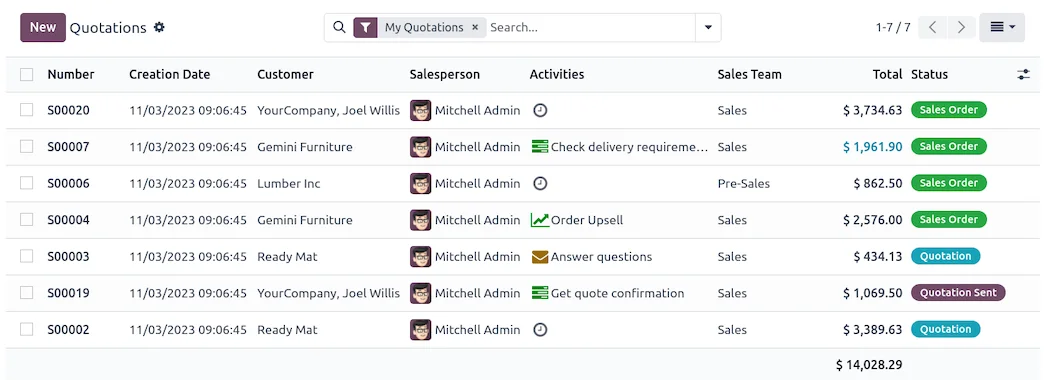
Guideline summary by focus; each business weighs priorities differently.
| Odoo | HubSpot | |
|---|---|---|
| Tipo | CRM integrated into an ERP, open source | Marketing and CRM Platform |
| Key Strength | Integration with entire business and cost | Marketing, inbound, and ease of use |
| Ideal for | SMEs wanting CRM + integrated management | Businesses focused on lead generation and marketing |
| Cost as You Grow | More predictable | Can scale quickly |
| Spanish Tax Compliance | Localisation + VeriFactu as standard | Not for Spanish invoicing |
| Scope | Complete ERP | Marketing and Sales |
Guideline comparison. Specific features depend on the plan and configuration; confirm this on the official websites.
Powerful Marketing or Comprehensive Management
Here lies the key to the decision. If your priority is to attract and convert —campaigns, forms, marketing automations, contact nurturing—, HubSpot is an excellent and very user-friendly tool. If your priority is to manage the entire commercial cycle and have the CRM connected with invoicing, stock, and accounting, Odoo provides that integrated vision which HubSpot, due to its focus, omits. Many SMEs discover that they primarily need the latter: not so much a sophisticated marketing machine, but a system where a won opportunity becomes an invoice compliant with VeriFactu without duplicated effort. It's not that one option is inherently better than the other: it's that they address different priorities.
The Cost as Your Business Grows
A point worth calmly considering is how the cost evolves. HubSpot is very accessible initially, even free at its basic tier, which makes it very appealing to start with. The detail is that, as your contact base grows and you need more advanced features, the cost can increase significantly. Odoo, due to its model, maintains a more predictable cost as you grow. As always, the important thing is the total cost in the medium term, not just the upfront outlay: you have an honest guide in how much Odoo costs, and it's advisable to choose the right partner for implementation, because that's what most influences the outcome.
When to Choose Odoo and When to Choose HubSpot
HubSpot makes sense if your priority is marketing and lead generation, if you value ease of use and inbound automations, and if your subsequent management (invoicing, stock) is handled elsewhere. It's a great tool for teams focused on attracting and converting.
Odoo fits better if you want a robust CRM integrated with your business's real operations, if it's important to you that sales connect with Spanish invoicing and stock, and if you prefer a predictable cost as you grow. For most SMEs looking for order and integrated management rather than a marketing machine, Odoo usually fits better. And they are not entirely mutually exclusive: some businesses use a marketing tool alongside an ERP; the important thing is to be clear about the core of your operation.
Frequently Asked Questions
Is Odoo better than HubSpot?
Not in abstract terms: it depends on your priority. HubSpot wins on marketing, inbound, and ease of use; Odoo, on integrating the CRM with all business management and Spanish tax compliance. For SMEs focused on management, Odoo usually fits better.
Is HubSpot really free?
It has a very useful free tier to get started. The cost emerges as your contact base grows and you use advanced features, and it can scale quickly. It's advisable to look at the medium-term cost, not just the upfront fee.
Is Odoo CRM suitable for marketing?
Odoo covers email marketing and automations within its ecosystem, although HubSpot is more specialised in inbound. Odoo's major advantage is integrating the CRM with sales, invoicing, and stock.
Can I invoice in Spain with HubSpot?
HubSpot is not a Spanish invoicing tool; that part is handled with another system. In Odoo, invoicing compliant with VeriFactu is already integrated with the CRM.
HubSpot or Odoo for an SME?
If the core focus is marketing and lead generation, HubSpot is excellent. If the core focus is managing the entire commercial cycle integrated with invoicing and stock, Odoo usually fits better.
Can I use both at the same time?
Yes, some businesses combine a marketing tool with an ERP. The important thing is to decide which is the core of your operation and avoid uncontrolled data duplication.
How much does each cost?
It depends on the plan, contacts, and features of each platform, which should be officially consulted. Compare the total medium-term cost, especially how it evolves as you grow.
Does HubSpot include invoicing and accounting?
That's not its function: HubSpot focuses on marketing and sales. Invoicing and accounting are handled with another system. In Odoo, these components are already integrated with the CRM and compliant with Spanish tax regulations.
Does Odoo have marketing automations like HubSpot?
Odoo covers email and automations within its ecosystem, although HubSpot is more specialised in inbound. If advanced marketing is your absolute priority, it's worth considering; if you're looking for integrated management, Odoo fits better.
Can I migrate from HubSpot to Odoo?
Yes. With a planned migration, contacts, companies, and opportunities are transferred. It's advisable to do it with a partner to preserve the history and leave the CRM connected with sales and invoicing.
Unsure between Odoo and HubSpot?
At Nextdoo, an official Odoo partner, we frankly analyse your case and tell you if Odoo's integrated CRM offers more value than a marketing platform. Start by Odoo implementation or request a diagnosis.
Sources: official Odoo documentation and the electronic headquarters of the Tax Agency. Guideline comparison; the features and prices of each platform change, confirm them on their official websites.
Sources
Official sources consulted: official Odoo documentation y electronic headquarters of the Tax Agency (VeriFactu). Cost and timeline figures are indicative and non-binding, subject to variations depending on the project.