In summary. Holded adequately covers invoicing and basic accounting for freelancers and micro-SMEs without operational complexity. Odoo is a complete ERP with POS, e-commerce, advanced inventory, real CRM, and integrated marketing, designed for growing SMEs. If today you only need to invoice, Holded works. As soon as your business demands more, Odoo is the only scalable option between the two.
Holded has earned a real place among Spanish SMEs. Simple invoicing, clean interface, adjusted price. Odoo, on the other hand, is another product category: a complete ERP that covers everything from accounting to e-commerce, POS, or human resources. The question is not which is better in the abstract, but which fits your business now and in three years.
Holded is sufficient for basic invoicing, but Odoo prevails when your SME needs to manage inventory, sales and customer relationships in an integrated way.
What is Holded and what is it designed for?

Holded is management software born in Spain, aimed at freelancers and small SMEs. Its value proposition is simplicity: you register, connect your bank, and in a short time you are already issuing invoices and keeping a basic control of expenses and income.
It covers invoicing, basic accounting adapted to the Spanish General Accounting Plan, a very simple CRM, light project management, and an elementary inventory module. For someone who invoices services or sells products without much logistical complexity, it more than suffices.
What Holded lacks is depth. The CRM does not allow advanced automations. The inventory does not manage multiple warehouses or traceability. There is no POS, no integrated e-commerce, no marketing tools, no helpdesk. For that, you would have to contract other applications and connect them yourself, with the cost and friction that implies.
Holded also complies with VeriFactu, the verifiable invoicing system required by the Tax Agency from 2026, which is a minimum requirement for any invoicing software operating in Spain.
What is Odoo and why is it a different category?
Odoo is a modular open-source ERP with an Enterprise version. This means you can activate only the functionalities you need today and add more as your business demands, without changing systems or migrating data.
In its current version, it covers full accounting with the Spanish General Accounting Plan, electronic invoicing, CRM with visual process and automations, multi-warehouse inventory with batch and serial number traceability, POS for physical shops, e-commerce integrated with the online shop, email marketing, helpdesk, project management, human resources, payroll and much more.
Unlike Holded, Odoo requires initial implementation. It is not a 'plug and play' product from day one. You need an official partner to configure the system according to your business's reality: your workflows, your catalogue, your integrations with banks or marketplaces, your specific tax situation.
That initial investment has a clear return: a system that doesn't force you to jump between five different tools and that scales with you without additional structural cost for each new feature.
Odoo also complies with VeriFactu and TicketBAI for the chartered territories, and is adapted to the obligations of Modelo 303, 390 and the annual declaration 347 managed by the AEAT.
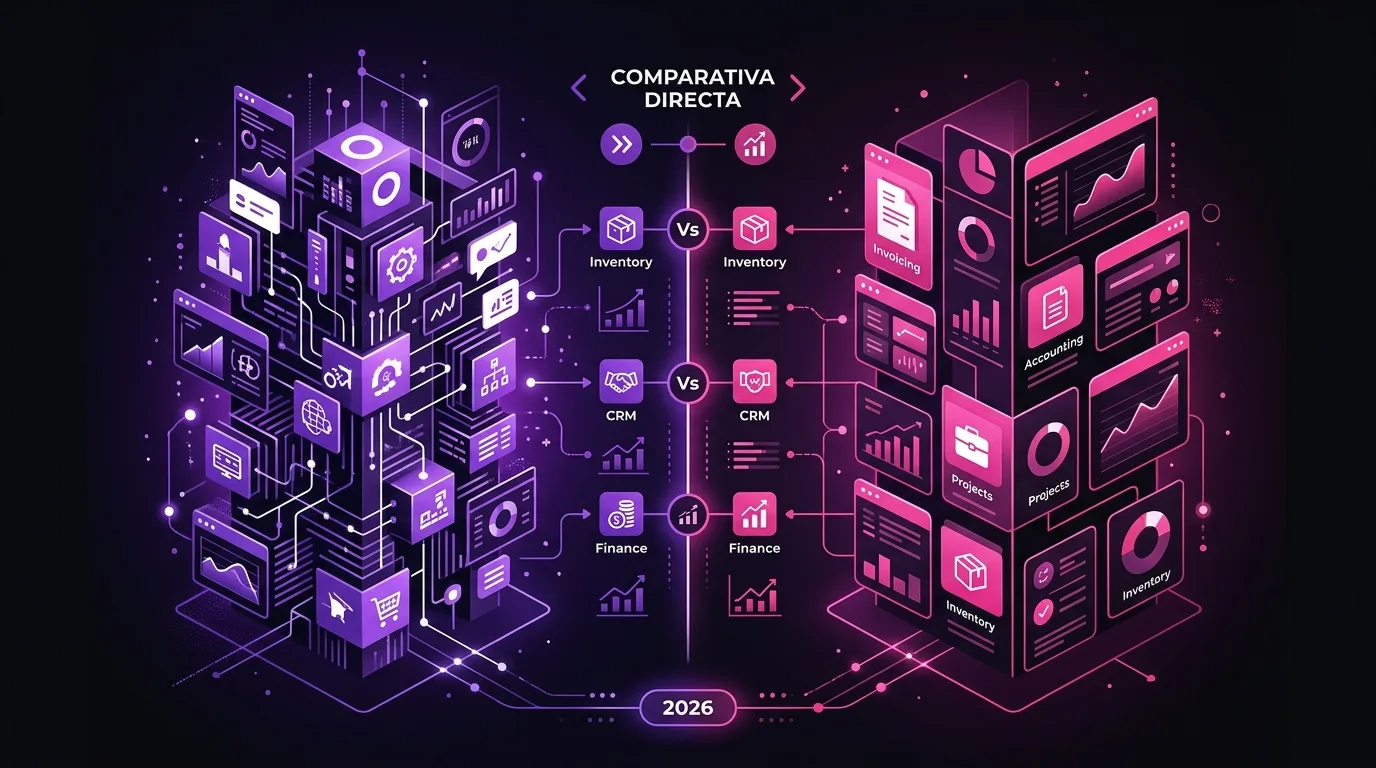
Direct comparison: feature by feature
To make the comparison useful, let's go feature by feature without technical jargon:
Accounting and invoicing
Both cover the basics: sales and purchase invoices, accounting entries, bank reconciliation. The difference lies in depth. Odoo's accounting is completely adapted to the PGCE, generates official books, and facilitates the submission of common tax models. Holded's is functional for simple operations but falls short when accounting scenarios become complicated.
In electronic invoicing, both have VeriFactu certification. Odoo also covers TicketBAI for the Basque Country and Navarre, which is relevant if you operate in those territories.
CRM and commercial management
Holded's CRM is basic: contacts, opportunity tracking, little else. It serves for a small client portfolio managed manually.
Odoo's CRM has a visual process, task and email automations, lead scoring, direct integration with email and marketing campaigns. If you have a sales team or manage a volume of opportunities that requires systematic tracking, there is no possible comparison.
Inventory and logistics
Here the difference is especially visible. Holded allows for basic stock management: ins, outs, valuation. For an SME that sells ten references without complexity, it can be sufficient.
Odoo manages multiple warehouses, configurable inbound and outbound routes, traceability by serial number or batch, inventory valuation by various methods, integration with barcode readers, and expedition labelling. For retail, distribution, or any business with real logistics, Odoo is the only option between the two.
POS and physical point of sale
Holded does not have a POS. Full stop. If you have a physical shop and need to take payments at the counter, record sales, manage the till, or control stock in real-time from the point of sale, Holded is not suitable for you.
Odoo has a complete POS, tested in retail and hospitality environments, with an offline mode for when Wi-Fi fails, table management for restaurants, and integrated customer loyalty.
E-commerce
Holded does not have an e-commerce module. Odoo does, and it's integrated with the rest of the system: the same catalogue, the same stock, the same accounting. When someone buys from your online store, the order goes directly into the workflow without manual steps.
Email marketing and communications
Holded does not include marketing tools. Odoo has email marketing with a template editor, subscriber list management, tracking of opens and clicks, and automations connected to the CRM.
Human Resources
Holded has basic HR functionality: employees, holidays, some attendance tracking. Odoo has complete employee management, hiring, performance appraisals, time tracking adapted to Spanish regulations and, in the Enterprise version with the corresponding modules, also payroll.
When does it make sense to stick with Holded?
We're not going to deny that Holded has its place. There are business profiles for which it is the right option:
- Freelancers who invoice for services and need to manage accounting simply.
- Micro-SMEs of fewer than five people without operational complexity.
- Businesses that do not manage physical stock or have a shop.
- Companies that only need to comply with basic tax obligations without investing in implementation.
- Very early-stage projects that want to start quickly and migrate later.
If you identify with any of these cases, Holded probably covers your current needs. The problem arises when the business grows and the system doesn't grow with it.
When is Odoo the obvious decision?

There are situations where sticking with Holded has a real opportunity cost. Odoo is the natural choice when:
- You have or plan to have a physical shop and need POS integrated with stock and accounting.
- You also sell online and want the webshop and ERP to be the same system.
- Your inventory has a minimum complexity: multiple warehouses, references with sizes and colours, batch traceability.
- You have a sales team that needs a real CRM with systematic tracking.
- You are paying several subscriptions for different tools that don't communicate with each other.
- Your company has between five and fifty users and you expect to continue growing.
- You operate in the Basque Country or Navarre and need to comply with TicketBAI.
- You want a solution that in 2026 and beyond won't force you to change systems.
In all these cases, the question isn't whether Odoo is worth the initial investment. The question is how much it's already costing you not to have it.
What is the real cost of working with disconnected tools?
One of the most frequent arguments for not making the leap to a full ERP is the cost. Holded seems cheaper because the monthly fee is lower. But that calculation is rarely complete.
When a business grows with Holded as its base, it ends up adding external tools: one for e-commerce, another for the CRM, another for email marketing, perhaps one for the POS. Each has its subscription cost, its learning curve, and, above all, its integration cost. Data doesn't flow between systems on its own: someone has to synchronise them, check for duplicates, and correct errors.
Odoo unifies all of that into a single environment. The licence fee covers functionalities which, in a scenario of separate tools, would mean several different subscriptions. And integration isn't a problem, because everything is within the same system from day one.
The cost of implementing Odoo with a partner like Nextdoo is a one-off investment with a measurable return. There is no standard price because each business is different, but an indicative range can be estimated after an analysis of your specific case.
What to expect when migrating from Holded to Odoo?
Many Spanish SMEs come to Odoo from Holded. The migration process isn't complicated if done well, but it needs to be planned carefully.
What usually migrates smoothly is the customer and supplier database, the product catalogue, the invoice history, and accounting balances. What requires more work is configuring your business's specific workflows in Odoo: how you want to manage orders, how you structure the warehouse, what automations you need in the CRM.
The value of working with an official partner like Nextdoo lies precisely there: we don't just migrate data; we configure Odoo to work the way your business works, not the other way around. Before starting, we perform an analysis of your current situation to define the scope and timeline of the implementation.
The process is organised, with defined phases, and the Nextdoo team supports the launch so that the transition doesn't interrupt daily operations.
How do Holded and Odoo stand regarding VeriFactu and the tax obligations for 2026?
From a tax perspective, both Holded and Odoo have planned for the adaptation to VeriFactu, the verifiable invoicing system that the AEAT will progressively implement from 2026 according to the calendar published in the BOE.
VeriFactu requires that invoicing software generates an electronic record of each invoice with a hash code that guarantees its integrity. Both products have or plan to have that functionality.
Where Odoo extends tax coverage is to TicketBAI, mandatory in the Basque Country and Navarre, and to the generation of files and declarations for the Modelo 303 for quarterly VAT, the Modelo 390 for the annual summary, and the informative declaration 347 for third-party transactions. For accounting firms and businesses with a certain volume of transactions, having that integrated into the same system where invoices are recorded saves time and reduces errors.
Frequently asked questions
Is Odoo too big for a small SME?
Not necessarily. Odoo is modular: you can start with accounting and invoicing, which is exactly what Holded covers, and activate more functionalities when you need them. The entry point does not have to be a complex ERP. The difference with Holded is that when it's time to grow, you won't have to change systems.
Can I migrate my data from Holded to Odoo without losing the history?
Yes. The migration of customers, suppliers, products, and invoices is common and well-documented. The accounting history can be imported with the opening balances correctly configured. An official partner is responsible for validating that the data balances before bringing the system live into production.
Does Holded comply with VeriFactu?
Holded has planned the adaptation to VeriFactu to comply with the AEAT calendar. It is advisable to verify with the provider itself the exact status of that adaptation before making decisions, as the BOE deadlines may have updates. Odoo Enterprise also has that adaptation within its official roadmap.
How long does it take to implement Odoo coming from Holded?
It depends on the scope. A basic accounting and invoicing implementation for a small SME is notably shorter than a project that includes POS, e-commerce, and inventory. At Nextdoo, we offer a free preliminary analysis to give you an estimate tailored to your case before committing to any deadlines.
Is Odoo more expensive than Holded?
The Odoo Enterprise licence fee is higher than Holded's. But the full calculation also includes what you stop paying for external tools by having everything integrated. For many SMEs, the total cost ends up being similar or lower, especially when counting the hours of manual work that disappear by no longer synchronising separate systems.
Does Nextdoo only work with Odoo?
Yes. Nextdoo is an official Odoo Enterprise partner in Spain. We do not implement or recommend other ERPs or management software. Our speciality is Spanish SMEs, retail, hospitality, and the motorcycle sector. If you come from Holded, Sage, Dynamics, or any other system, we help you make the transition to Odoo in an organised manner.
Conclusion: the decision depends on where you want to be in three years
Holded is a good tool for what it is. If you are self-employed, invoice services, and have no operational complexity, you probably don't need more. Use it without guilt.
But if your business has or aspires to have a physical shop, an online shop, a sales team, real inventory, or simply doesn't want to rely on five tools that don't communicate with each other, Odoo is the option that makes sense. Not because it's more modern or bigger, but because it's designed to grow with the business without you having to change systems every time you take a step forward.
At Nextdoo, we work with Spanish SMEs that have made that decision and want to do it right from the start. If you want to see how Odoo would be configured for your specific business, request a demo, and we will show you without obligation.
Indicative information. Actual deadlines, costs, and scopes are confirmed after a personalised analysis. JLM Business Solutions SL · B16842831.
Frequently asked questions
Is Odoo too big for a small SME?
Not necessarily. Odoo is modular: you can start with accounting and invoicing, exactly what Holded covers, and activate more functionalities when you need them. The entry point does not have to be a complex ERP. The difference is that when it's time to grow, you won't have to change systems.
Can I migrate my data from Holded to Odoo without losing the history?
Yes. The migration of customers, suppliers, products, and invoices is common and well-documented. The accounting history can be imported with the opening balances correctly configured. An official partner validates that the data balances before bringing the system live into production.
Does Holded comply with VeriFactu?
Holded has planned the adaptation to VeriFactu to comply with the calendar published by the AEAT. It is advisable to verify with the provider itself the exact status of that adaptation, as the deadlines may have updates. Odoo Enterprise also has that adaptation within its official roadmap and also covers TicketBAI for the foral territories.
How long does it take to implement Odoo coming from Holded?
It depends on the scope. A basic accounting and invoicing implementation for a small SME is notably shorter than a project that includes POS, e-commerce, and inventory. At Nextdoo, we offer a free preliminary analysis to give you an estimate tailored to your specific case before committing to any deadlines.
Is Odoo more expensive than Holded?
The Odoo Enterprise licence is higher than Holded's. But the full calculation also includes what you stop paying for external tools by having everything integrated. For many SMEs, the total cost ends up being similar or lower, especially when counting the hours of manual work that disappear by no longer synchronising separate systems.
Does Nextdoo only work with Odoo?
Yes. Nextdoo is an official Odoo Enterprise partner in Spain. We do not implement or recommend other ERPs or management software. Our speciality is Spanish SMEs, retail, hospitality, and the motorcycle sector. If you come from Holded, Sage, Dynamics, or any other system, we help you make the transition to Odoo in an organised manner.
Frequently asked questions
What is the main difference between Holded and Odoo?
Holded is a basic invoicing and accounting tool designed for self-employed individuals and micro-SMEs with simple operations. Odoo is a complete ERP that integrates invoicing, accounting, POS, e-commerce, advanced inventory, CRM, and human resources, designed for growing SMEs.
When should I choose Holded instead of Odoo?
Choose Holded if you are self-employed or a micro-SME that only needs to invoice and manage basic accounting without operational complexity. Its interface is simple, the price is fair, and it works well for service businesses or simple sales without complex inventory management.
Is Odoo scalable if my business grows?
Yes, Odoo is the scalable option between the two. As your business grows and you need real inventory, functional CRM, integrated POS or ecommerce, Odoo can adapt without the need to change systems.
What happens if I start with Holded and then need to migrate to Odoo?
Migrating from Holded to Odoo is possible but requires planning. You will need to transfer invoice, customer and accounting data, which involves time and possible adjustments to Odoo's configuration to adapt it to your current structure.
Do both comply with Spanish tax obligations for 2026?
Both systems are adapted to Spanish tax regulations, including VeriFactu. The difference is that Odoo offers more integrated functionalities to manage tax complexity as your business grows.