You can have the best Odoo in the world, perfectly configured, and still fail for a silly reason: that the team doesn't use it properly. Training is the most neglected part of implementations, yet it's what determines whether Odoo is adopted or abandoned. This guide explains why training is key, how to train your team by profiles, and what mistakes to avoid for true adoption to work. Because a system no one uses properly organises nothing; on the contrary, it generates distrust.
En 30 segundos. Odoo training: why it's key to success, how to train your team by profile, and mistakes to avoid for effective adoption. Your guide.
Why Training is Key
The reason is simple: an ERP only provides value if people use it properly. Odoo can be impeccably configured, with up-to-date tax compliance and defined processes, but if the salesperson doesn't know how to log an opportunity, the warehouse doesn't know how to prepare an order, or administration doesn't know how to issue an invoice, the system organises nothing. Worse still: a team that doesn't understand the tool perceives it as a hindrance and looks for ways to bypass it, reverting to their spreadsheets and old methods. Training is not an optional extra at the end of the project; it's what makes all the prior investment worthwhile. That's why good projects treat it as a fully-fledged phase, not a last-minute add-on.
Train by Profiles, Not Generically
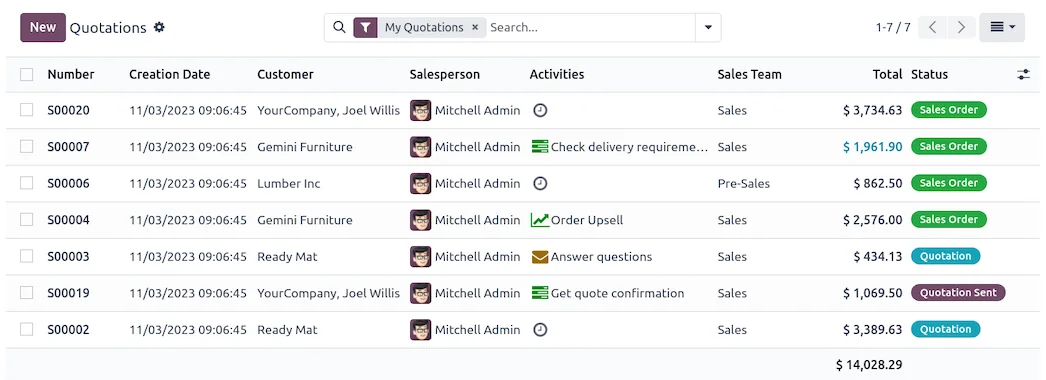
The most common mistake is to give a generic 'Odoo course' to everyone. It doesn't work, because each person needs different things. What really works is training by profiles, focusing on what each person uses in their day-to-day work:
- Sales & Commercial: logging opportunities, creating quotes, converting to orders, following up with
customers in the CRM.
- Warehouse & Inventory: receiving goods, preparing and dispatching orders, conducting stocktakes, controlling
stock.
- Administration & Invoicing: issuing invoices compliant with VeriFactu, managing
collections, handling the accounting side.
- Purchasing: managing suppliers, placing purchase orders, monitoring receptions.
- Management: reading reports and dashboards to make data-driven decisions.
Each profile learns what they need, using the company's real processes, not abstract examples. This way, the training is effective and isn't forgotten within a week.
What Good Training Should Be Like
Effective training has several characteristics. It's practical: you learn by doing, with real company cases, not by watching slides. It's tailored to profiles, as we've seen, so that everyone learns what they use. It's progressive: first the essentials for working, then the advanced topics, without overwhelming. It's supported by reference materials (short guides, the Odoo documentation) to consult for queries afterwards. And, very importantly, it includes support during the first few days of real use, when genuine questions arise. Training isn't about delivering a course and disappearing: it's about providing support until the team operates confidently. This post-training support is one of the most significant contributions a partner makes to an Odoo project.
Common Training Mistakes
Certain mistakes are repeated with training that should be avoided. Firstly, leaving it until the end and rushing it just before go-live, when the team is already overwhelmed. Secondly, a generic course for everyone instead of training by profiles. Thirdly, training only one person, meaning the knowledge leaves with them if they depart the company. Fourthly, not providing materials for later consultation, so every query becomes an interruption. And fifthly, not providing support during the first few days, which is when real learning happens. All these mistakes lead to the same outcome: an insecure team that ends up avoiding Odoo. The project framework is in Odoo implementation, and it's advisable to choose the right partner who genuinely trains, rather than just delivering a course and leaving.
Training as an Investment, Not an Expense
It's advisable to change how training is viewed: it's not an expense that can be cut, but the investment that protects everything else. Think of it this way: if you've invested in properly implementing Odoo, migrating data, ensuring up-to-date tax compliance, and then skimp on training, you're jeopardising all that investment by saving on the final piece. A well-trained team maximises Odoo's potential, works faster and makes fewer mistakes; a poorly trained team turns a good tool into a source of frustration. Training is, ultimately, what determines the real return on the entire project. Therefore, when you evaluate how much Odoo costs, training should not be the item sacrificed, but the one that ensures the rest is worthwhile.
Frequently Asked Questions
Why is Odoo training so important?
Because an ERP only provides value if the team uses it properly. Without training, the risk is abandonment: reverting to spreadsheets and wasting the entire investment in the implementation.
How should I train my team in Odoo?
By profiles, not with a generic course: each person learns what they use in their job (sales, warehouse, invoicing). Practical, using the company's real processes and with support during the first few days.
How long does Odoo training last?
It depends on the scope and profiles, but it should be progressive: first the essentials for working, then the advanced topics. More than the duration, what matters is that it's practical and that the team benefits from it.
Is training just one person enough?
It's not advisable: if knowledge is concentrated in one person, it leaves with them if they depart. It's advisable to train each profile and provide reference materials so the team is autonomous.
Is training done before or after go-live?
The ideal is to train on the essentials before go-live and provide support afterwards, during the first few days of real use, which is when genuine questions arise. It's not advisable to leave it all until the last minute.
Does a partner include training?
A good partner treats training as part of the project, not as an extra: they train by profiles, using your processes, and provide support after go-live. It's advisable to confirm that training is properly accounted for.
What happens if the team isn't trained properly?
The risk is that Odoo is used incorrectly or abandoned, with the team reverting to their old methods. All the investment in a good implementation is lost if the final piece, training, fails.
Can I train the team using Odoo documentation?
Documentation is good support for checking queries, but it doesn't replace practical training with your own processes. The ideal is to combine tailored training with reference materials for day-to-day use.
How often should training be reinforced?
Reinforcement is advisable after the first few weeks of use, once real queries have arisen, and whenever a new module is added or new people join. Training is not a one-off event, but something that is maintained.
Does training cover new version updates?
It's advisable: Odoo evolves, and a brief refresher when there are relevant changes keeps the team making the most of the tool. A good partner usually advises on what needs reviewing.
Is it worth investing in training if the team is small?
Yes. In a small team, each person performs more distinct functions, so properly training each one is even more important for Odoo to be genuinely utilised and not become a hindrance.
Do you want your team to genuinely use Odoo, not suffer from it?
At Nextdoo, an official Odoo partner, we train by profiles with your real processes and provide support after go-live, so that adoption works. Start with Odoo implementation or request a diagnosis for your case.
Sources: official Odoo documentation. Indicative information; the training plan is tailored to the profiles and reality of each company.
Sources
Official sources consulted: official Odoo documentation y Tax Agency's electronic office (VeriFactu). Cost and timeline figures are indicative and non-binding, subject to variations depending on the project.