
In summary. Odoo allows a Spanish sports shop to manage complex product variants (size, colour, version), custom kit orders for local clubs, equipment rental with deposit and return, automatic seasonal pricing, and mandatory 2026 tax compliance (VeriFactu, IVA, Modelo 303). All in a single system, without fragile external integrations, adapted to Spanish SMEs.
A sports shop is not just any shop. It manages technical apparel with dozens of size and colour combinations, sells customised kits to local clubs, rents bicycles or skis seasonally, and has to reconcile all of that with Spanish tax compliance for 2026. If you try to manage that with a spreadsheet or generic software, sooner or later it will explode in your hands.
Odoo solves this problem natively. Not with patches or fragile integrations, but with a system that connects the catalogue, B2B sales, rental, and accounting in a single environment.
What is the real problem of a sports shop with generic software?
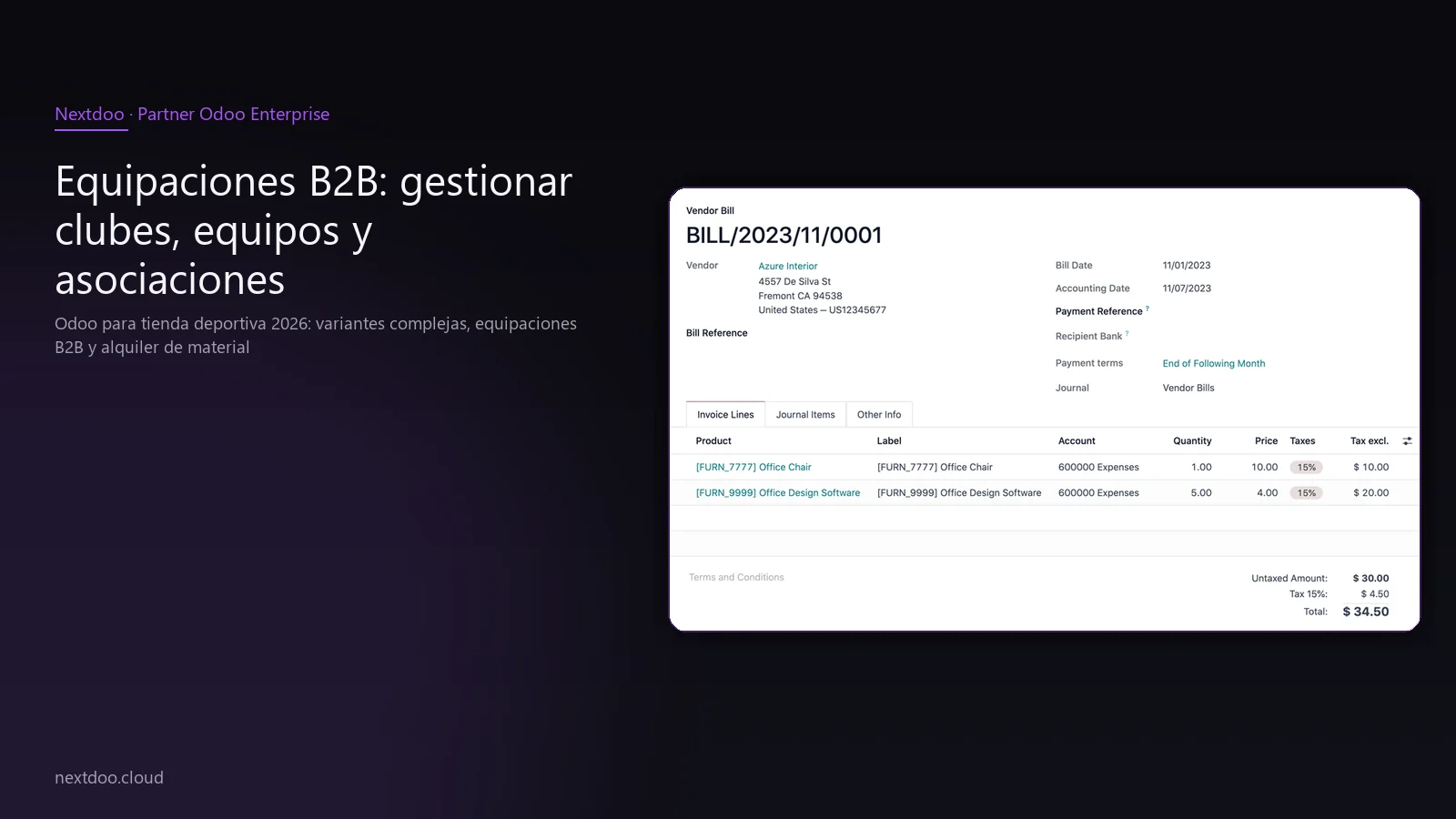
Most small and medium-sized sports shops come to Nextdoo from a similar situation: they keep stock in a basic invoicing programme, club B2B orders in an Excel shared by email, and rental in a notebook or diary. It works until it doesn't.
The first symptom is usually stock. You sell a red size M t-shirt online, but in the physical shop you had already reserved it for a club order. The second symptom is rental invoicing: deposits that are not settled correctly, returns that are not registered, damaged material that returns without an assigned cost.
The third symptom, increasingly present in 2026, is tax compliance. VeriFactu requires verifiable invoices to be issued in real-time. If your software is not adapted, each rental ticket or each kit invoice can be a problem with the AEAT.
Odoo solves all three fronts from the same system. Without the need to connect three different tools that desynchronise at the worst possible moment.
How does Odoo manage complex variants in the sports catalogue?
Technical apparel is the most demanding product in terms of catalogue. A running t-shirt can have five sizes, four colours, and three sleeve versions. That's sixty combinations for a single model. Multiply that by fifty technical clothing references and you understand the problem.
Odoo manages this with a system of attributes and variants. You define the attributes once (size, colour, sleeve type) and the system generates the combinations automatically. You can activate only the combinations that actually exist, not all possible ones, which avoids phantom references in the catalogue.
Each variant has its own stock, its own price if necessary, and its own barcode. At the physical point of sale, the sales assistant scans the t-shirt's barcode and the system knows exactly which size and colour has just left the warehouse.
Bicycles have a different logic. Here, each unit is normally an item with an individual serial number, because the warranty is associated with the specific chassis. Odoo allows inventory to be managed by serial number within the same variants catalogue. A black size M bicycle can have ten physical units, each with its serial number registered.
Technical footwear, skis, kayaks: each category has its own attribute logic. Odoo allows this logic to be configured by product category, not globally, which gives real flexibility without overcomplicating what doesn't need to be complicated.
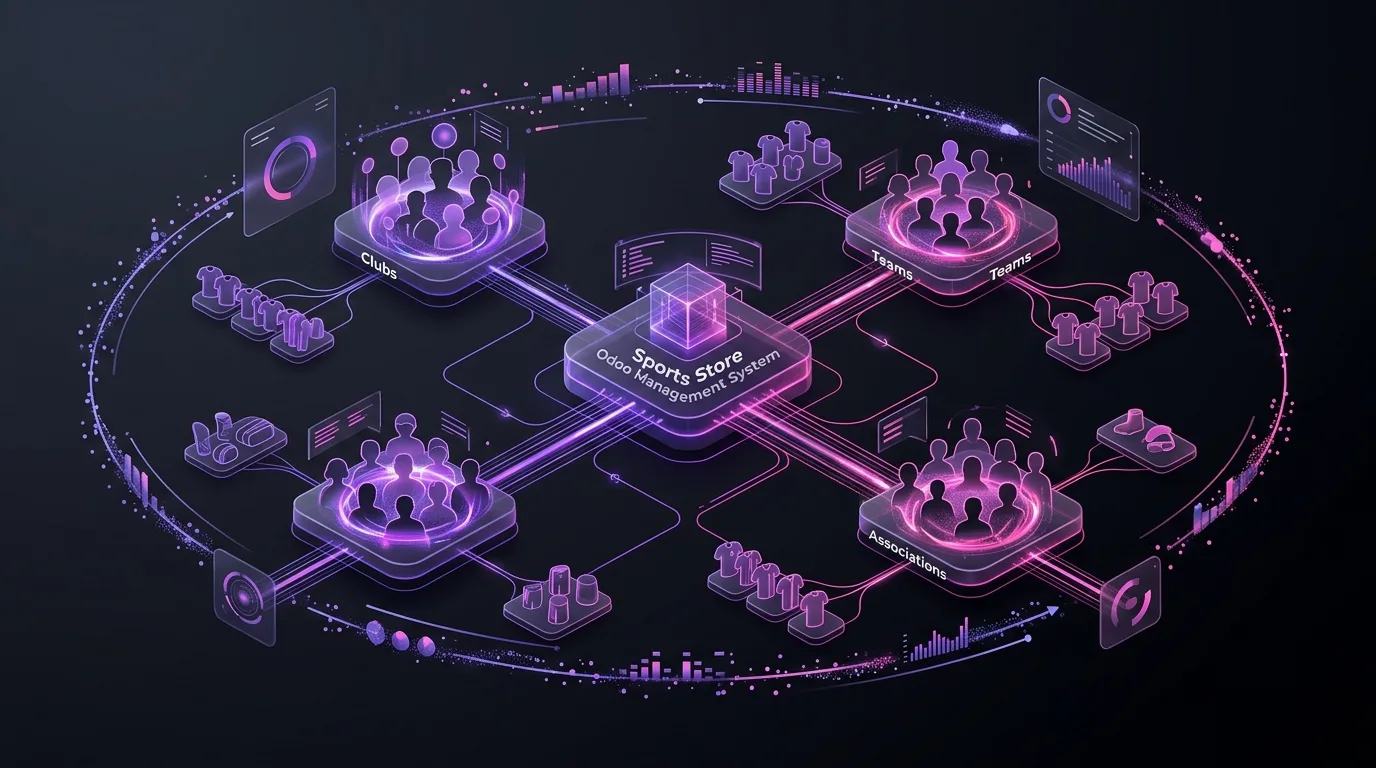
B2B Kits: managing clubs, teams, and associations
The B2B business with sports clubs is strategic for many shops. A local football club can represent an order for forty t-shirts with personalised numbers and names, plus trousers, plus goalkeeper's kit. Repeated two or three times a year if they change sponsors or get promoted.
This type of order has characteristics that generic software does not manage well. Firstly, there is an agreed price with the club that has nothing to do with the retail price. Secondly, each t-shirt has a different name and number, which implies line-by-line customisation within the same order. Thirdly, part of the work is done by an external screen printing or embroidery supplier, which adds a layer of purchasing and costs.
In Odoo, each club is a B2B customer with its own pricing. The salesperson creates a single sales order where each line corresponds to a size with its quantity, and customisations are collected as options with an additional price. The order can be linked to a purchase order to the screen printing supplier if the finishing is outsourced.
Associations and federations have a variant of this model: they need an invoice with specific tax details and sometimes pay by bank transfer at thirty or sixty days. Odoo manages payment due dates within the same order, with automatic reminders if payment is delayed.
Some aspects that this workflow resolves natively:
- Specific B2B customer pricing without affecting the retail price
- Line-item customisation with automatic extra price
- Linking the sales order with the purchase from the external supplier
- Invoicing with the correct tax details of the club or association
- Tracking order status: pending customisation, in production, ready for delivery
How to manage sports equipment rental: deposit, return, and availability?
Rental is a business within a business for many sports shops. Skis in winter, bicycles in summer, kayaks in coastal areas. The operational problem is always the same: knowing what equipment is available, what is rented out and in what condition it returns.
Odoo includes specific rental functionality that manages the complete cycle. The customer makes a reservation for specific dates, the system checks availability in real time and blocks the reserved equipment. When collected, the condition of the equipment is recorded before it leaves. On return, the condition is checked, and the discount on the deposit is applied if there is damage.
Payment can be configured by the hour, by the day or by season. The deposit is collected at the start and released or partially executed on return, depending on the condition of the equipment. Everything is automatically recorded for accounting purposes, which greatly simplifies management at the end of the month.
What this solves in practice:
- Availability control by specific equipment and dates
- Collection and return with condition recording
- Automated deposit management
- Flexible payment according to rental type
- History of each piece of equipment: how many times rented, incidents, maintenance
For shops with online rental, the reservation can be integrated directly into the website, showing real-time availability to the customer without the need to call the shop.
How do seasonal rates with automatically changing prices work?
A sports shop thrives on seasons. Skis are worth more in November than in April. Beach equipment peaks in July. End-of-season sales need to be activated on a specific date and deactivated on another.
Managing this manually in basic software is a constant source of errors. Promotional prices are forgotten, high-season rates are applied to out-of-season customers, or stock is sold at a discount without sufficient margin.
Odoo allows you to define rates with automatic activation and deactivation dates. You define the ski season rate with the corresponding dates and the system applies it only during that period, without manual intervention. When the season ends, the base rate returns.
Some common scenarios in sports shops:
- High season rate for ski rental, active from November to March
- Summer sale rate on spring-summer collection
- Special Black Friday price for a specific week
- Permanent B2B rate for clubs, regardless of the season
- End-of-season rate to clear stock before the collection change
Each rate can be applied generally or only to certain products or categories. This allows, for example, to apply an end-of-season discount on clothing without affecting technical footwear that maintains its margin.
The online shop: selling with a product configurator
Selling sports equipment online has a specific difficulty: the customer needs to configure their purchase. A bicycle is sold with component options. Skis are sold with bindings adapted to the skier's size and level. A club kit is customised with name and number.
Odoo allows these options to be displayed on the web store with dynamic pricing. The customer selects attributes and the final price updates in real time. When the order is confirmed, all that configuration goes directly to the shop team without the need for manual reinterpretation.
This reduces errors and reduces verification calls before manufacturing or ordering. The incoming order already has all the necessary information to process it.
The online shop shares the same stock as the physical point of sale. If the last size M of a T-shirt is sold in-store, it automatically disappears from the website. No scheduled synchronisations, no risk of selling what isn't there.
What tax regulations should you be aware of in 2026 and what can't you ignore?
The 2026 financial year brings specific tax obligations for any Spanish business, and sports shops are no exception.
VeriFactu becomes mandatory for companies and self-employed individuals not covered by the SII. It requires every invoice issued to be registered in a system verifiable by the AEAT. Odoo has an adaptation for VeriFactu within the Spanish localisation, which means that day-to-day invoicing already complies with this obligation without additional steps.
TicketBAI applies if you operate in the Basque Country or Navarre. If your sports shop is in these communities, you need certified software. Odoo covers this requirement within the same localisation.
Regarding periodic models, a sports shop with normal activity will submit Modelo 303 (quarterly VAT settlement) and Modelo 390 (annual summary). If you have operations with other businesses or professionals above the legal threshold, also Modelo 347 (transactions with third parties).
Equipment rental has specific accounting treatment: it is a provision of services, not a sale of goods. Odoo differentiates these two types of operation in invoicing, which facilitates the correct declaration of accrued VAT.
Having software adapted to Spanish tax regulations is not a luxury; it is an operational requirement. The AEAT can cross-reference data automatically, and discrepancies between declared and invoiced amounts are becoming increasingly visible.
What to expect from an implementation in a sports shop?
A sports shop with a textile and footwear catalogue, B2B kits for clubs, equipment rental and integrated eCommerce is a medium-to-high complexity implementation project. Not because Odoo is difficult, but because the variant logic, rates, rental circuit and tax regulations must be properly configured from the outset.
The usual process begins with a needs analysis: which products have complex variants, which clubs are recurring B2B clients, what equipment is rented and under what conditions, what integrations exist with suppliers or with the current website.
Based on this analysis, the actual scope of the project is defined. The timeline and cost depend on this definition. At Nextdoo, we work with a progressive implementation approach: first what is critical for the business, and then the functionalities that provide additional value but do not block daily operations.
Some aspects that determine the complexity of the implementation:
- Number of references with complex variants to migrate
- Volume of active B2B clients and their specific conditions
- Integration with existing rental system or start from scratch
- Need to keep the online shop active during migration
- Adaptation to VeriFactu or TicketBAI depending on the autonomous community
The result is a system that the shop team can manage without technical training. The learning curve exists, but it is reasonable for any SME that has previously worked with any management software.
FAQ
How does Odoo manage kit orders for sports clubs?
Each club is configured as a B2B client with its own agreed rate. The kit order is created with as many lines as sizes or variants the club needs, and each line can include customisation information: player's name, squad number, type of screen printing. The system automatically calculates the total price including customisation extras. If the finish is done by an external supplier, the sales order can be linked to the corresponding purchase to control costs and margins.
Can I manage equipment rental alongside normal sales in the same system?
Yes. Odoo differentiates between sales products and rental products within the same catalogue. The rental circuit has its own flow: reservation, delivery with status registration, return with deposit settlement. This does not interfere with the normal sale of other items. You can have sales items and rental items in the same order if the customer needs it, for example, in the case of a customer who buys accessories and rents a bicycle.
How is the customisation of squad numbers and names on kits managed?
Customisation is configured as an option within the order, with an additional price if applicable. The production team or screen printing supplier receives complete information for each line: name, number, position, type of finish. Everything is recorded in the sales order, so if there is a subsequent complaint, it is possible to check exactly what was ordered and how.
Are seasonal rates activated and deactivated automatically?
Yes. Each rate has a start date and an end date. When the start date is reached, the rate is automatically applied to the configured customers or products. When the end date arrives, the base rate reverts without the need for manual intervention. This avoids the common mistake of forgetting to remove a discount when a promotion ends.
Is Odoo adapted to VeriFactu for 2026?
Yes. Odoo's Spanish localisation includes adaptation to VeriFactu for the issuance of verifiable invoices according to the requirements of the AEAT. This affects companies and self-employed individuals not covered by SII and who issue invoices from the established mandatory date. If you operate in the Basque Country or Navarre, the localisation also covers TicketBAI. In any case, we recommend verifying with your accounting firm the exact scope of obligations according to your situation.
Can I migrate from other software without losing customer and product history?
In most cases, yes. The migration process depends on the source software and the quality of exportable data. At Nextdoo, we analyse what information is critical to retain (customers, B2B order history, products with variants) and plan the migration so that the start-up on Odoo is as clean as possible. It is common to perform an initial master data load (customers, products, rates) and start the transaction history from the go-live date, without needing to migrate years of old invoices.
Conclusion: a sports shop needs a system that understands its business
Managing a sports shop in 2026 with generic tools is like fighting with one hand tied behind your back. Complex variants, kit orders for clubs, equipment rental and updated taxation are real needs that require a system designed to handle them.
Odoo covers this scenario natively, without the need to connect third-party software that desynchronises or fails at the most inconvenient moment. And it does so in an environment adapted to the Spanish SME: including taxation, support in Spanish and a local partner who knows the sector.
If you own a sports shop and recognise any of the problems described in this article, the next step is a conversation. No obligation, no budget until we are clear on the actual scope.
Indicative information. Actual timescales, costs and scopes are confirmed after a personalised analysis. JLM Business Solutions SL · B16842831.
Frequently Asked Questions
How does Odoo manage kit orders for sports clubs?
Each club is configured as a B2B client with its own agreed rate. The order includes as many lines as variants the club needs, with customisation information per line: name, squad number, type of finish. The system automatically calculates the total price with customisation extras. If the finish is done by an external supplier, the sales order can be linked to the corresponding purchase to control costs and margins in real-time.
Can I manage equipment rental alongside normal sales in the same system?
Yes. Odoo differentiates between sales products and rental products within the same catalogue. The rental circuit has its own flow: reservation, delivery with status registration, return with deposit settlement. This does not interfere with normal sales. You can have sales items and rental items in the same order if the customer needs it, which is common in shops that combine both businesses.
Are seasonal rates activated and deactivated automatically?
Yes. Each rate has configurable start and end dates. When the start date arrives, the rate is automatically applied to the defined customers or products. Upon reaching the end date, the base rate reverts without manual intervention. This eliminates the common mistake of forgetting to remove a discount when a promotion or season ends.
Is Odoo adapted to VeriFactu for 2026?
Yes. Odoo's Spanish localisation includes adaptation to VeriFactu for the issuance of verifiable invoices according to the requirements of the AEAT. If you operate in the Basque Country or Navarre, the localisation also covers TicketBAI. We recommend verifying with your accounting firm the exact scope of obligations according to your specific tax situation.
How is the customisation of squad numbers and names on kits managed?
Customisation is configured as an option within the order, with an additional price if applicable. The production team or screen printing supplier receives complete information for each line: name, number, position, type of finish. Everything is recorded in the sales order, so any subsequent complaint can be resolved by checking exactly what was ordered.
Can I migrate from other software without losing customer and product history?
In most cases, yes. The process depends on the source software and the quality of exportable data. At Nextdoo, we analyse what information is critical to retain (customers, B2B history, products with variants) and plan the migration so that the start-up on Odoo is clean. It is common to load master data at the beginning and start the transaction history from the launch date.