In summary. Odoo centralises on a single platform the batch traceability required by Regulation (EC) 178/2002, FEFO expiry date management, weight-based selling with a connected scale, labelling in accordance with Regulation (EU) 1169/2011 and taxation with differentiated VAT for food. It is the most complete solution for a Spanish food SME that wants to operate with all legal and operational guarantees in 2026.
If you own a food shop, a supermarket, or a small local chain, you know that management goes far beyond scanning items at the till. Batches, expiry dates, cold chain, selling by weight, allergens, reduced VAT: these are daily demands that generic software cannot resolve. Odoo, in its current version, covers all of this natively and without requiring external tools.
Why the food sector needs a specialised ERP?
Not all retail businesses are the same. A clothing shop manages sizes and colours. A food shop manages batches, expiry dates, cold chains, health regulations, and different VAT types per product. These are completely different categories of complexity.
A generic ERP leaves you half-finished. It might track stock, but it doesn't distinguish between a batch of cheese with three days of shelf life and another with three weeks. It doesn't apply FEFO automatically. It doesn't alert you when the cold room has products about to expire.
Odoo was born as a modular platform and has developed specific capabilities for food operators. It's not a patch: it's an architecture designed to comply with Regulation (EC) 178/2002, Regulation (EU) 1169/2011 and the Spanish tax regulations in force in 2026.
In this article, you will see, section by section, how Odoo solves each of the operational challenges of a medium-sized shop or supermarket in Spain.
How to comply with Regulation (EC) 178/2002 in batch traceability?
Regulation (EC) 178/2002 establishes the general principles of European food law. Among them, traceability is mandatory for all operators in the food chain: from the producer to the final consumer's point of sale.
Odoo covers this obligation with its native batch tracking system. When you receive goods from a supplier, you record the manufacturer's batch number, the quantity received, and the incoming date. From then on, every movement of that batch is automatically recorded.
What does this mean in practice? It means that if the AESAN issues a recall alert for a specific batch of cured meat, Odoo tells you in seconds which shops received that batch, how much stock remains and, if you have identified customers, who it was sold to. You can launch the recall notification immediately and comply with the legal deadline.
The movement history of a batch includes:
- Originating supplier and reception date
- Initial quantity and storage location
- Outflows due to sale, transfer, or return
- Current stock in real-time
- Upstream and downstream traceability on a single screen
This is not just regulatory compliance. It is also real operational management: knowing exactly what you have, where it came from and where it has gone.
What is the FEFO rule and how to manage expiry dates?
In the food sector, stock is not just quantity. It is quantity plus time. A product expiring tomorrow has a completely different value from the same product with three weeks of shelf life.
Odoo allows four distinct dates to be associated with each batch: expiry date, best-before date, discard date, and early warning date. This enables precise management of both products with strict expiry dates (butchery, dairy) and products with a best-before date (canned goods, cereals).
The FEFO (First Expired, First Out) rule is automatically applied to warehouse outflows. When an assistant prepares an order or restocks a shelf, the system always suggests the batch with the closest expiry date. This systematically reduces waste, without relying on memory or the discretion of each employee.
For batches with imminent expiry, you can configure automatic alerts to the shop manager. These alerts allow timely action: preparing a promotion, removing the product before it expires, or communicating it to the supplier if applicable.
Active expiry date management has a direct impact on the profit and loss account. Every product not discarded is margin recovered.
Weight-based selling: scales connected to the point of sale
Greengrocers, delicatessens, fishmongers, bulk bakeries: in fresh food, selling by weight is the norm. The price is not per unit, but per kilogram, and the amount depends on the exact weight of each piece.
Odoo solves this through its integration with scales via IoT Box. The process is simple and quick:
- The sales assistant selects the product at the point of sale.
- Places the item on the connected scale.
- Odoo receives the weight automatically.
- The system calculates the amount based on the configured price per kilogram.
- If necessary, a label is printed with the weight, the unit price, and the total amount.
This flow eliminates manual weight entry errors and speeds up service at high-turnover counters. During peak hours, those seconds matter.
The most common scales in Spanish food retail are compatible with this system. The integration is carried out during implementation and does not require special hardware beyond Odoo's IoT Box.
How to manage the cold chain and temperature-controlled storage?
A food shop does not have just one warehouse. It has differentiated temperature zones: chilled, frozen, ambient temperature. Managing stock without distinguishing these zones is an operational error and, in some cases, a breach of HACCP requirements.
Odoo allows you to define storage locations with their own conditions. You can have a refrigerated chamber for dairy and cured meats, a freezing zone for negative-temperature products and a dry warehouse for the rest of the catalogue.
Each product is associated with its usual location. When a transfer is made between zones, the movement is recorded. This is relevant for HACCP (Hazard Analysis and Critical Control Points) controls, where you must demonstrate that products have always been in the appropriate conditions.
Furthermore, Odoo can integrate with temperature probes that send periodic readings to the system. This provides a continuous temperature log for each storage zone, accessible from the same environment where you manage stock. This integration requires specific configuration depending on the hardware available in each installation.
Food labelling: Regulation (EU) 1169/2011
Regulation (EU) 1169/2011 on the provision of food information to consumers requires a series of specific data to be included on product labelling: ingredient list, visually highlighted allergen declaration, nutritional value table per 100 grams, expiry date or best-before date, storage conditions, and country of origin where applicable.
Odoo stores all this information in each product's record. Fields are custom-configured during implementation to collect exactly the data required by the Regulation. Among the elements you can manage:
- Complete ingredient list
- The 14 mandatory declaration allergens according to the Regulation (multiple selection)
- Nutritional values: energy, total fats, saturated fatty acids, carbohydrates, sugars, proteins and salt per 100 grams
- Country of origin of the main ingredient
- Specific storage and use conditions
Physical labels are generated from Odoo with configurable templates. You can print compliant labels directly from the point of sale or from the warehouse area, with all legal information visible and correctly formatted.
This is especially useful for bulk sale products or those prepared on the premises (ready meals, salads, trays of sliced meat), where the label is generated at the time of packaging.
Taxation: differentiated VAT on food and VeriFactu 2026
Spain applies differentiated VAT rates to food products according to article 91 of Law 37/1992 on VAT. Not all foods are taxed equally, and an error in rate assignment has consequences for the quarterly declaration and a possible AEAT inspection.
The three applicable rates for food are:
- Super-reduced rate (4%): common bread, milk, cheese, eggs, fruits, vegetables, pulses, tubers and cereals.
- Reduced rate (10%): other processed foods, meats, processed fish and non-alcoholic beverages.
- General rate (21%): alcoholic beverages and certain exceptions provided for in the Law.
Odoo allows you to assign the correct VAT rate to each product in its record. When a sale is made at the point of sale or an invoice is issued, the system automatically applies the corresponding rate. This eliminates manual calculation errors and ensures that tax models are generated with correct data.
Regarding VeriFactu, Royal Decree 1007/2023 establishes the obligation for verifiable invoicing systems for companies. The implementation of Odoo in 2026 includes adaptation to this requirement so that your business is up to date with the AEAT from day one.
Models 303, 390 and 347 are generated from Odoo's Spanish fiscal localisation, without the need to export data or work with external tools.
How to manage food purchases and suppliers?
A medium-sized food shop works with dozens of different suppliers: wholesalers, specialised distributors by category (fruits, fish, meat, pastries), and brands that supply directly. Coordinating all this without a centralised system is a constant source of inefficiencies.
Odoo manages the entire purchasing chain from a single environment:
- Each product can have several alternative suppliers, with their own prices and conditions.
- Automatic replenishment rules generate purchase orders when stock falls below the defined minimum. For perishable products, this is especially relevant: you neither run out of product nor accumulate more than you can sell before expiry.
- Delivery notes are received in the system with the lot number and quantity, updating stock in real time.
- Supplier invoices are reconciled with orders and receipts, which reduces discrepancies in accounting management.
This purchase traceability is directly connected to product traceability: you can go from a lot in the shop to the supplier's delivery note in just a few clicks.
How does Odoo implementation work in a food shop?
An Odoo implementation for a medium-sized food shop (a single establishment, between three and eight employees, several thousand active references, with chilled, frozen, and dry sections) has a scope ranging from initial analysis to go-live.
The usual process includes:
- Initial analysis of current processes, including the review of the existing HACCP system.
- Inventory configuration with batch tracking, temperature-controlled locations and replenishment rules.
- Point of sale integration with scales and barcode reader.
- Configuration of labelling fields according to Regulation (EU) 1169/2011.
- Purchasing and multi-supplier management with automatic replenishment.
- Accounting with Spanish localisation, differentiated VAT rates and adaptation to VeriFactu.
- Data migration from the previous system (SKUs, suppliers, stock history).
- Team training in the different roles: shop, warehouse, administration.
- Testing and accompanied go-live.
The budget and timeline vary depending on the size of the business, the number of SKUs, the complexity of the cold chain and the state of the current system. At Nextdoo we work with a fixed budget after an initial no-obligation analysis, so you know exactly what you are committing to before signing anything.
Frequently asked questions
Can Odoo manage traceability if I sell in several physical shops?
Yes. Odoo allows you to manage several locations or establishments from a single platform. Batch traceability works centrally: you can see which shop each batch is in, how much has been sold at each point of sale, and what stock remains in each location. If there is a recall alert, you can identify all affected points from a single query.
What happens if my supplier does not indicate the batch number on the delivery note?
Odoo allows you to create internal batches when the supplier does not provide them. In that case, the system generates its own identifier at the time of receipt. This covers the minimum internal traceability requirements, although the ideal is always to record the manufacturer's batch to be able to respond to an external health alert.
Does Odoo comply with VeriFactu requirements for 2026?
Yes. Odoo's Spanish fiscal localisation adapts to the requirements of Royal Decree 1007/2023 on verifiable invoicing systems. In a new implementation in 2026, this point is configured from the outset. If you have Odoo installed previously, it is advisable to check with your partner that the version and configuration are aligned with current regulations.
Can I integrate Odoo with my current allergen management software?
Odoo can directly store allergen information in the product sheet without the need for external software. If you already have a specific allergen management system with consolidated data, an integration or data migration can be considered during implementation. The most efficient approach is usually to centralise all information in Odoo to avoid duplication.
Does expiry date management also work for products with a best-before date?
Yes. Odoo distinguishes between strict expiry date and best-before date. You can configure alerts and the FEFO rule independently for each product type. This way, you manage, for example, fresh dairy products (strict expiry) and preserves or cereals (best-before date) with different logic.
How long does an Odoo implementation take for a food shop?
The timeline depends on the specific scope of each project: number of SKUs, complexity of the cold chain, necessary integrations and the state of the current system. Generally speaking, an implementation for a medium-sized establishment can be described as a short to medium-duration project. The exact timeline is determined in the initial analysis. At Nextdoo, we do not provide indicative timelines without reviewing the specific case, because the differences between businesses are too significant to generalise.
Conclusion: manage your food shop with all the guarantees
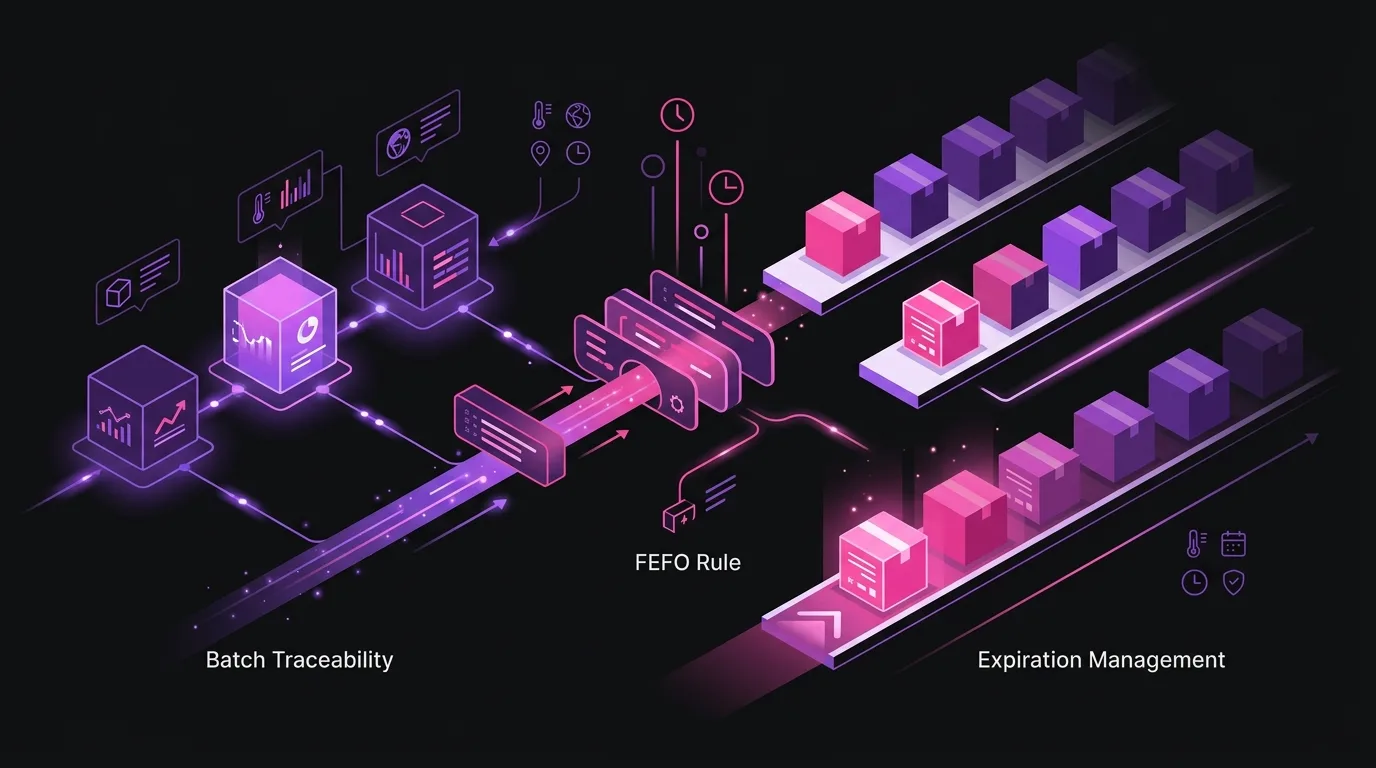
Odoo is not just invoicing software with a POS. For a food shop in Spain in 2026, it is the platform that connects legally required traceability, active expiry date management, weight-based sales, legal labelling and correct taxation in a single environment.
If you currently work with a combination of spreadsheets, basic POS and an external consultancy for taxes, you know the cost in time and errors that this entails. Odoo centralises everything and gives you real visibility over what happens in your business every day.
At Nextdoo, we are an official Odoo Enterprise partner in Spain and carry out implementations in food retail with all the particularities of the Spanish market. If you want to know what Odoo would mean for your specific shop, the first step is a no-obligation analysis call.
Indicative information. Actual timelines, costs and scopes are confirmed after a personalised analysis. JLM Business Solutions SL · B16842831.
Official sources:
- Regulation (EC) 178/2002 of the European Parliament and of the Council of 28 January 2002 · EUR-Lex
- Regulation (EU) 1169/2011 on the provision of food information to consumers · EUR-Lex
- Law 37/1992, of 28 December, on Value Added Tax · BOE
- Royal Decree 1007/2023 · BOE
- Official Odoo documentation · odoo.com/documentation
Frequently asked questions
Can Odoo manage traceability if I sell in several physical shops?
Yes. Odoo allows you to manage multiple locations from a single platform. Batch traceability works centrally: you can see which store each batch is in, how much has been sold at each point of sale, and what stock remains at each location. If there's a recall alert, you identify all affected points from a single query, without having to cross-reference different systems.
What happens if my supplier doesn't state the batch number on the delivery note?
Odoo allows you to create internal batches when the supplier doesn't provide them. In that case, the system generates its own identifier at the time of receipt. This covers the minimum requirements for internal traceability, although the ideal is always to record the manufacturer's batch to be able to respond fully to an external health alert from the AESAN or the supplier themselves.
Does Odoo comply with VeriFactu requirements for 2026?
Yes. Odoo's Spanish fiscal localisation adapts to the requirements of Royal Decree 1007/2023 on verifiable invoicing systems. For a new implementation in 2026, this point is configured from the outset. If you have Odoo installed from before, it's advisable to check with your partner that the version and configuration are aligned with the current regulations before the obligation comes into force.
Does expiry date management also work for products with a best-before date?
Yes. Odoo distinguishes between a strict expiry date and a best-before date. You can configure alerts and the FEFO rule independently for each product type. This way you apply different logics, for example, to fresh dairy products with a strict expiry date and to preserves or cereals with a best-before date. Each category is managed according to its actual nature.
Can I integrate Odoo with my current allergen management software?
Odoo can directly store allergen information in the product sheet without the need for external software, covering the 14 mandatory declarable allergens according to Regulation (EU) 1169/2011. If you already have a specific system with consolidated data, a data migration can be considered during implementation. The most efficient approach is usually to centralise all information in Odoo to avoid duplications and points of failure.
How is differentiated VAT managed at the point of sale?
Odoo automatically applies the VAT rate assigned to each product at the time of sale. The Spanish fiscal localisation includes predefined rates for food: super-reduced at 4% for bread, milk, eggs, fruit, and vegetables; reduced at 10% for other foodstuffs; and general at 21% for alcoholic beverages and other exceptions according to Law 37/1992. Models 303, 390, and 347 are generated directly from Odoo without external tools.
Frequently asked questions
What is batch traceability and why is it mandatory in food?
Batch traceability is the record of where each product comes from and to whom it is sold, required by Regulation (EC) 178/2002. It allows quick identification of which products are affected in case of a health alert and is mandatory for any food business in Spain.
What does the FEFO rule mean in expiry date management?
FEFO means 'First Expired, First Out': selling products that expire sooner first. Odoo automatically manages this order to prevent expired products from being sold and reduce losses due to spoilage.
How does selling by weight with a connected scale work in Odoo?
Odoo connects directly with electronic scales at the point of sale, automatically recording the weight, price, and batch data. This speeds up the sales process and eliminates manual errors for products such as fruit, vegetables, or meat.
What information must labelling include according to European regulations?
Regulation (EU) 1169/2011 requires the inclusion of ingredients, allergens, nutritional information, expiry date, and batch. Odoo automatically generates labels compliant with these regulations based on product data.
Do I need additional tools to manage the cold chain with Odoo?
No, Odoo natively includes temperature-controlled warehouse management, allowing you to control which products are in refrigerated chambers and alert if the cold chain is broken without the need for external software.