In summary. Odoo 19 natively integrates artificial intelligence across accounting, sales, inventory, and recruitment. For Spanish SMEs, the most relevant new features in 2026 are automatic invoice processing, assisted bank reconciliation, and VeriFactu compatibility. Migrating from previous versions requires planning, but the value it brings justifies the effort in most cases.
Odoo 19 is the most ambitious version the platform has launched to date. We're not talking about incremental improvements: we're talking about a qualitative leap in automation, user experience, and native artificial intelligence integration at the heart of the system. If you manage your business with Odoo, or are considering taking the step, this guide explains what changes, what improves, and what you should consider before updating.
Odoo 19 automates invoicing, bank reconciliation, and inventory management with native artificial intelligence for Spanish SMEs in 2026.
What new features does the artificial intelligence integrated into Odoo 19 bring?
Until now, any artificial intelligence functionality in an ERP was an external add-on: a third-party integration, a parallel tool, or a bespoke development. Odoo 19 breaks that logic. AI lives within the system, accesses your data with your session permissions, and operates from the same screens where you already work.
This is important because it eliminates friction. There's no need to export data, change tools, or learn a new platform. The assistant is there, in the form you already know.
The conversational assistant allows you to ask questions in natural language directly about your operations. You can ask who your highest-billing customers are in the quarter, which quotes have been lost in recent months and why, or ask it to generate a product description based on its characteristics. The system responds and, in many cases, can execute the action directly.
For a Spanish SME with a non-technical team, this is a real game-changer. There's no longer a need to know where the filters are or how to build a report. Just ask.
How does AI reduce manual work in accounting and improve control?
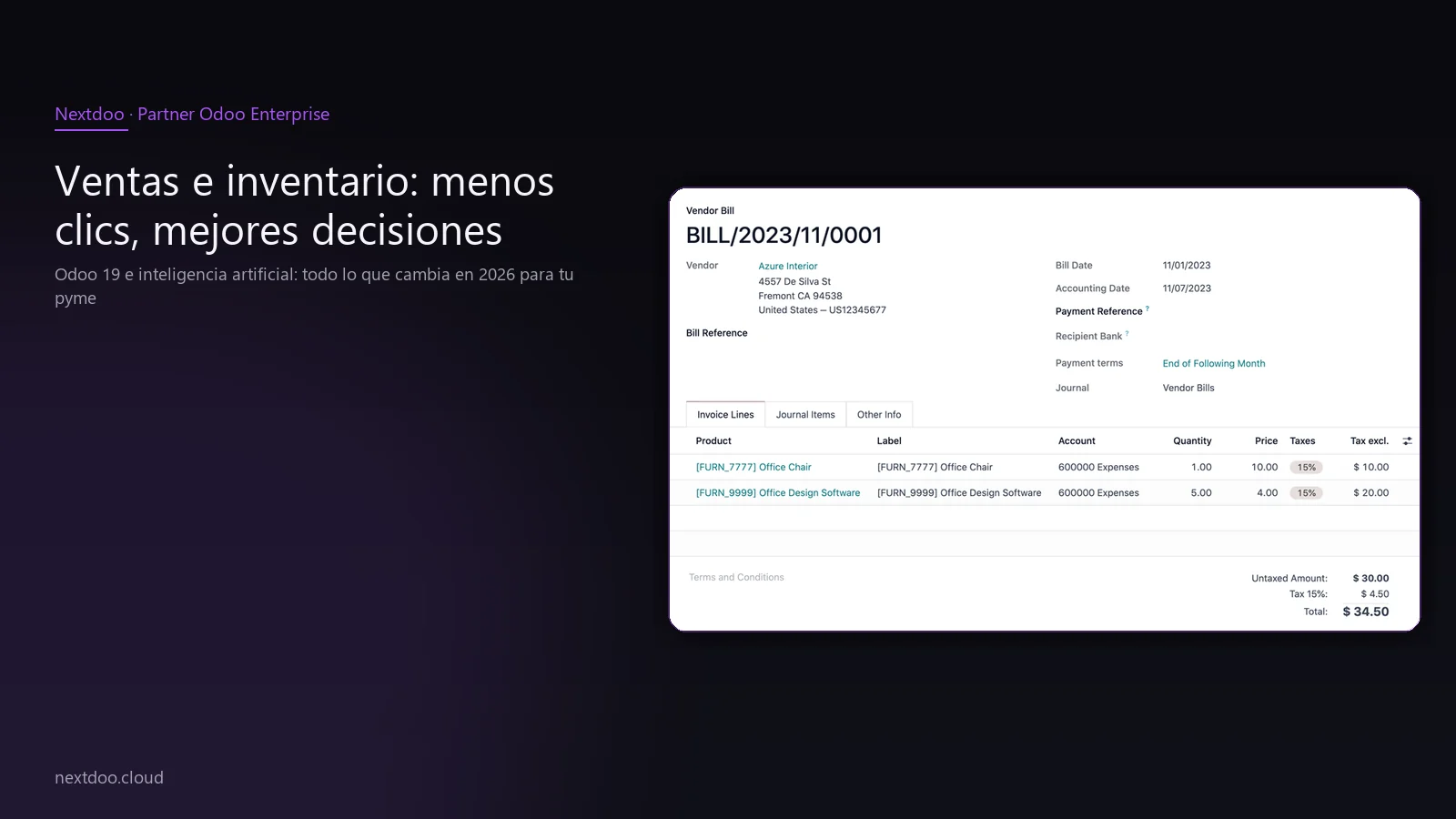
If there's one area where Odoo 19 makes an immediate difference for a Spanish company, it's accounting. The processing of received invoices becomes automatic: the system reads the PDF or image, detects the supplier, product lines, itemised VAT, totals, and date, and proposes the accounting entry without human intervention.
The accuracy level for invoices with standard Spanish format is high. Naturally, invoices with unusual formats or incomplete information require review, but the volume of administrative work is substantially reduced.
Bank reconciliation also improves. Odoo 19 analyses bank movements and compares them with pending entries, suggesting the most probable allocation. The accountant reviews and confirms, instead of searching and reconciling from scratch.
Regarding tax compliance, Odoo 19 strengthens compatibility with the requirements of the VeriFactu system that the Spanish Tax Agency is promoting for 2026. The generation of verifiable invoices, event logging, and data integrity are incorporated into the system's logic, not as an external patch.
Integration with TicketBAI for the Basque Country and Navarre is also maintained and improved, as is the generation of files for models 303, 390, and declaration 347, which continue to be common tax obligations for any Spanish company.
Sales and inventory: fewer clicks, better decisions
The quote creation process has been thoroughly redesigned. It is now possible to build a quote with a more visual and flexible interface, and the system can suggest product lines from a free-text description. Useful when the salesperson knows what the client needs but can't remember the exact item code.
Native integration with electronic invoicing is another relevant new feature. For Spain, this translates into direct compatibility with the formats required by current regulations, without the need to export to external tools.
In warehouse management, the system incorporates demand forecasting based on sales history. Odoo 19 analyses patterns and suggests replenishment before stock reaches critical levels. For retail or distribution companies, this avoids stockouts during periods of high demand without overstocking.
Customer returns are also managed more efficiently. The system automatically classifies the status of the returned product and suggests the appropriate processing flow: replenishment, review, or write-off.
Human resources: faster recruitment with AI
The human resources area incorporates automatic candidate analysis. When a job offer is published and CVs arrive, the system assesses the suitability of each candidate against the desired profile and sorts the results. The selection team still makes the decisions, but doesn't have to read dozens of documents from scratch to perform an initial screening.
To be clear: AI doesn't select people. It helps to prioritise human review. The final decision is always made by the team.
The management of absences, shifts, and performance appraisals also receives interface improvements that simplify daily operations for companies with medium-sized workforces.
What to expect when migrating from previous Odoo versions?
If your company already uses Odoo 17 or Odoo 18, the inevitable question is when and how to update. The answer depends on several factors.
From Odoo 18 to Odoo 19
It's the simplest leap. The data structure is compatible, information migration is straightforward, and the adaptation effort is moderate. If you don't have very complex bespoke developments, the process can be relatively quick. It's the cleanest scenario.
From Odoo 17 to Odoo 19
It requires more planning. The accumulated technical changes across two versions are greater: there are adjustments to the presentation layer and to compatibility with customised developments. If you also have integrations with external systems (POS, payment gateways, marketplaces), each one requires validation.
It's not a process that should be undertaken lightly or during peak season. The recommendation is to plan it during a period of lower operational activity.
When it's advisable to wait
There are situations where postponing migration is the most sensible decision:
- If your company is in an intense invoicing period or approaching a tax year-end.
- If you rely on bespoke developments or integrations that are not yet validated for Odoo 19.
- If your team cannot accommodate an adaptation period at this time.
Conversely, it makes sense to prioritise the migration if the volume of invoices you process is high and the automation of accounting OCR will save you real hours, or if your product catalogue is extensive and the automatic generation of descriptions results in a specific time saving.
What's removed or changes in an incompatible way
Each major Odoo version consolidates features that were previously independent and deprecates others. In Odoo 19, the most relevant changes for SMEs are:
- Document management is no longer a separate functionality: it's integrated into every area of the platform that needs it.
- Odoo Studio, the no-code customisation tool, is now available at no additional cost in Enterprise, albeit with a revamped interface. If you had customised views, they need to be reviewed.
- Some community developments (OCA addons) are pending updates. If you rely on a specific one, it's advisable to verify its status before planning the migration.
- The theme designer for the online shop becomes obsolete. Visual customisation will now be done by other means.
This is not a list of problems: it's a list of things that need to be checked. With planning, none of them are blockers.
Is Odoo 19 a good option for the Spanish SME in 2026?
Spain's fiscal and operational context in 2026 makes this update particularly relevant. The Spanish Tax Agency is advancing in the digitalisation of tax control with systems like VeriFactu. Companies already using Odoo 19 have the technical foundation to comply with these requirements without additional developments.
Furthermore, the pressure on operational efficiency doesn't let up. Spanish SMEs compete on tight margins, and any real reduction in administrative work — automatically processed invoices, reports generated without manual intervention, bank reconciliations resolved in minutes — has a direct impact on the profit and loss account.
Odoo 19 is not a promise of the future. It's a tool available now, with artificial intelligence functionalities that previously required costly and complex integrations, integrated as standard into the platform you already know.
The key lies in implementation. A well-planned migration, with a partner who understands the reality of Spanish SMEs and local tax requirements, makes the difference between an orderly process and one that creates more problems than it solves.
Conclusion: the question is not whether to migrate, but when

Odoo 19 is the platform's most significant leap in several years. For a Spanish SME already using Odoo, the question isn't whether it makes sense to update, but when is the best time to do so and how to ensure the process doesn't interrupt operations.
If you're not yet working with Odoo and are evaluating options for your company, Odoo 19 enters 2026 with a value proposition that's hard to match: an integrated platform, with native artificial intelligence, adapted to Spanish tax requirements, and with a consolidated support ecosystem.
From Nextdoo, as an official partner of Odoo Enterprise in Spain, we support SMEs in this process: from initial analysis to implementation and subsequent support. If you want to know what a migration or a new implementation implies for your specific case, the first step is a no-obligation chat.
Guidance information. Actual timelines, costs, and scopes are confirmed after a personalised analysis. JLM Business Solutions SL · B16842831.
Frequently Asked Questions
Is Odoo 19's artificial intelligence included in the Enterprise licence or does it incur additional cost?
Basic artificial intelligence functionalities, such as the conversational assistant and bank reconciliation suggestions, are included in the Enterprise licence. Some more advanced functionalities, such as bulk document processing or large-scale content generation, may require the use of external AI services with their own cost structure. In any case, an analysis of what is included and what isn't in your specific contract should be performed before planning the migration.
Does Odoo 19 comply with VeriFactu requirements and Spanish tax regulations for 2026?
Odoo 19 incorporates the technical basis for VeriFactu compliance: event logging, data integrity, and generation of verifiable invoices according to the criteria of the Spanish Tax Agency. It also maintains integration with TicketBAI for the Basque Country and Navarre, and the generation of necessary files for common models such as 303 or 347. That said, tax compliance also depends on the correct configuration of the system for each specific company.
Can I continue using Odoo Community instead of Enterprise and take advantage of the AI new features?
Odoo 19's native artificial intelligence functionalities are exclusive to the Enterprise version. In Community, it's possible to integrate external AI tools via bespoke developments, but you don't get the integrated experience or official Odoo maintenance. For an SME that wants to take advantage of these functionalities without incurring the cost of additional developments, Enterprise is the option that makes the most sense.
I have Odoo 17 with bespoke developments. What's the real risk of migrating to Odoo 19?
The main risk is the incompatibility of bespoke developments with the accumulated technical changes between versions. It's not an insurmountable problem, but it requires prior analysis: each customisation needs to be reviewed, what needs adapting identified, and the work planned before touching the production environment. Doing so without that prior analysis is the most common mistake. With a partner who knows the platform well, the process can be managed with confidence.
How long does a migration to Odoo 19 take for a medium-sized company?
There's no standard timeframe applicable to all cases. It depends on the volume of data, the complexity of bespoke developments, the number of integrations with external systems, and the internal team's availability for testing. What is certain is that attempting to accelerate it without adequate planning usually generates issues in production. Prior analysis is the most cost-effective investment in the entire process.
Does Odoo 19 work well in Spanish and with Spain's tax configuration?
Yes. Odoo has maintained Spanish localisation for years, which includes the Spanish chart of accounts, VAT models, IRPF withholdings, and standard declaration formats. The artificial intelligence functionalities also operate correctly in Spanish, both for document comprehension and text generation. The Spanish localisation is one of the most comprehensive in the Odoo ecosystem.
Frequently Asked Questions
What are the main changes Odoo 19 brings for my company's accounting?
Odoo 19 incorporates native artificial intelligence which automates invoice processing and performs assisted bank reconciliation. This significantly reduces manual work in repetitive accounting tasks and improves control over your finances.
Is it mandatory to migrate to Odoo 19 in 2026 to comply with VeriFactu?
Odoo 19 includes enhanced compatibility with VeriFactu and other Spanish tax requirements for 2026, but whether it's mandatory depends on your specific tax situation. It is advisable to plan the migration in good time to ensure regulatory compliance.
How much time and resources do I need to migrate from an older version of Odoo?
Migration requires prior planning, but the time varies depending on your company's size and the complexity of your processes. The initial effort is quickly offset by savings in manual work and improved decision-making.
How does Odoo 19 improve sales and stock management?
Integrated artificial intelligence reduces the number of manual actions required and provides more accurate recommendations for stock management and business decisions. This allows your team to focus on strategic tasks instead of repetitive ones.
What advantages does AI bring to human resources within Odoo 19?
Odoo 19 streamlines the recruitment process through artificial intelligence that assists in candidate evaluation and recruitment process management. This allows your human resources team to be more efficient in talent identification.