In summary. There are over 120 Odoo partners in Spain and they all promise the same thing. The criteria that really matter are demonstrable experience in your sector, an in-house technical team without subcontracting, a project methodology with real commitments, a fixed budget with a defined scope, and post-go-live support. The certification level (Ready, Silver, Gold) measures commercial volume, not quality. Ask for contactable references from companies similar to yours before signing anything.
There are over 120 certified Odoo partners in Spain. They all have nice websites, success stories with screenshots, and a famous client on the homepage. The problem is that when you get to the meeting, most sell you the same thing using different words. This guide gives you the real criteria to distinguish those who know from those who improvise.
Selecting an Odoo partner in Spain requires evaluating sector experience, an in-house technical team, a clear methodology, and post-implementation support, beyond commercial promises.
What is an Odoo partner and why isn't the certification level everything?

An Odoo partner is a company authorised by Odoo S.A. to implement, adapt, and support the software. Certification has three levels: Ready, Silver, and Gold. The Gold level indicates a higher volume of business with Odoo, not higher service quality or greater project success.
A Gold partner with 200 implementations in large corporations can be a disaster for a hospitality SME with 15 employees. And vice versa: a Silver partner specialising in your sector can give you exactly what you need, with less friction and more local knowledge.
What certification measures is volume and commercial commitment to Odoo S.A. What measures the real quality of the partner is something else: the history of projects similar to yours, contactable references, and the honesty with which they manage expectations from day one.
So when someone tells you “we are a Gold partner”, ask the following: How many projects in my sector? Can I speak to any of those clients? The answer to those two questions is worth more than any badge on the website.
How to evaluate a partner's demonstrable sector experience?
Odoo is a generalist system. That's an advantage and also a trap. A partner who has been implementing Odoo for years in law firms knows nothing about how to manage a retail warehouse or how to reconcile the inventory of a restaurant chain. The software is the same; the business knowledge is not.
Before discussing price, ask how many projects they have completed in your specific sector. Not “similar projects”. Your sector. If you have a motorcycle dealership, ask about dealerships and motor shops. If you have a chain of shops, ask about multi-site retail. If you have a restaurant with a central kitchen, ask about hospitality and distribution.
Ask for real references. A good partner has no problem giving you the name and phone number of a similar client. If they hesitate, if “they need to check”, if they send you a PDF with logos but no contact details for contact, it's a warning sign.
References are the cheapest and most reliable proof you have. A twenty-minute call with another business owner who has gone through the same process will save you months of pain.
In-house technical team versus covert subcontracting
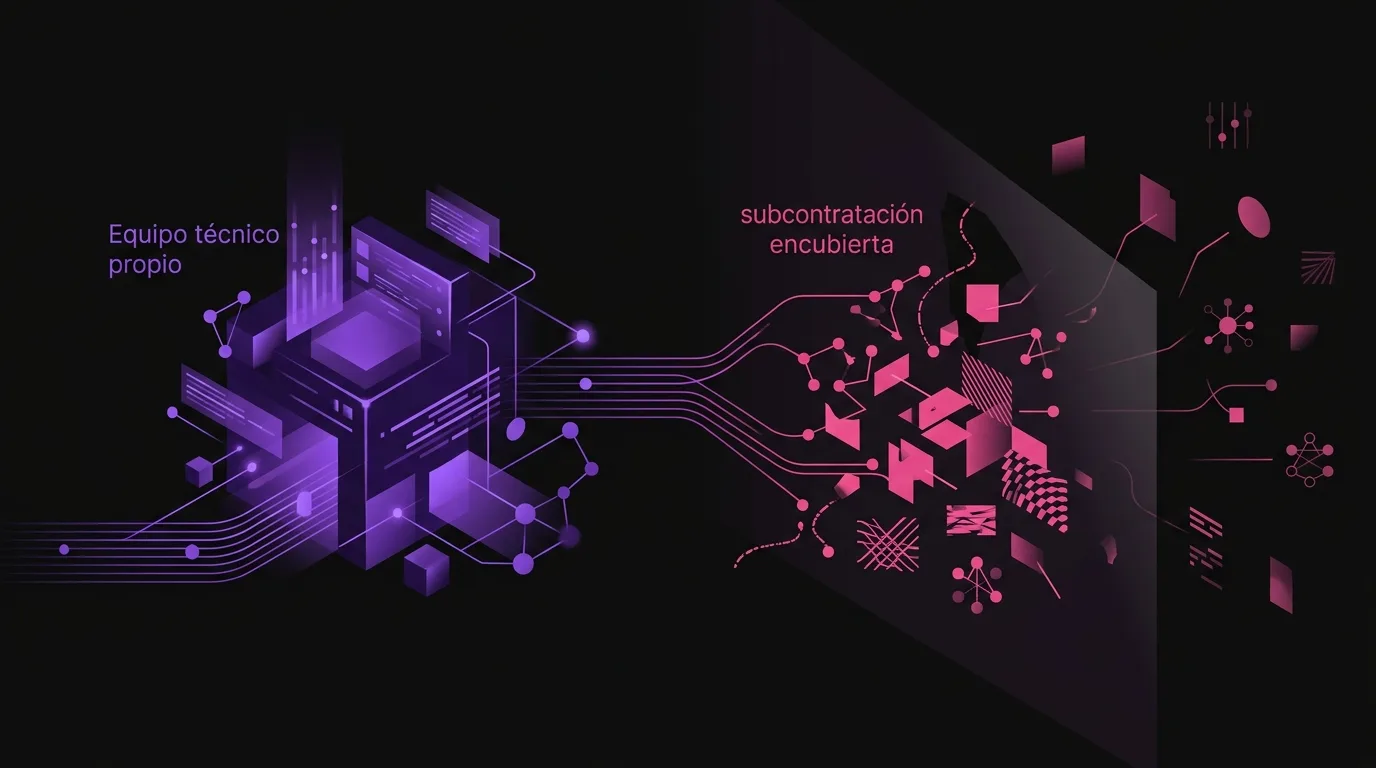
This point is uncomfortable but necessary. Some partners in Spain do not have their own technical team. They sell the project, manage the client, and subcontract the development to freelancers or another company. In the best-case scenario, that adds a layer of communication that slows everything down. In the worst-case scenario, the day the freelance disappears, your project is left without support.
Ask directly: How many Odoo certified technicians do you have on staff? Who will be my technical contact during the project? And after go-live?
If the answer is vague or changes from one meeting to another, assume there is subcontracting. It's not necessarily an insurmountable problem, but you need to know about it to assess the risk and demand the corresponding contractual guarantees.
An in-house team also means continuity. If there's an incident six months after implementation, you want it resolved by someone who knows your project, not someone seeing it for the first time.
What to ask about the technical team
- How many certified technicians do you currently have on staff?
- Who will lead my project from start to finish?
- Is there an assigned functional consultant, or does the technician also perform that role?
- If the assigned technician leaves the company, what protocol do you follow?
- How do you document the project so that any team member can take it over?
Project methodology: paper will bear anything
Any partner can present you with a PowerPoint showing phases, milestones, and deliverables. What differentiates a solid partner is that this PowerPoint turns into a contract with real commitments, and that during the project there is someone who provides you with weekly follow-up.
A serious implementation methodology includes at least these phases: initial business analysis, scope definition, configuration and customisation, team training, controlled testing before launch, and support in the period after launch.
What you should watch out for is the gap between the commercial proposal and the project's reality. Ask how they manage scope changes. What happens if, during implementation, you identify a need not included in the initial budget. How that change is documented and approved. A serious partner has a clear process for this. One who improvises will tell you, 'we'll see as we go along'.
Also ask what tools they use for project management and if you will have access to them. Seeing in real time what phase your implementation is in, which tasks are open and which are closed, is a sign of transparency that makes a difference.
Signs of a real methodology versus a paper one
- They have a pre-analysis template that they complete with you, not a generic proposal.
- The scope is defined in writing before signing, detailing what is included and what is not.
- There is a named project manager assigned from day one.
- Deliverables are dated and verifiable, not vague descriptions.
- There is a validation protocol at each phase before moving to the next.
What is the difference between a fixed-price budget and an hour bank?
The hourly pricing model might seem flexible. In reality, it shifts all financial risk to the client. If the partner takes longer than expected, you pay more. If a new need arises, you pay more. If something needs to be repeated because it wasn't done correctly, you pay more.
A fixed-price budget with a defined scope gives you predictability. You know what you will pay. If the partner has to invest more time than expected due to their poor estimation, that cost is theirs, not yours.
That doesn't mean a fixed-price project cannot have modifications. It will have them, especially if, during the analysis, needs arise that were not identified at the beginning. But these modifications must be managed with a formal change order, signed by both parties, before being executed. Not as a surprise on the final invoice.
When comparing quotes, check what each item includes. Team training, post-launch support, system documentation: these elements have a real cost. If a quote doesn't mention them, it's not that they're free. It's that they will appear later as an extra.
Post-go-live support: where most fail
Implementation is the beginning, not the end. The most critical time for any company starting with Odoo is the first few weeks of real use. That's when doubts that didn't arise during training appear, exceptional cases not covered in the analysis, and the small adjustments that make the system truly work for your operations.
Ask what support the project includes after go-live. Not in vague terms. In detail: what communication channel, at what times, what type of incidents it covers, what response time is reasonable to expect, for how long.
Weak or non-existent post-implementation support is one of the most frequent causes of failure in ERP implementations. The team doesn't adopt the system because they don't have anyone to ask when something doesn't work as expected. And a system that the team doesn't use is money wasted.
Also ask what happens when the included support period ends. What ongoing maintenance options they offer, how Odoo version updates are managed, and who is responsible for ensuring the system is always in optimum condition.
What are the warning signs you should take seriously?
There are behaviours during the sales phase that anticipate project problems. Learn to recognise them before signing.
- “We are the number one partner in Spain”: At least five different partners claim this. Ask for the specific criteria by which they measure themselves.
- They cannot provide you with contactable references from your sector: If they have done projects like yours, there's no reason why you shouldn't be able to speak to one of those clients.
- The proposal arrives within forty-eight hours without a serious pre-analysis having been carried out: A quote without analysis is a blind estimate that will change.
- Training is not included in the quote: Team training is part of the implementation, not an extra.
- They respond to all your needs with ‘that can be customised’ without specifying how or what the cost is: Every customisation has a cost and an impact on future maintenance.
- The sales contact and the technical contact are different people who have not met with you together: The salesperson sells what the technician will have to execute. If they are not aligned from the beginning, the project starts with a gap.
Why Nextdoo and what differentiates us in practice
Nextdoo is an official Odoo Enterprise partner in Spain, specialising in retail, hospitality, and SMEs that need a real system that works from day one, not in six months.
Our proposal is based on three specific commitments. Firstly, honest pre-analysis: before submitting a quote, we understand your business. If Odoo isn't the right solution for you at this time, we'll tell you. Secondly, fixed scope: the quote you sign is what you pay, with no surprises for changes you haven't approved. Thirdly, training and support included: implementation doesn't end when the system goes live. It ends when your team uses it proficiently.
We work with our own technical team, without subcontracting. Each project has an assigned consultant who knows it from start to finish. And we have demonstrable experience in the sectors where most Spanish companies have specific needs that a generic ERP alone cannot resolve.
If you are evaluating partners, we invite you to ask us the same questions we have recommended you ask in this guide. References from your sector, project methodology, what post-implementation support includes. The answers will tell you if we are a good fit.
Frequently asked questions
How long does an Odoo implementation take for a Spanish SME?
It depends on the scope, business complexity, and the company's internal level of preparation. A well-defined project for an SME with standard needs can be resolved within a reasonable timeframe. Projects that are unduly prolonged are usually due to inadequate pre-analysis or unmanaged scope changes. A good partner will give you an indicative timeframe based on a real analysis, not a generic estimate.
Is a local partner or a national one better?
Location matters less than sectoral specialisation and responsiveness. A partner from Barcelona can work perfectly with a company in Seville if they have good remote working processes. What is worth assessing is whether they are available for in-person visits during critical project phases, such as the launch or initial training.
What is the difference between Odoo Community and Odoo Enterprise?
Odoo Community is the free open-source version. Odoo Enterprise is the paid licensed version that includes additional functionalities, guaranteed updates, and official support from Odoo S.A. For an SME in Spain that needs to comply with tax obligations such as VeriFactu or TicketBAI, the Enterprise version offers specific adaptations that the Community version does not natively cover. An official partner like Nextdoo works with Odoo Enterprise.
Can I migrate to Odoo from another system without losing my historical data?
Yes, it is possible to migrate historical data from most management systems. The complexity and cost of that migration depend on the volume of data, its quality, and the format in which it is stored. A pre-migration analysis is essential before committing to a scope and budget. The most common data migrated includes customers, suppliers, products, and invoice history.
What happens if we identify new needs during implementation?
It is common for needs to emerge during the process that were not detected in the initial analysis. A serious partner manages these changes through formal change orders: a written document with a description, impact on timeframe and cost, signed by both parties before execution. Be wary of anyone who adds functionalities without documenting them, because that breaks the agreed scope and can become a source of conflict.
Does Nextdoo work with companies from any sector or only in retail and hospitality?
Nextdoo has demonstrable specialisation in retail, hospitality, and the motorcycle and vehicle sector, but works with Spanish SMEs from various sectors when the project fits with our methodology. The best way to find out is with an initial call where we analyse if we can bring you real value. If we are not the right partner for your case, we tell you upfront.
Conclusion: choose wisely, not based on the lowest price
Choosing an Odoo partner in Spain is not a decision made in twenty minutes by comparing quotes in an Excel spreadsheet. It is a decision that affects how your company will operate for the coming years.
The criteria that matter are demonstrable sectoral experience, the in-house technical team, the project methodology with real commitments, the fixed-scope pricing model, and post-launch support. The certification level is an initial filter, not a guarantee.
Ask the uncomfortable questions. Ask for references and call them. Demand a preliminary analysis before signing anything. And if a partner is unwilling to answer your questions transparently, you already have the answer you need.
If you want to talk to Nextdoo, without sales pressure and with all cards on the table, you can request a free demo. We tell you what we can and cannot do for your company. No nonsense.
Indicative information. Actual timelines, costs, and scopes are confirmed after a personalised analysis. JLM Business Solutions SL · B16842831.
Frequently asked questions
How long does an Odoo implementation take for a Spanish SME?
It depends on the scope, business complexity, and the company's internal level of preparation. A well-defined project for an SME with standard needs can be resolved within a reasonable timeframe. Projects that are unduly prolonged are usually due to inadequate pre-analysis or unmanaged scope changes. A good partner will give you an indicative timeframe based on a real analysis, not a generic estimate.
Is a local partner or a national one better?
Location matters less than sectoral specialisation and responsiveness. A partner can work perfectly well with a company in another city if they have good remote working processes. What is worth considering is whether they have availability for in-person visits during critical project phases, such as the kick-off or initial team training.
What is the difference between Odoo Community and Odoo Enterprise?
Odoo Community is the free open-source version. Odoo Enterprise is the paid licensed version that includes additional functionalities, guaranteed updates, and official support from Odoo S.A. For an SME in Spain that needs to comply with tax obligations such as VeriFactu or TicketBAI, the Enterprise version offers specific adaptations that the Community version does not natively cover. Nextdoo works exclusively with Odoo Enterprise.
Can I migrate to Odoo from another system without losing my historical data?
Yes, it is possible to migrate historical data from most management systems. The complexity and cost of that migration depend on the volume of data, its quality, and the format in which it is stored. A pre-migration analysis is essential before committing to a scope and budget. The most common data migrated includes customers, suppliers, products, and invoice history.
What happens if we identify new needs during implementation?
It is common for needs to emerge during the process that were not detected in the initial analysis. A serious partner manages these changes through formal change orders: a written document with a description, impact on timeline and cost, signed by both parties before execution. Be wary of anyone who adds functionalities without documenting them, as this breaks the agreed scope and can become a source of conflict at the end of the project.
Does Nextdoo work with companies from any sector or only in retail and hospitality?
Nextdoo has demonstrable specialisation in retail, hospitality, and the motorcycle and vehicle sector, but works with Spanish SMEs from various sectors when the project fits with their methodology. The best way to find out is with an initial call where they analyse if they can bring you real value. If they are not the right partner for your case, they tell you upfront.