
'How soon can I get it up and running?' is one of the first questions when considering Odoo, and the honest answer is: it depends on the scope. But 'it depends' doesn't help with decisions, so here are real ranges by project size, what truly extends timelines, and how they can be shortened without risking the launch.
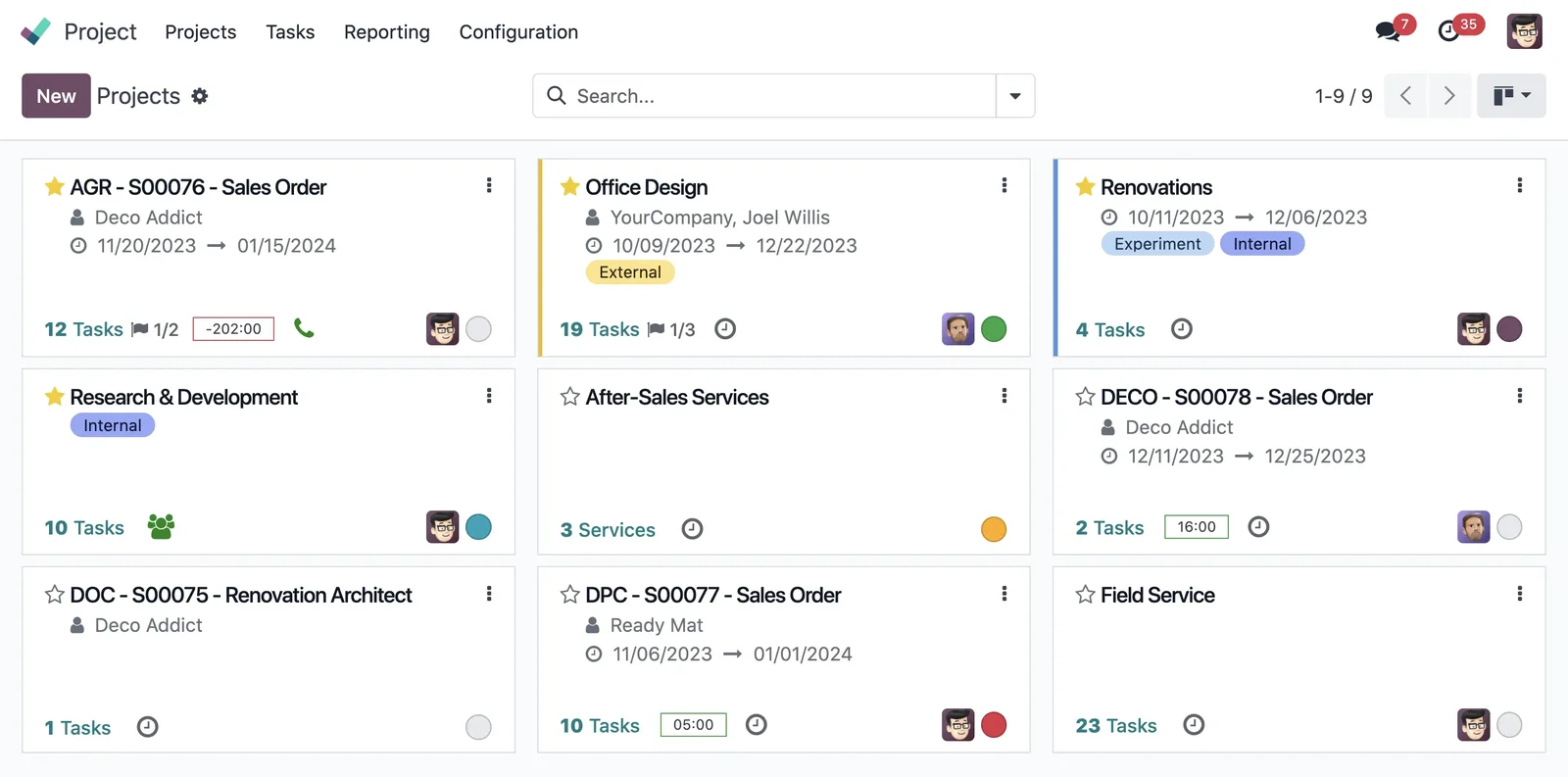
En 30 segundos. Odoo implementation time: real project deadlines by size. Discover what prolongs projects & how to shorten them without risking a smooth go-live. A Nextdoo guide.
Indicative timelines by project size
| Project type | Indicative timeline | What it includes |
|---|---|---|
| Simple implementation | 4 – 8 weeks | Sales, basic inventory and invoicing in one company |
| Medium project | 2 – 4 months | Several areas, data migration and some customisation |
| Complex project / multi-company | 4 – 6 months or more | Manufacturing, multi-warehouse, integrations, several companies |
Indicative and non-binding ranges; the actual timeline comes from a diagnosis of your case.
What truly extends an implementation
- Dirty data. Duplicate catalogues, unmatched balances or unpurified customers. Cleaning before
migrating saves weeks; migrating without cleaning multiplies them.
- Over-customising at the beginning. Each adaptation outside the standard adds analysis time,
development and testing. We cover it in Odoo implementation.
- Delayed decisions. If no one on the team can validate, the project stops. An
internal person responsible with decision-making authority is what maintains the pace.
- Scope creep mid-way. Adding modules on the fly reopens already closed phases.
How to shorten the timeline without risking the launch
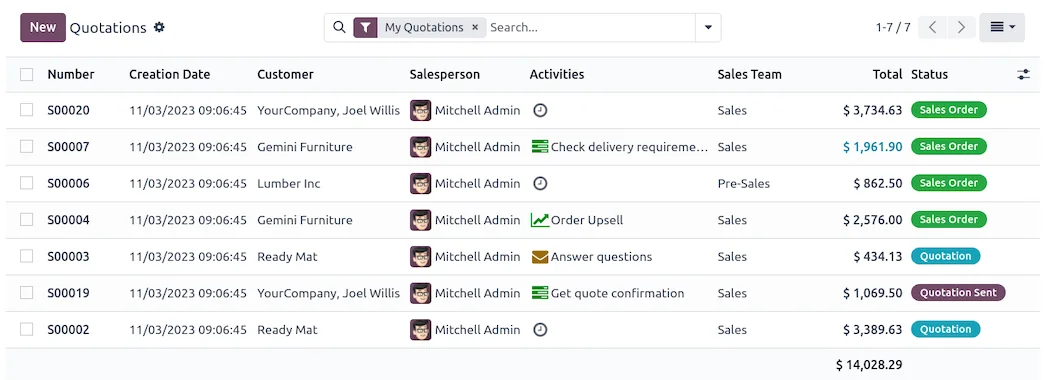
- Start with the minimum viable product and expand in phases. You can find the details in our guide to
progressive implementation.
- Configure standard first, customise only where it adds value.
- Prepare the data in parallel with the configuration, not at the end.
- Train before go-live, not on the same day.
- Work with a partner who already has a well-established process. See
how to choose an Odoo partner.
Timeline and cost go hand in hand
A longer project usually means a broader scope, and therefore more investment. If you want to compare both variables, look at how much Odoo costs: you’ll see that starting with a limited scope not only shortens the timeline, but also spreads the cost.
What you can have up and running in the first month
In a well-scoped project, the first month isn't just preparation: it already gets things working. It's common to have the core sales and invoicing operational, the catalogue loaded and the initial inventory reconciled, and the team practising with real data. Not everything will be ready —full accounting, ecommerce, or manufacturing come later— but the business will already be invoicing from Odoo. This early start is also what sustains team motivation: seeing results quickly makes the rest of the project feel less burdensome.
Why two projects of the same size take different amounts of time
Two similar companies can have very different timelines, and it's almost never due to Odoo. The most critical variable is the quality of the source data: a company with an organised catalogue and balances progresses smoothly, while another with duplicated or incomplete data spends weeks just on data cleansing. The second variable is internal availability: if the decision-maker is contactable, the project doesn't stop; if not, every query slows it down. That's why preparing data and appointing a responsible person shortens timelines more than any technical shortcut.
What a typical week during implementation is like
Knowing how long it takes helps, but understanding how the work is distributed helps more, because that way you see what is expected of you and why your availability influences the timeline so much.
A typical week combines three things. First, work sessions with the partner —usually one or two per week— where decisions are made and configuration is done live. Second, tasks on your side: cleansing a part of the catalogue, validating migrated data from an area, or reviewing that a workflow reflects how you work. And third, testing: as configuration progresses, someone from your team checks that what has been set up works with real-world cases. The more agile this internal validation is, the faster everything progresses; when tasks on your side accumulate undone, the project stalls even if the partner has capacity.
Therefore, rather than just asking «how long does it take?», it's better to ask «what do you need from me each week?». A project where the client sets aside a couple of fixed hours per week progresses much faster than one where no one has time until the end. If you want to be prepared for these sessions, review what you need to implement Odoo.
Beware of 'Odoo in two weeks' promises
You see messages about lightning-fast implementations on the market, and it's wise to read them critically. It's true that a very simple and data-ready set-up can start quickly, but «having Odoo installed» is not the same as «having the business running well on Odoo». A rushed go-live that overlooks correct data migration, team training, or tax configuration often results in weeks of corrections afterwards, when you're already in production and every error comes at a high cost.
The useful question isn't «what's the shortest possible timeline?», but «what's a realistic timeline for my team to work well and without surprises?». A good partner will give you an honest range after looking at your case, not a round figure from a brochure. And if the promised timeline seems too good to be true, it almost always means something is being cut that you'll pay for later: unverified data, minimal training, or a standard configuration that doesn't quite fit how you work.
Going fast is fine; going fast by skipping migration, testing, and training isn't going fast, it's postponing the problem. That's why the phased approach, which starts early with the essentials and expands judiciously, usually beats the promise of having «everything ready» within an impossible timeframe.
How to ask your partner for a reliable timeline
When you ask for a quote, the way you ask significantly changes the quality of the answer. Instead of «how long will it take?», which invites a brochure figure, ask for a phased timeline: how long to get the essentials working, how long for the next stage, and what each timeline depends on. A serious answer will come with conditions —«if the data is prepared», «if the team dedicates a few hours a week»— because these conditions are what truly dictate the pace.
Be wary of anyone who gives you an exact date without having seen your data or processes: they're either inflating the price to cover themselves, or cutting corners you'll pay for later. A good partner prefers to give you an honest range and adjust it after a quick diagnosis. And always ask what happens if the timeline extends: how it's managed, if there's an extra cost, and how it's avoided. That conversation, uncomfortable at first, is the best sign that the project is well-planned from the outset.
Frequently asked questions
How long does it take to implement Odoo in an SME?
A simple set-up usually takes between 4 and 8 weeks. A project with several areas and migration takes between 2 and 4 months. This is determined by the modules, the data, and the team's availability.
Can Odoo be up and running in a month?
In simple and well-prepared cases, yes: sales, basic inventory, and invoicing. The condition is to start with a limited scope and have the data ready.
What prolongs the project the most?
Dirty data and customising before having used the standard. Both are avoided with preparation and a phased approach.
Does working with a partner shorten timelines?
It usually shortens them, because the process is already well-established and errors that force phases to be redone are avoided. The key is that the internal team is also available.
Do you want to know how long it would take to get Odoo up and running?
At Nextdoo, an official Odoo partner, we give you a realistic timeline after a quick diagnosis of your case. Start with the Odoo implementation.
Source: official Odoo documentation. Indicative and non-binding timelines, subject to variations.
Sources
Official sources consulted: official Odoo documentation and Spanish Tax Agency's e-office (VeriFactu). Cost and timeline figures are indicative and non-binding, subject to variations depending on the project.