In summary. An Odoo B2B e-commerce displays each customer's negotiated prices, their specific catalogue, and their deferred payment terms. Each order confirmed by the customer automatically generates the delivery note, invoice, and warehouse movement without manual intervention. If you sell to distributors, wholesalers, or professionals and manage these sales via email or phone, Odoo's B2B portal eliminates that administrative work and gives your customers real autonomy.
If you sell to other businesses —distributors, retailers, professionals, franchised stores— you know that a standard B2C e-commerce won't work for you. Your customers don't want to pay by card instantly, they don't want to see the public price, and certainly don't want to add a hundred items to their basket one by one. They need a portal designed for the existing commercial relationship between you.
Odoo solves this at its root, because B2B e-commerce is not a last-minute add-on module: it is the natural consequence of having the ERP, CRM, warehouse, and invoicing unified under a single system. In this article, we explain what differentiates a real B2B e-commerce from a generic one, how Odoo manages it, and why this is especially important if you run a Spanish SME with an active distribution network.
Odoo automates B2B sales management, allowing each customer to view their negotiated prices, personalised catalogue, and place recurring orders without manual intervention.
What makes B2B e-commerce different?
Business-to-business commerce has its own logic. There isn't a single price for everyone, immediate payment is not the norm, and the customer relationship doesn't start at the basket: it begins weeks or months before, when conditions, discounts, and terms are negotiated.
A conventional B2C e-commerce —or a generic platform like Shopify or WooCommerce without deep personalisation— is not prepared for this. It can sell to the end consumer efficiently, but the moment you introduce customer-specific rates, restricted catalogues, or deferred orders, the patches begin: plugins, manual integrations, spreadsheets that someone updates every Monday.
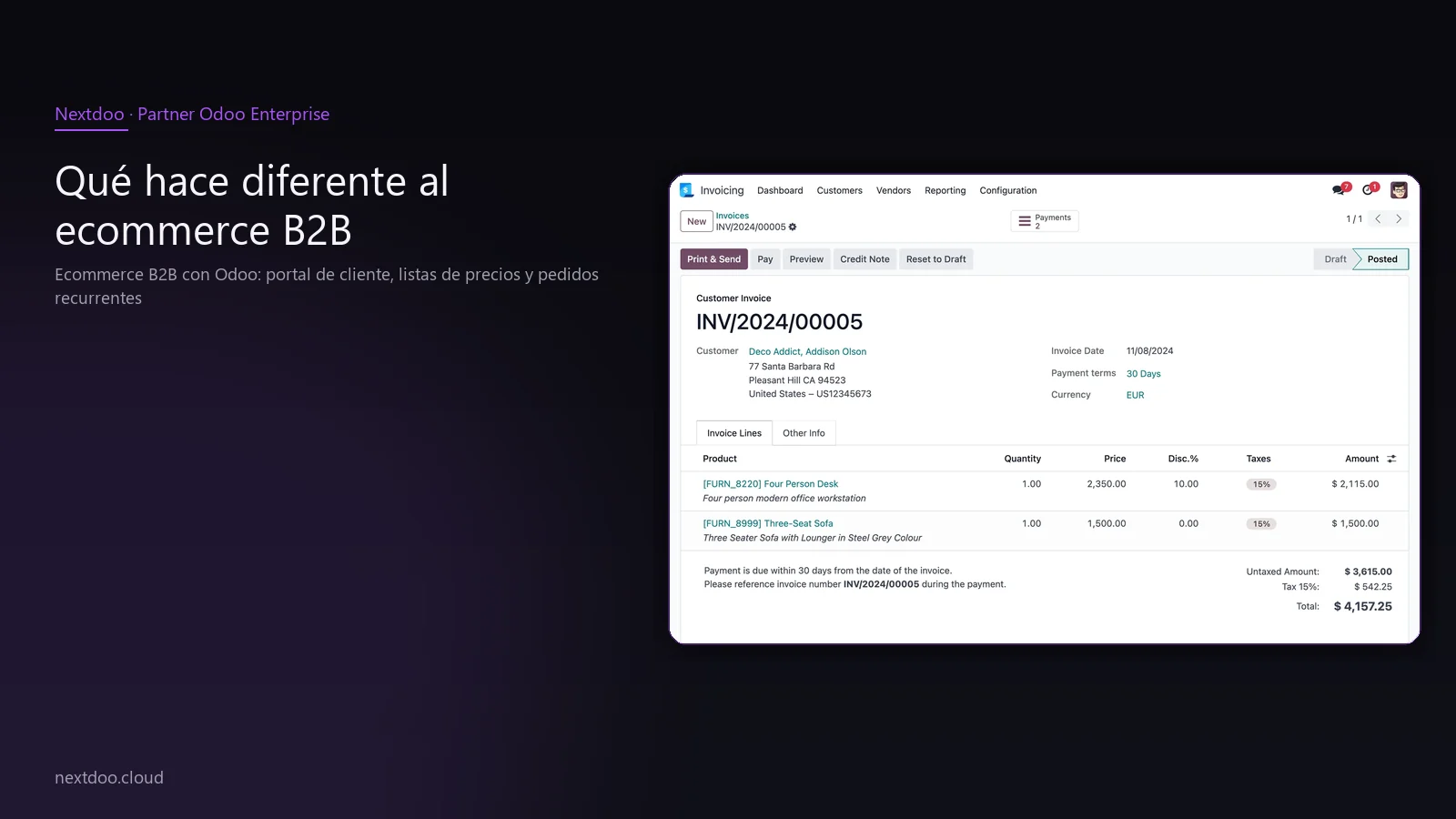
Real B2B e-commerce requires the online store and the management system to speak the same language from the very first click. If the price the customer sees on the website is not exactly what they have in their contract, you lose credibility. If the order placed online doesn't automatically reach the warehouse, you lose time. If the invoice isn't generated automatically with its payment terms, you lose money on administrative management.
That is precisely what differentiates an integrated solution like Odoo from setting up an e-commerce on one side and an ERP on the other.
What are the key functionalities your B2B portal needs?
Personalised prices by customer or group
In B2B, the price is confidential and negotiated. Your northern distributor doesn't need to see what the southern wholesaler pays. Odoo manages this through price lists assigned to each customer or customer group. When that customer enters the portal, the system automatically displays their rate: without manual intervention, without risk of error.
You can define volume prices —beyond a certain quantity, the price drops— and also seasonal or campaign prices. Everything is configured from the same place where you manage your usual sales. There isn't a separate database for the shop and another for the ERP: they are one and the same.
Restricted catalogue by customer
Not all your customers should see all your products. A motorcycle spare parts distributor only needs to see their brand's catalogue. A chain of franchised stores should only be able to order the items from their supply agreement. Displaying the full catalogue creates confusion, incorrect orders, and more work for the sales team.
With Odoo, you can restrict which products each customer or customer group sees. The portal automatically filters the catalogue as soon as the customer logs in. No customer will see what is not relevant to them.
Deferred payment terms
Payment at 30, 60 or 90 days is the norm in many Spanish B2B sectors. A generic e-commerce platform only understands immediate payment: card, Bizum, or instant bank transfer. That doesn't fit with the reality of wholesale distribution.
Odoo applies the customer's payment terms directly to the online order. If a customer has agreed to 60-day payment, their order in the portal generates an invoice with that due date. Without anyone having to manually modify it afterwards.
Order approval workflows
In many B2B businesses, an order above a certain amount requires internal validation before being processed. Odoo allows approval rules to be configured: if the order exceeds a threshold, it remains in pending status until an authorised person approves it. This is especially useful when the customer is a large company with multiple buyers with different levels of autonomy.
The workflow is transparent for the customer: they see the status of their order in real-time from the portal.
The B2B customer portal: what they see and what they can do
Odoo's customer portal is not a static page with orders in PDF. It is an active workspace where the customer can manage the entire commercial relationship with you without needing to call or send emails.
From the portal, the B2B customer can:
- Consult their complete order history, with status updated in real-time.
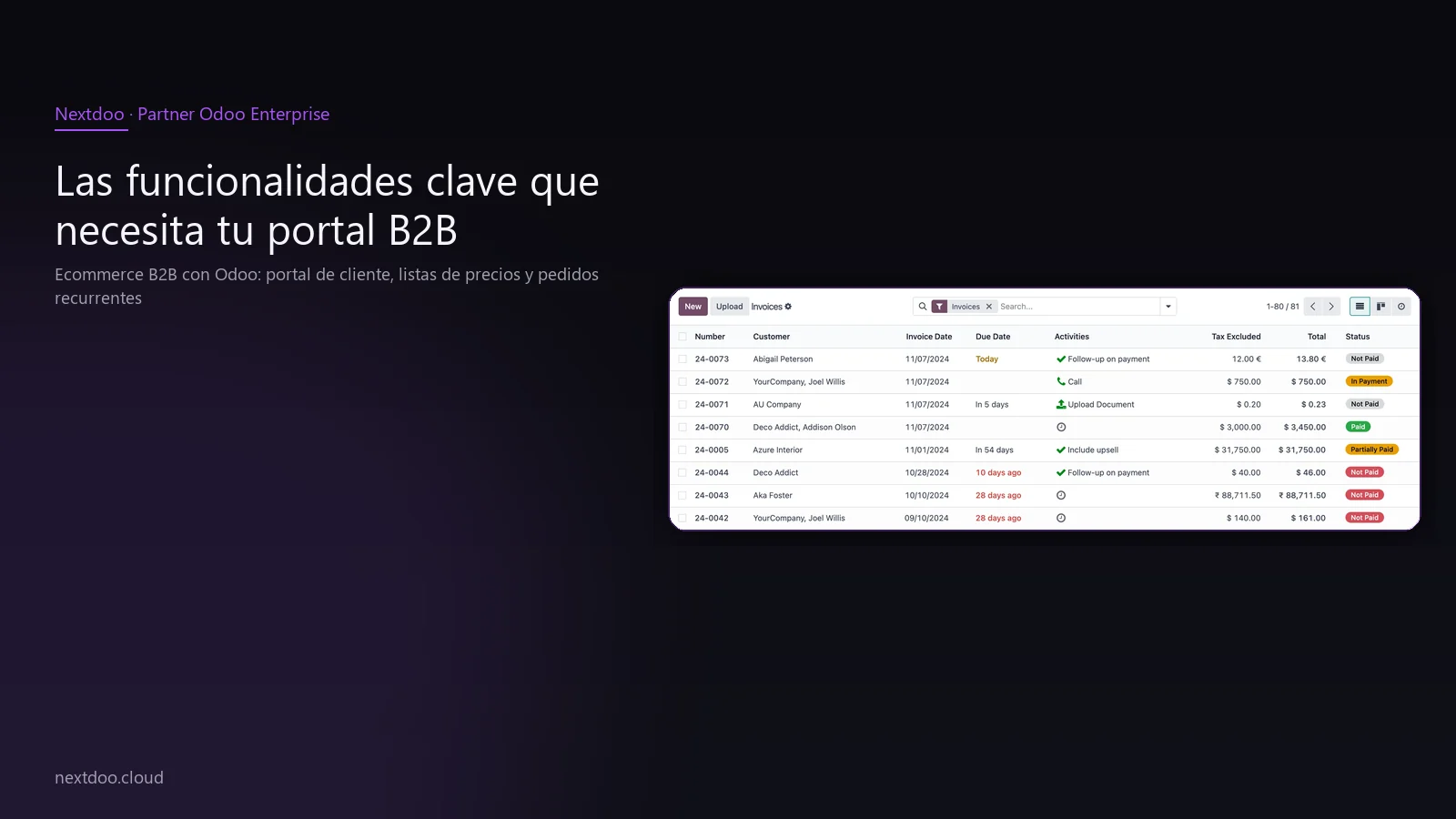
- Download invoices and delivery notes whenever they need them.
- Repeat a previous order with a single click, without having to search for items again.
- Place a new order with their assigned catalogue and prices.
- Upload a file with references and quantities for large orders, without adding product by product.
- Check the status of their payments and outstanding due dates.
This drastically reduces calls to the customer service department and emails like «Can you send me March's invoice?». The customer has access to everything they need, always up-to-date, because the data comes directly from the ERP.
Are recurring orders the ultimate argument for distribution?
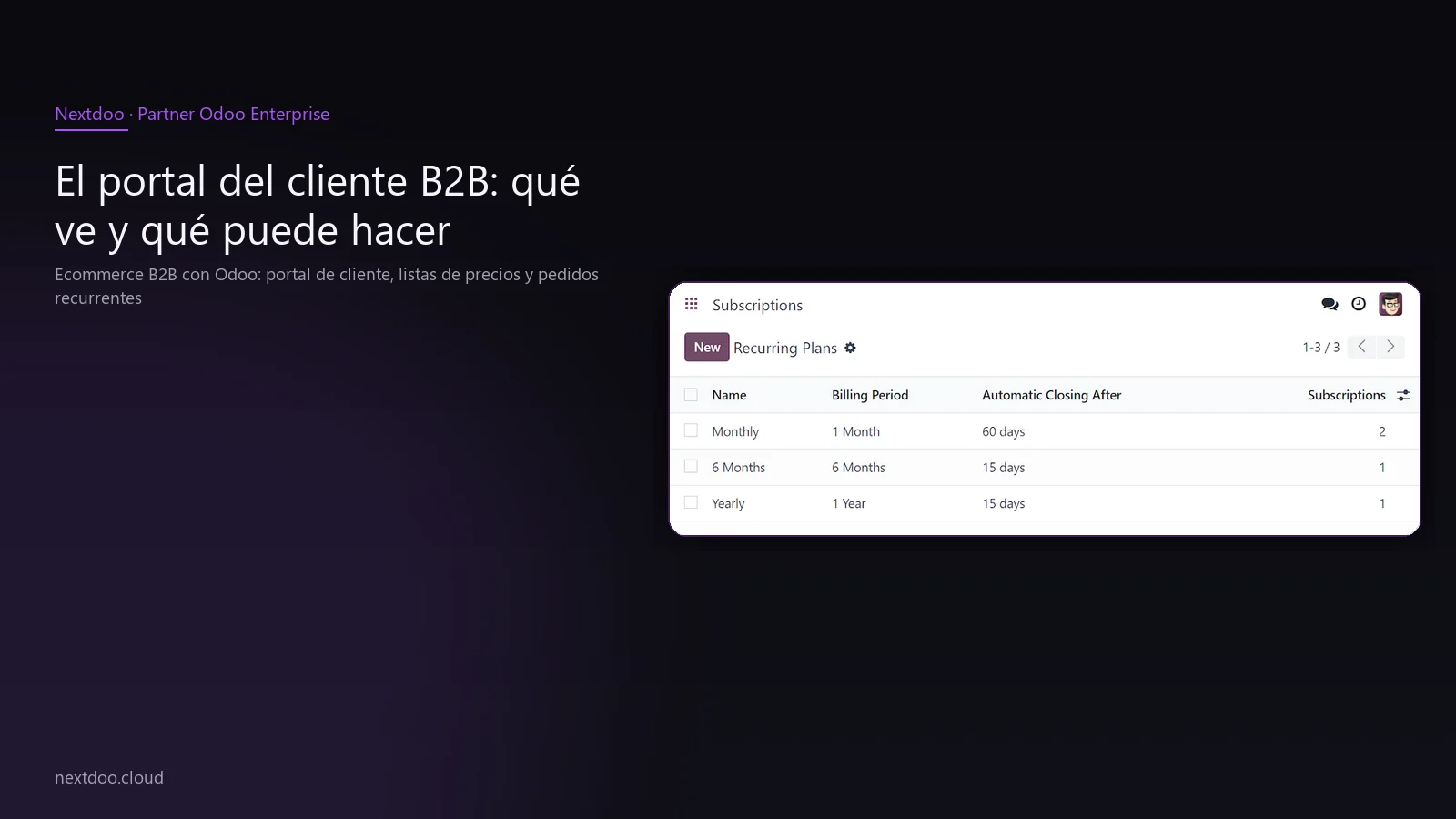
If you have customers who order practically the same thing every week or every month—a chain of shops restocking its stock, a restaurant ordering its cleaning products, a workshop ordering its usual spare parts—Odoo's recurring orders functionality is one of the most powerful arguments.
The customer logs into their portal, sees their last order or their template order, reviews it, adjusts quantities if necessary, and confirms. In seconds. Without searching for references, without rebuilding the basket from scratch, without typing errors in the references.
For the sales team, this is also a clear advantage: less time managing routine orders, more time dedicated to new customers or expanding relationships with existing ones. The system works autonomously on repetitive tasks.
In addition, Odoo can be configured to send automatic reminders to the customer when their usual order cycle approaches. It's not intrusive: it's useful. And it builds loyalty.
How does the real integration with the ERP work without manual work?
Here's the crux of the matter. Many companies have a B2B e-commerce that operates in isolation: the order arrives in an email or an inbox, and someone manually enters it into the ERP or spreadsheet. That's a bottleneck, a source of errors, and a hidden cost that very few people calculate accurately.
With Odoo, the order confirmed by the customer on the portal automatically triggers:
- The stock reservation in the corresponding warehouse.
- The generation of the delivery note for the logistics team.
- The creation of the invoice with the customer's payment terms.
- The corresponding accounting entry.
- The update of available stock in real time.
None of this requires human intervention. The administration team doesn't have to input data. The warehouse team receives the order directly. The finance team has the invoice generated and the due date calculated.
This integration is possible because in Odoo there isn't a separate e-commerce platform that needs to be connected to an external ERP via APIs or fragile integrations. It's the same system. The online order and the telephone order live in the same place, with the same logic.
In which sectors does B2B e-commerce make a difference with Odoo?
Not all B2B businesses have the same needs, but there are sectors where Odoo's value proposition is especially clear.
Food and beverage distribution
Recurring orders, delivery routes by zone, customer catalogue based on distribution agreements, management of expiry dates in the warehouse. Everything connected. The customer orders, the warehouse prepares, and the sales representative supervises without having to manage each order manually.
Motorcycle and spare parts sector
In Nextdoo we have direct experience in this sector. A motorcycle spare parts distributor has enormous catalogues, prices by brand and by volume, and customers who are workshops and specialised shops. Odoo's B2B portal allows each workshop to access only the spare parts corresponding to their agreement, with their pricing, and place their weekly order without intervention from the sales representative for each line.
Office supplies and corporate supplies
Medium-sized company with several departments ordering supplies: stationery, IT equipment, consumables. Each department has its own buyer and its own spending limit. Odoo manages approval workflows, cost centres, and catalogues by department. The invoice arrives correctly itemised in accounting without anyone having built it manually.
Wholesale textiles and fashion
Seasonal collections, volume pricing, pre-orders. Odoo's B2B portal allows for managing collection pre-sales: the customer places their order before stock arrives, with the agreed conditions. When the goods arrive, the delivery note is automatically generated.
Hospitality and catering
Suppliers to restaurants and hotels with frequent orders, scheduled deliveries, and negotiated rates. The hospitality customer particularly appreciates being able to repeat last week's order with a click from their mobile before closing the night shift.
How to migrate from your current system to a B2B portal with Odoo?
If you currently manage your B2B sales by phone, email, or with a solution not integrated with your ERP, the leap to a portal like Odoo's might seem big. It's not so much if done with methodology.
The starting point is the analysis of your current process: how orders arrive, who processes them, what information each customer needs, and what commercial conditions you have configured. From there, the implementation of the B2B portal is designed to replicate and improve that process, not to impose a new way of working abruptly.
In most cases, B2B customers quickly adopt the portal because it simplifies their lives. They don't have to call to order, they don't have to wait for someone to send them the invoice, and they can track their orders themselves. Resistance to change from the end customer is usually less than the internal team expects.
The sales team also benefits: less time on administrative tasks, more visibility on each customer's purchasing behaviour, and more data to identify cross-selling opportunities.
Frequently asked questions about B2B e-commerce with Odoo
Can a B2B customer see different prices from those in the public shop?
Yes. Odoo manages price lists by customer or by group. When the customer logs into the portal, the system automatically applies their pricing. If there are products you don't want them to see, they also don't appear in their catalogue. The public shop can have general list prices, and the private portal shows the negotiated prices for each account.
Can one order from a mobile?
Yes. The Odoo customer portal is responsive and works correctly on mobile devices. For customers who work on the go —representatives, purchasing managers who are in the warehouse— this is an immediate practical advantage.
What happens if the customer orders a product without sufficient stock?
Odoo shows real-time availability. The customer can see if there is sufficient stock before confirming. If there isn't, the system can allow the order with partial delivery or with an estimated date, depending on how the process is configured. The customer always has accurate information, not a generic promise.
Can I have multiple portals for different distribution networks?
Yes. Odoo allows managing multiple websites or portals under the same system, each with its catalogue, conditions, and brand image. Useful if you have different distribution networks or separate brands under the same business group.
Is the B2B portal ready for VeriFactu and mandatory e-invoicing in Spain?
Odoo is working to align its platform with the requirements of VeriFactu and e-invoicing according to the calendar established by the AEAT for Spanish companies. Invoices generated from the portal follow the same invoicing process as the ERP, with the integrity and traceability controls required by current regulations. This is a point that should be reviewed in detail in the implementation analysis, because the legal deadlines affect all companies equally.
How long does it take to have a B2B portal operational?
It depends on the volume of data to migrate, the complexity of commercial conditions, and how many customers need to be configured from the outset. As a guideline, a basic B2B portal with a catalogue, customer-specific prices, and online orders can be operational within a reasonable timeframe for an SME. Projects with multiple distribution networks, complex catalogues, or integrations with third-party systems require more time. Prior analysis is essential to provide a realistic estimate.
Conclusion: the B2B portal is not an add-on, it's business operations
If you sell to businesses and manage those sales by mail, phone, or with a system not integrated with your ERP, you are investing time and money in tasks that should be automatic. Every order manually entered, every invoice manually generated, every call to confirm stock availability: all of this has a cost that grows with business volume.
The Odoo B2B portal is not just a pretty online shop on top of your ERP. It is the same operational process of your business, accessible to your customers. When a customer places an order, you already have the delivery note, invoice, and warehouse movement generated. That is what differentiates a real implementation from a digital showcase.
At Nextdoo, as an official Odoo Enterprise partner in Spain, we support SMEs in the implementation of B2B portals adapted to their sector and distribution network. If you want to see how it would work with your products and customers, the next step is a direct conversation.
Guideline information. Actual timescales, costs, and scopes are confirmed after a personalised analysis. JLM Business Solutions SL · B16842831.
Frequently Asked Questions
Can a B2B customer see different prices from those in the public shop?
Yes. Odoo manages price lists per customer or per group. When the customer logs into the portal, the system automatically applies their negotiated rate. If there are products they shouldn't see, they also don't appear in their catalogue. The public store can show general list prices while the private portal accurately reflects the conditions of each commercial account.
Can orders be placed from a mobile?
Yes. The Odoo customer portal is responsive and works correctly on mobile devices. For customers who work on the go —buyers in the warehouse, shop managers— being able to confirm an order from their mobile in seconds is an immediate practical advantage that reduces the time it takes them to repurchase.
What happens if the customer orders a product without sufficient stock?
Odoo shows real-time availability. The customer can check the stock before confirming. If availability is partial, the system can allow the order with split delivery or with an estimated date, depending on how the process is configured. The customer receives accurate information at the time of order, not a generic promise that then needs to be managed by email.
Can I have different portals for different distribution networks?
Yes. Odoo allows managing multiple sites or portals under the same system, each with its catalogue, commercial conditions, and brand image. This is especially useful if you have separate distribution networks, different brands, or channel exclusivity agreements that require each network to see only what is relevant to them.
Is the Odoo B2B portal ready for VeriFactu and mandatory e-invoicing in Spain?
Odoo is working to align its platform with the requirements of VeriFactu and e-invoicing according to the calendar established by the AEAT. Invoices generated from the portal follow the same invoicing process as the ERP, with the traceability controls required by the regulations. This point should be reviewed in detail in the implementation analysis, as the legal deadlines affect all Spanish companies equally.
How long does it take to have a B2B portal operational?
It depends on the volume of data, the complexity of commercial conditions, and the number of customers to configure from the outset. A basic portal with a catalogue, customer-specific prices, and online orders can be operational within a reasonable timeframe for an SME. Projects with multiple distribution networks or complex catalogues require more time. Prior analysis is essential to provide a realistic estimate tailored to your case.