In summary. Odoo 19 includes native artificial intelligence built into accounting, sales, customer service, inventory, and human resources. The ten automations we explain enable small teams to work with greater efficiency, eliminating repetitive tasks and reducing manual errors. Nextdoo, an official Odoo Enterprise partner in Spain, helps you implement them in a structured way, tailored to your sector.
If you've been hearing about artificial intelligence applied to business for a while but without seeing anything concrete, this post is for you. Odoo 19 incorporates native AI into several key areas of business management, and at Nextdoo, we've been implementing it for months in Spanish SMEs in retail, hospitality, and distribution.
What you'll see here aren't promises of the future. They are real automations, with specific use cases, that any SME can activate with Odoo 19.
Why is Odoo 19's native AI different from what you've seen so far?
Before delving into the automations, it's worth clarifying one thing. When discussing AI in management software, it often refers to cosmetic functionalities: a button that generates generic text or a graph they call 'prediction' but that learns nothing.
Odoo 19 goes further. The AI is integrated into the workflow, not merely added on top. It learns from your real data: your customers, your products, your sales patterns, your banking history. You don't need to connect external tools or pay separately for a dedicated AI service.
For a Spanish SME, this offers a very clear practical advantage: there's no need to set up a technical infrastructure. The AI functions within the same environment where you already manage your invoices, orders, and team.
At Nextdoo, we've found that the biggest hurdle isn't the technology, but knowing what to automate first and how to configure it correctly from the outset. That's why this article focuses on concrete examples.
1. Automatic bank reconciliation
Bank reconciliation is one of those tasks nobody enjoys but that needs doing every week. Comparing bank transactions with outstanding invoices, finding the payment corresponding to each entry, marking what has already been collected.
Odoo 19 automates this process with AI. The system analyses bank movements that come in via direct connection with your bank and matches them with outstanding invoices or payments. It doesn't do it based on exact amount matches: it learns the patterns of your suppliers and customers.
If a customer always pays a few days after the due date, or if a supplier includes a slightly different description each time, the AI recognises it. Over time, the accuracy rate increases because the system learns from the corrections you make.
For sole traders and SMEs that process many monthly invoices, this can mean no longer dedicating hours to a task that the computer can resolve on its own.
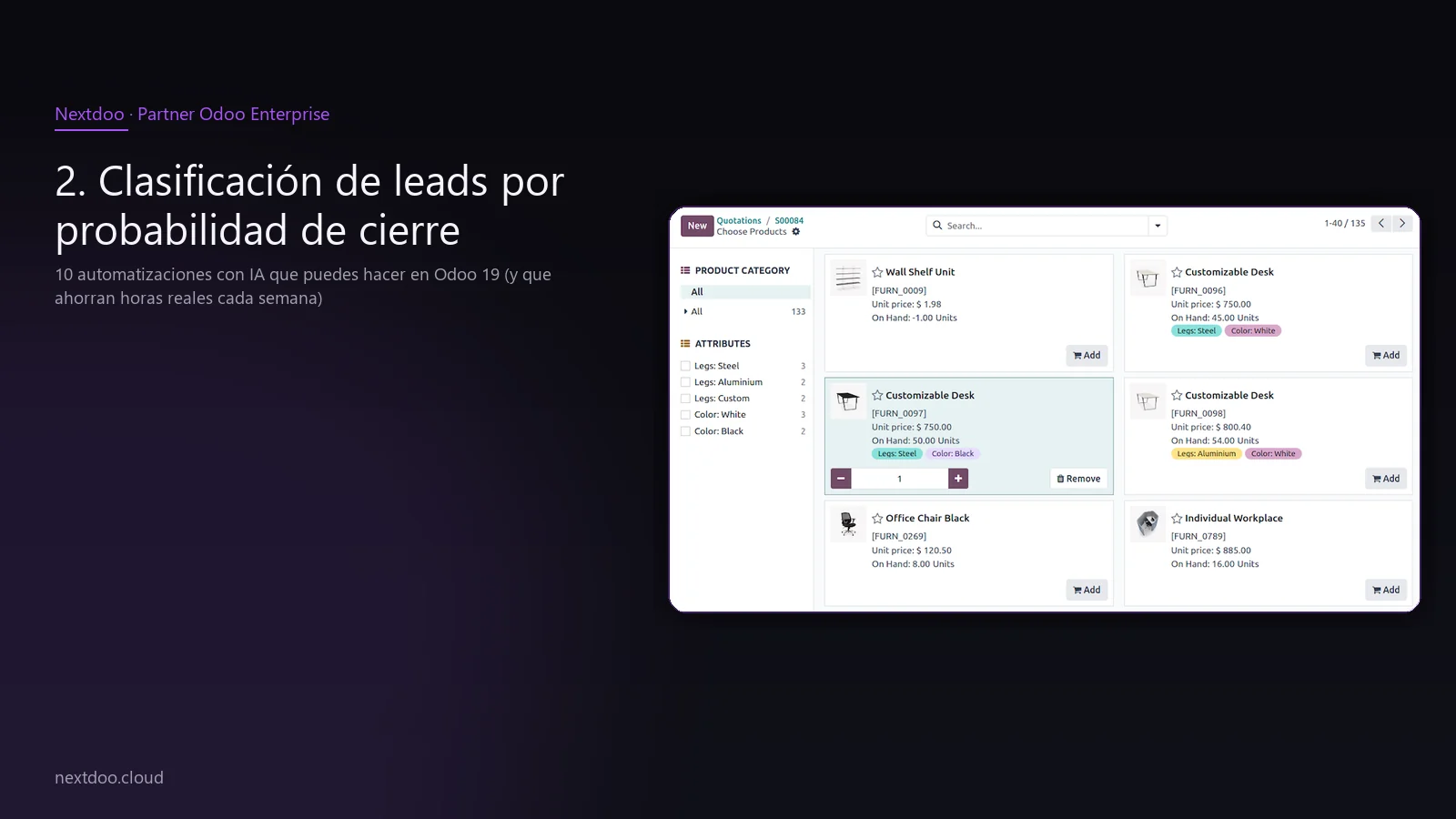
2. Lead classification by close probability
Any SME's sales team faces the same problem: there are more open opportunities than can be properly addressed. The question is which ones deserve the most attention this week.
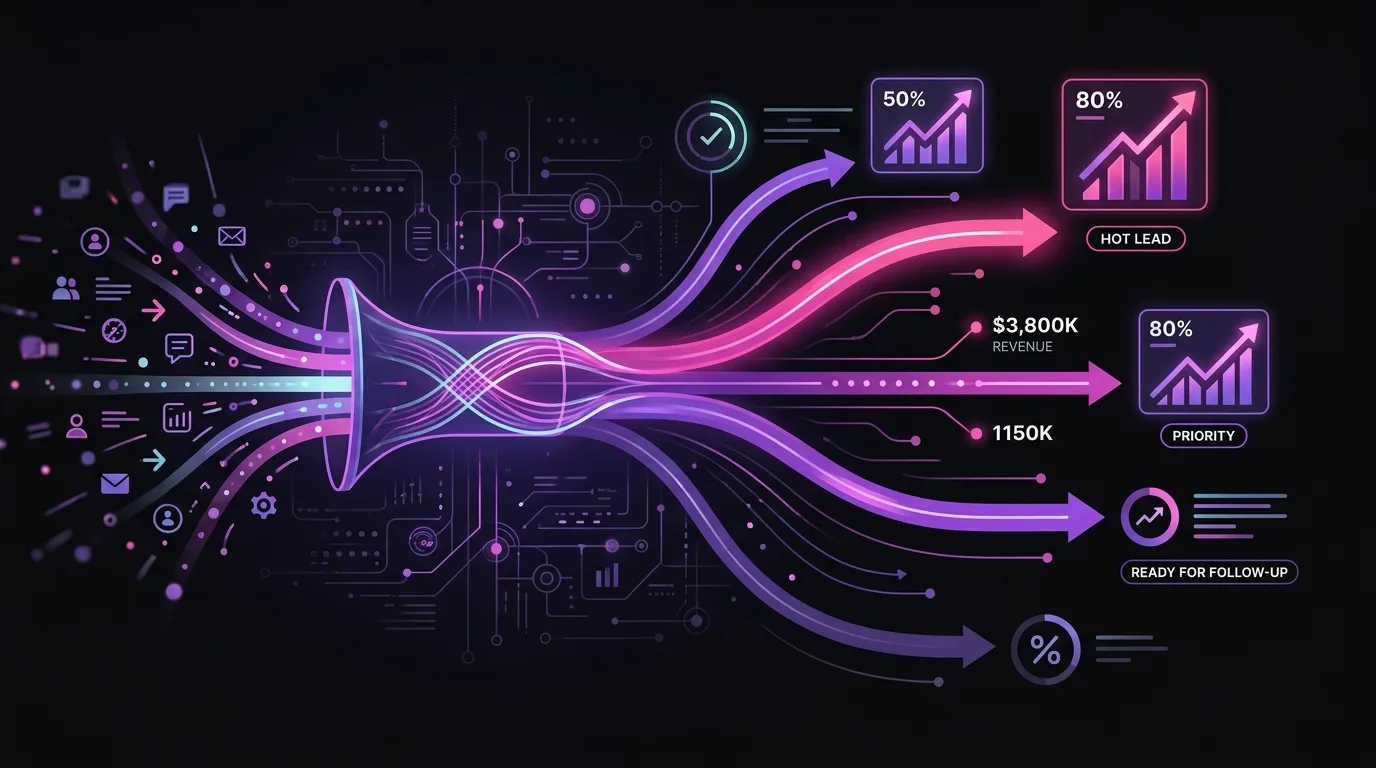
Odoo 19's CRM automatically scores each lead based on its probability of closing. It does this by analysing the history of closed sales: which sector, what company size, what type of prior interactions led to a sale and which didn't.
The result is a list of opportunities ordered by real probability, not by the salesperson's intuition. The team can focus its energy on the leads most likely to convert into customers.
In retail and hospitality, where sales cycles differ, this feature can be adjusted to the business's specific characteristics. Nextdoo configures it so that the scoring criteria reflect the reality of your sector, not those of an American tech company.
3. Automatic responses in customer service
When a customer writes with a query or an issue, they expect a quick response. But no SME has customer service staff available twenty-four hours a day.
Odoo 19 includes an AI-powered support system that automatically answers frequently asked questions, at any time of day. It's not a generic chatbot: it's trained with your company's information, products, and processes.
When the query is more complex or the AI doesn't have a clear answer, it automatically creates a ticket and assigns it to the most suitable agent based on the type of issue. The agent receives the full context of the conversation, without the customer having to repeat what they've already explained.
This has two direct advantages. Firstly: the customer receives immediate attention, even outside working hours. Secondly: the internal team only receives tickets that truly require human intervention, not questions the AI can resolve.
How this affects customer loyalty
In hospitality and retail, response speed has a direct impact on customer perception. A useful response in minutes is worth more than a perfect response the next day. Odoo's AI doesn't replace the human team, but it fills the gap where the absence of a response is most noticeable.
4. Demand and inventory prediction
Overstocking ties up capital. Stockouts lead to lost sales. Both are common problems for SMEs in distribution and retail that manage extensive catalogues.
Odoo 19 analyses each product's sales history and generates demand predictions for upcoming periods. It takes into account seasonality, trends, and patterns by product category.
Based on these predictions, the system generates automatic purchasing suggestions. The purchasing manager doesn't start from scratch each week: they receive a proposal they can review, adjust, and approve.
The result is that stock levels are better adjusted to real demand, supplier orders are placed further in advance, and stockouts for fast-moving products are reduced. In distribution, where margins are tight, this type of optimisation has a real economic impact.
5. Automatic product sheet generation
If you have an extensive catalogue and need to publish products on your online store or marketplaces, you know how much effort it takes to write well-crafted product sheets. Description, attributes, email text, meta description for SEO.
Odoo 19 allows these texts to be generated automatically with AI. You upload the product with its name, reference, and photo, and the system generates a complete product sheet: commercial description, key product points, and proposed text for campaigns.
This isn't generic text copied from anywhere. The AI uses the tone and vocabulary you've used in the rest of your catalogue as a reference, maintaining brand consistency.
For shops with dozens or hundreds of new references each season, this significantly reduces the time it takes to launch new products.
6. Automated sales follow-up
How many quotes go unanswered due to a lack of follow-up. The salesperson is busy with other accounts, time passes, and the opportunity cools.
Odoo 19 detects when a quote has been inactive for a while and automatically triggers a follow-up. The follow-up message isn't a standard email sent to everyone alike: the AI personalises the content according to the client type, the product quoted, and the relationship history.
The salesperson can review the message before it's sent if they prefer, or leave it on automatic for lower-value opportunities. In any case, no quote goes without follow-up due to oversight.
Smart follow-up in long sales cycles
In sectors with longer decision cycles, such as B2B or newly opened hospitality businesses, well-executed follow-up makes the difference between winning or losing an account. Odoo 19 allows you to schedule follow-up sequences tailored to each stage of the sales cycle.
7. Automatic expense categorisation
Processing supplier invoices is a repetitive task that consumes administration team time. Reviewing each invoice, determining which accounting ledger it goes to, checking that the supplier is properly registered.
Odoo 19 automates most of this process. When a supplier invoice comes in, the AI detects the supplier, analyses the description, and automatically assigns the corresponding accounting category. It relies on the history of previous invoices from the same supplier and patterns of similar descriptions.
The result is that the administration team reviews instead of classifying from scratch. The time spent on each invoice drops considerably, especially in companies with many regular suppliers.
This function also offers an advantage for tax compliance. When categorisation is consistent and well-documented, the quarterly and annual AEAT models, such as Modelo 303, Modelo 390, or 347, are generated with greater reliability and less review work.
How do cross-selling suggestions work at the time of order?
Well-executed cross-selling increases the average order value without pressuring the customer. The problem is that doing it well requires knowing which products complement each other and what that customer has purchased before.
Odoo 19 analyses order history and detects purchase patterns between products. When a salesperson is creating an order, the system automatically suggests complementary products that other customers with a similar profile have bought together.
The suggestions aren't random. They are based on real correlations within your own sales data, not on rules manually configured by someone unfamiliar with your catalogue.
In retail, this can be applied both in physical stores via the point of sale and in the online channel. In hospitality, it applies to event and catering management, where packages are built upon base orders.
What is sentiment analysis in customer communications?
An unsatisfied customer who doesn't complain aloud but also doesn't renew is one of the hardest problems to detect in time. By the time you realise, they're already gone.
Odoo 19 automatically analyses written customer communications, emails, and in-system messages, detecting signs of dissatisfaction or tension. If sentiment analysis detects a customer with a sustained negative tone over time, it generates an alert for the sales manager.
This allows action to be taken before the problem escalates. The salesperson can get in contact proactively, understand what's happening, and find a solution before the customer decides to leave.
For SMEs with a client portfolio where every account matters, this type of early warning has a value that's difficult to quantify but very real in terms of retention.
How does optimised shift planning work?
Shift management in hospitality and retail is one of the most common headaches. Balancing availability, team skills, peak demand periods, and collective agreement restrictions takes time and generates conflicts.
Odoo 19 uses AI to generate optimised shift planning proposals. The system considers the declared availability of each employee, historical demand by time slot and day of the week, and the skills or roles of each team member.
The proposal it generates isn't definitive: the manager reviews and adjusts it. But the starting point is already established, and the most obvious conflicts, such as assigning someone on their day off or leaving a shift uncovered, are detected before the roster is published.
In hospitality with multiple daily shifts and variable staffing, this reduces the time spent on planning and improves team satisfaction because the process is more transparent.
What Nextdoo brings to Odoo 19's AI
Odoo 19 comes with the technology. However, activating these automations so they work well for your specific business requires knowing both Odoo and the sector in which you operate.
At Nextdoo, we've been implementing Odoo in Spanish SMEs in retail, hospitality, and distribution for years. We know which functionalities have the most impact depending on the type of business, in what order it makes sense to activate them, and how to avoid configuration errors that cause an automation to generate more work than it saves.
Our way of working involves first understanding how your business operates before touching any settings. There isn't a universal template that suits everyone. A fashion store with online sales doesn't need the same automations as a restaurant with catering services and multiple venues.
We also support the team during the transition. Odoo 19's AI learns from historical data, but someone needs to supervise the first few weeks, correct when the system makes mistakes, and ensure the team trusts the automatic suggestions. This adaptation phase is part of what we do.
Tax compliance and AI: a combination that matters in 2026
In 2026, VeriFactu obligations come into force for most companies required to issue electronic invoices according to AEAT regulations. Odoo 19 is prepared for this requirement, and the accounting, expense categorisation, and bank reconciliation automations described in this article are connected with the electronic invoicing flow.
Activating well-configured AI not only saves time: it also reduces errors which subsequently complicate quarterly models and annual declarations. Mis-categorised data in October can cause issues with the January Model 390.
FAQ
Is Odoo 19 with AI already available in Spain?
Yes. Odoo 19 is available in its Enterprise version, and AI functionalities can be activated in new installations and in upgrades from previous versions. The availability of some specific features may vary depending on the version and configuration. Nextdoo can review with you which automations are applicable to your specific case before committing to any scope.
Do I need a lot of historical data for the AI to work?
The more data the system has, the better it learns. That said, some automations such as product data sheet generation or expense categorisation work from day one without needing historical data. Others, such as demand forecasting or lead classification, improve over time. If you have been using Odoo for years or are migrating from another system with historical data, you can start with an advantage.
Does Odoo's AI replace the administrative or sales team?
No. What it does is eliminate repetitive, low-value tasks so that the team can focus on what requires human judgement. Bank reconciliation is done by the AI, but someone has to review the exceptions. Sales follow-up is automated by the system, but the salesperson closes the sale. Odoo's AI works with the team, not in its place.
How much does it cost to implement Odoo 19 with these automations?
The cost depends on the scope, the number of users, the modules required, and the company's starting position. There is no standard price that can be honestly published. At Nextdoo, we perform a no-obligation preliminary analysis to provide you with a quote tailored to your actual situation, with no surprises afterwards.
Is it compatible with the electronic invoicing system and VeriFactu?
Yes. Odoo 19 is prepared for the electronic invoicing requirements set by the AEAT, including VeriFactu and TicketBAI for the foral territories. The correct configuration depends on the type of company and the territory. Nextdoo ensures that the implementation complies with the current tax regulations in Spain.
Can it be implemented in phases or does everything have to be activated at once?
It can, and in most cases, it is advisable. Attempting to activate ten automations at once in a company that has not previously worked with this level of automation creates chaos. At Nextdoo, we define with you an implementation order that starts with the automations with the most immediate impact and progresses at a pace the team can absorb.
Conclusion: the time to act is now
AI in business management has gone from being a promise to being a tool available today, in the Enterprise version of Odoo 19, without the need for complex technical projects or disproportionate investments.
The ten automations we have described in this article are not science fiction. They are real functionalities that Nextdoo is implementing in Spanish SMEs right now. Some are noticeable from the first week. Others mature over time and with the data.
If you manage an SME in retail, hospitality, or distribution and feel that your team dedicates too much time to tasks that should be automated, it's time to see what Odoo 19 can do for your specific operations.
The first step is a conversation. Without obligation and without generic templates. Schedule a demo with Nextdoo, and we will show you live the automations that best suit your type of business.
Indicative information. Actual timescales, costs, and scopes are confirmed after a personalised analysis. JLM Business Solutions SL · B16842831.
Frequently Asked Questions
Is Odoo 19 with AI already available in Spain?
Yes. Odoo 19 is available in its Enterprise version, and AI functionalities can be activated in new installations and in upgrades from previous versions. The availability of some specific features may vary depending on the version and configuration. Nextdoo can review with you which automations are applicable to your specific case before committing to any scope.
Do I need a lot of historical data for the AI to work?
The more data the system has, the better it learns. Some automations, such as product data sheet generation or expense categorisation, work from day one. Others, such as demand forecasting or lead classification, improve over time and with accumulated data. If you have been using Odoo for years or are migrating from another system with historical data, you can start with an advantage.
Does Odoo's AI replace the administrative or sales team?
No. What it does is eliminate repetitive, low-value tasks so that the team can focus on what requires human judgement. Bank reconciliation is done by the AI, but someone reviews the exceptions. Sales follow-up is automated by the system, but the salesperson closes the sale. Odoo's AI works with the team, not in its place.
How much does it cost to implement Odoo 19 with these automations?
The cost depends on the scope, the number of users, the functionalities required, and the company's starting position. There is no standard price that can be honestly published. At Nextdoo, we perform a no-obligation preliminary analysis to provide a quote tailored to the actual situation, with no surprises afterwards.
Is it compatible with the electronic invoicing system and VeriFactu?
Yes. Odoo 19 is prepared for the electronic invoicing requirements set by the AEAT, including VeriFactu and TicketBAI for the foral territories. The correct configuration depends on the type of company and the territory. Nextdoo ensures that the implementation complies with the current tax regulations in Spain in 2026.
Can it be implemented in phases or does everything have to be activated at once?
It can, and in most cases, it is advisable. Attempting to activate ten automations at once in a company that has not worked with this level of automation creates adaptation issues. At Nextdoo, we define an implementation order that starts with the automations with the most immediate impact and progresses at a pace the team can absorb without friction.