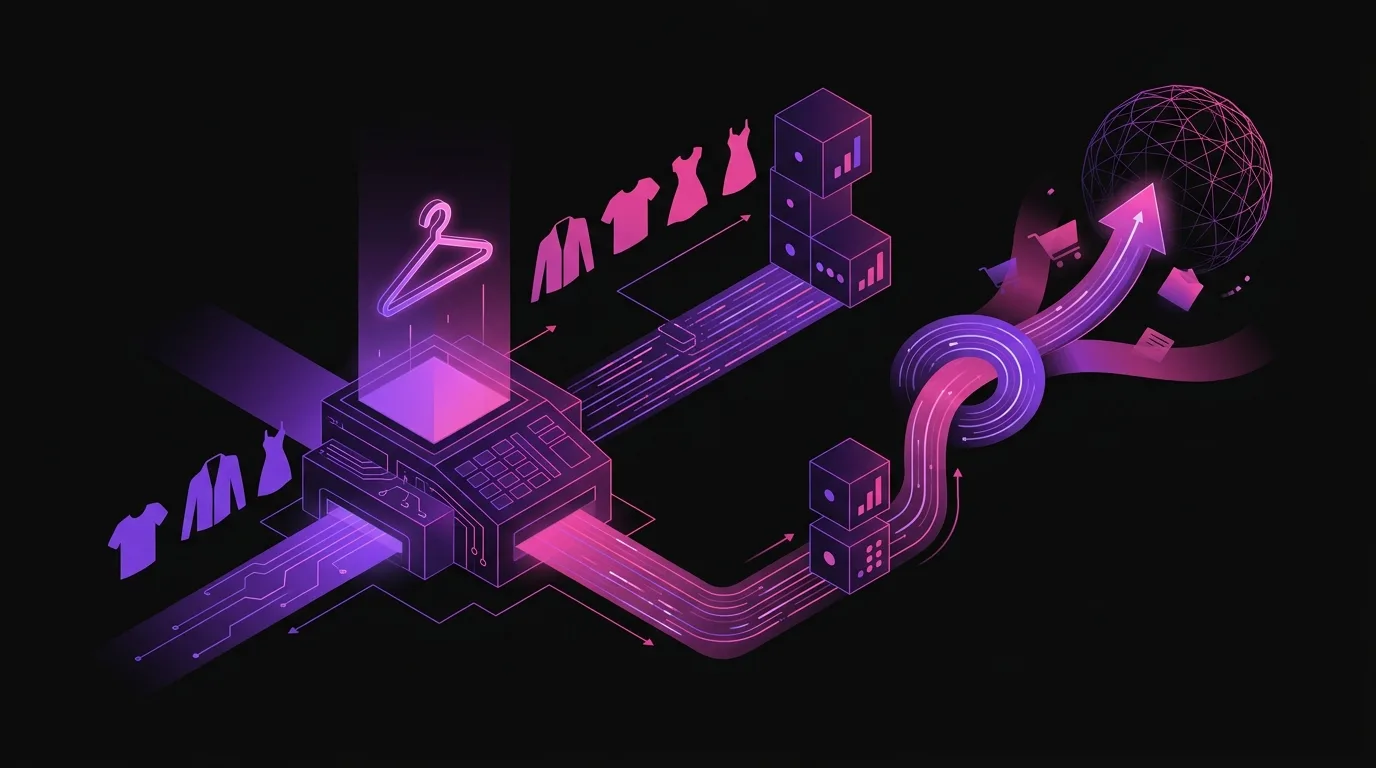
In summary. Odoo centralises on a single platform the physical store POS, inventory by sizes and colours, and the online store. When you sell an item at the till, the stock is updated across all channels instantly. For a Spanish fashion SME, that means fewer errors, fewer discrepancies, and more time to sell. Nextdoo, as an official Odoo Enterprise partner in Spain, implements this solution adapted to fashion retail.
If you own a clothing store, you know that the catalogue is your most recurring nightmare. The same pair of trousers in six sizes and four colours make twenty-four different references. Multiply that by two hundred seasonal models and you already have a real, not theoretical, management problem.
Odoo automatically synchronises inventory between physical store, online and warehouse, eliminating stock discrepancies in fashion businesses.
Why is variant management the Gordian knot of fashion retail?
Retail fashion has a complexity that does not exist in other sectors. A t-shirt is not a product, it is a family of products. Size, colour, fabric, collection, season: each attribute multiplies the number of references you need to control.
When those references live in spreadsheets, on an old POS, and on a separate e-commerce platform, errors are inevitable. You sell an online size S in red and don't realise that in the store it was just sold ten minutes ago. The customer receives a cancellation message. Trust is broken.
The problem is not complexity itself. The problem is managing it with tools that were not designed for it. And that's where Odoo comes in.
Odoo treats product variants as a native concept, not as an added patch. From the moment you create a product family with its attributes, the system autonomously generates and manages each combination. Each variant has its own barcode, its own stock level and, if you need it, its own price.
What are product variants: sizes, colours and custom attributes?
In Odoo, you define your catalogue attributes once: size, colour, material, collection. From then on, the system works for you. A product with six sizes and four colours automatically generates twenty-four variants, each independently trackable.
This has immediate practical consequences. When a customer returns an item, the stock for that specific variant returns to its correct position. When you carry out an inventory, you can filter it by category, by size or by supplier. You don't have to go through the entire database.
Barcodes per variant are another key point. Each item's label uniquely identifies the model, size and colour. When you scan at the till, there is no ambiguity. The system knows exactly what has been sold.
Price management by variant also addresses real sector needs. A limited edition in a special colour can have a different price without needing to create a new product. Everything lives within the same family.
Variant matrices and working with collections
When working with seasonal collections, Odoo allows you to organise the catalogue by campaigns. You can see at a glance which autumn-winter collection models are in stock, which are running low and which need to be cleared. This visibility is what allows purchase and pricing decisions to be made with sound judgement, not intuition.
Mass import of references is also designed for the real pace of a fashion store. When the new season arrives with one hundred new models, you don't have to create each variant manually.
POS designed for fashion retail
Odoo's point of sale terminal is designed to make the checkout process quick and frictionless. In fashion, this means that the sales assistant can locate the item, select the size and colour, and process payment in a few seconds, with or without an internet connection.
If the customer asks if a size M is available in another store within the group, the answer is on the same screen. There's no need to call by phone or consult another system. The stock across all points of sale is visible in real time.
The most useful functionalities for the fashion sector in Odoo's POS are the following:
- Search and selection by unique barcode per variant.
- Size changes without complicated return processes.
- Gift cards and discount vouchers integrated into the checkout flow.
- Application of seasonal or product category discounts.
- Customer record with purchase history, including usual sizes.
- Stock enquiry in other warehouses or stores from the POS itself.
- Till closing with automatic reconciliation and direct accounting export.
That last point deserves attention. In many clothing stores, till closing is a manual process that consumes time and generates errors. With Odoo, POS data goes directly to accounting without human intervention. That is real time saved every day.
Loyalty and customer cards
Odoo allows you to manage loyalty programmes linked to the customer profile. Points for purchases, birthday discounts, early access to sales: all configurable without the need for an external platform. The customer profile accumulates purchase history, usual sizes, and preferences. This information is useful for the sales assistant when the customer returns to the shop, but also for email marketing campaigns that can be launched from the same platform.
How does size-based inventory work for real warehouse control?
Inventory is where many clothing shops lose money without knowing it. Stock immobilised in sizes that don't sell, stock-outs in the most demanded sizes, poorly registered transfers between shops. Odoo addresses these problems at the root.
The inventory module manages variants natively. You can view the stock of each size and colour in each warehouse or point of sale. You can configure minimum levels per variant so that the system generates automatic replenishment orders. You can perform partial inventories, filtering only by a category or a season, without having to count the entire shop.
Transfers between shops are registered with full traceability. If you send fifteen units of a jacket in size L from the central warehouse to the Valencia shop, the movement is documented, and the stock is updated in both locations instantly.
Rotation analysis is another valuable tool. Odoo shows you which variants sell faster, which have been stagnant for weeks, and which generate more returns. With this information, purchasing decisions for the next season are much more informed.
Labelling and goods receipt
When new goods arrive, Odoo allows you to register the receipt against the purchase order, validate quantities by variant, and print barcode labels from the same process. This flow eliminates double data entry and reduces reception errors.
Integrated e-commerce: a single source of truth for stock
Odoo's e-commerce is not an external platform connected via a fragile integration. It is part of the same application. This means that the stock your customer sees on the web is the same as your sales assistant sees on the POS, in real time.
When a size sells out in store, it automatically disappears from the website. When new goods arrive, they appear available without anyone having to update anything. This instant synchronisation eliminates cancellations due to stock errors and poor customer experiences.
Odoo's online shop displays variants with visual selectors. The customer chooses size and colour, sees real-time availability, and buys. If a combination is out of stock, it appears disabled or with an email notification option for when it's back in stock.
The online returns process is also integrated. The customer requests the return from their personal area, the shop manages it from Odoo, and the stock of the returned variant is automatically replenished.
Marketplaces and additional channels
If, in addition to your own online shop, you sell on marketplaces, Odoo allows you to centralise orders from different channels into a single inbox. Stock is deducted uniformly regardless of the channel through which the order arrives.
How to manage seasons, sales, and pricing campaigns?
The fashion sector lives by seasons. The January and July sales, Black Friday campaigns, end-of-collection clearances: all these events involve massive price changes which, if poorly managed, cause problems both in store and on the website.
Odoo allows you to create price lists by season or campaign. You can schedule a price list to come into effect on a specific date and affect specific product categories. When that date arrives, prices change automatically, across all channels simultaneously.
This eliminates the manual process of updating prices on the POS, then on the website, then checking that everything matches. Everything happens in one step, scheduled in advance.
Conditional promotions are also possible: volume discount, gift with purchase above a certain amount, discount on the second item. All configurable without the need for custom development.
What is VeriFactu and how does it affect invoicing in the retail sector?
From 2026, the VeriFactu regulation from the Tax Agency requires invoicing systems to guarantee the integrity and immutability of records. For a clothing shop that issues tickets and invoices, this means that the POS and management software must be adapted to this requirement.
Odoo, in its Enterprise version implemented by an official partner, incorporates the adaptation to VeriFactu for the Spanish market. Every ticket issued from the POS is recorded integrally and verifiably, complying with the provisions of the AEAT.
More information about VeriFactu on the official website of the Tax Agency: agenciatributaria.gob.es.
For shops in the Basque Country and Navarre, TicketBAI is the equivalent regulatory framework. The implementation with Nextdoo includes adaptation to the applicable tax framework in each territory.
Why Nextdoo for your clothing shop?
Nextdoo is an official Odoo Enterprise partner in Spain, with specific experience in retail and in managing businesses with multiple points of sale. We do not implement Odoo generically: we start from the real needs of the Spanish fashion sector to configure a solution that works from day one.
This includes data migration from the previous system, catalogue configuration with variants, shop team training, and subsequent support. The goal is for your team to operate smoothly and for the system to generate real value within a reasonable timeframe.
The implementation cost is adjustable to the size and needs of each shop. There is no single price, because each project is different. What does exist is an initial, no-obligation analysis to understand your situation and provide you with a concrete proposal.
If you are coming from another system, such as an adapted hospitality POS, a standalone inventory solution, or an e-commerce platform disconnected from your management, the migration to Odoo is planned so that the transition is orderly and without loss of historical data.
Frequently asked questions
Indicative information. Actual timescales, costs, and scopes are confirmed after a personalised analysis. JLM Business Solutions SL · B16842831.
Frequently asked questions
Does Odoo manage product variants with sizes and colours without custom developments?
Yes. Product variants are a native feature of Odoo. You can define attributes like size, colour or material, and the system automatically generates each combination. Each variant has its own barcode, its own stock level and, if you need it, its own price. No additional development is required for the standard use case of a clothing shop.
Is the stock of the physical shop and the online shop synchronised in real-time?
Exactly. Odoo does not connect two different systems via an integration: the online shop and the POS are part of the same platform. When an item is sold at the till, the stock is updated immediately on the website. If a size sells out, it automatically disappears from the online selector. This eliminates cancellations due to stock errors, which are a common source of poor customer experience in fashion retail.
Is Odoo adapted for VeriFactu for clothing shops with POS?
Yes. The Enterprise version of Odoo, implemented by an official partner such as Nextdoo, includes adaptation for VeriFactu according to the Spanish Tax Agency's requirements for invoicing systems in Spain from 2026. Every ticket issued from the POS is fully and verifiably recorded. For shops in the Basque Country or Navarra, the adaptation includes the corresponding TicketBAI framework.
Can I manage multiple physical shops with Odoo?
Yes. Odoo allows you to manage multiple points of sale from a single platform. The stock of each shop is visible in real-time from any point in the network. Transfers between shops are recorded with complete traceability and stock is updated in both locations instantly. Each shop's POS can operate autonomously even offline, synchronising data when connectivity is restored.
What happens to my data if I come from another management system or POS?
Nextdoo plans the data migration from the previous system before starting the implementation. The goal is for the product, customer, and sales history to be available in Odoo from the first day of operation. The exact scope of the migration depends on the source system and the state of the data, so it is analysed on a case-by-case basis during the initial phase of the project.
How are seasonal sales and price changes managed in Odoo?
Odoo allows you to create price lists by season or campaign and schedule their effective date. When that date arrives, prices change automatically across all channels: POS, online shop, and any other point of sale. You can apply the change to entire product categories, specific collections, or individual variants, without the need to update prices one by one.
Frequently asked questions
How does Odoo update the inventory when I sell an item in the physical shop?
When you register a sale at the shop's POS, Odoo instantly updates the stock across all channels: warehouse, online shop, and other points of sale. There are no manual synchronisations or discrepancies between what you see at the till and what appears on the website.
Can I control inventory by sizes and colours in Odoo?
Yes, Odoo manages each combination of size, colour and other attributes as an independent reference. Trousers in six sizes and four colours are twenty-four distinct references that the system controls separately without confusion.
Do I need two different platforms for the physical shop and the online shop?
No, Odoo integrates the physical POS, inventory control, and the online shop into a single platform. All channels share the same stock information, which prevents errors and returns due to lack of availability.
What are the advantages of using Odoo for a small fashion business in Spain?
It reduces operational costs by eliminating manual synchronisations, reduces inventory errors, prevents returns due to stock discrepancies, and frees up team time to focus on sales rather than administrative tasks.
How does Odoo manage seasonal sales and price changes?
Odoo allows you to create price campaigns and manage seasonal sales. Price changes are applied automatically across all channels, ensuring that the physical and online shops always display the same prices.