In summary. Odoo is worthwhile for freelancers with stock, multiple clients or real growth plans. It makes no sense if you only need to issue invoices and reconcile VAT. The decisive criterion is the operational complexity of your business, not its size. From 2026, VeriFactu will mandate the use of verifiable invoicing software: Odoo Enterprise is already working on this adaptation for the Spanish market, which guarantees continuity without changing tools.
Setting up your own business in Spain is complicated enough. On top of that, every year a new software appears promising to solve all your management problems. Odoo has been on the lips of SMEs and freelancers for years, but there is a legitimate question that needs to be answered directly: is it too much for someone who works alone or with a small team?
The honest answer is: it depends on what you do. Not on your size, but on the real complexity of your business. Size in terms of turnover or number of employees is a poor indicator. What matters is how many processes you have on the table every day and whether those processes are talking to each other or living in separate silos.
Here we explain it with discernment, without selling you anything that doesn't fit your situation.
What is Odoo and why do many freelancers discard it without analysing it?
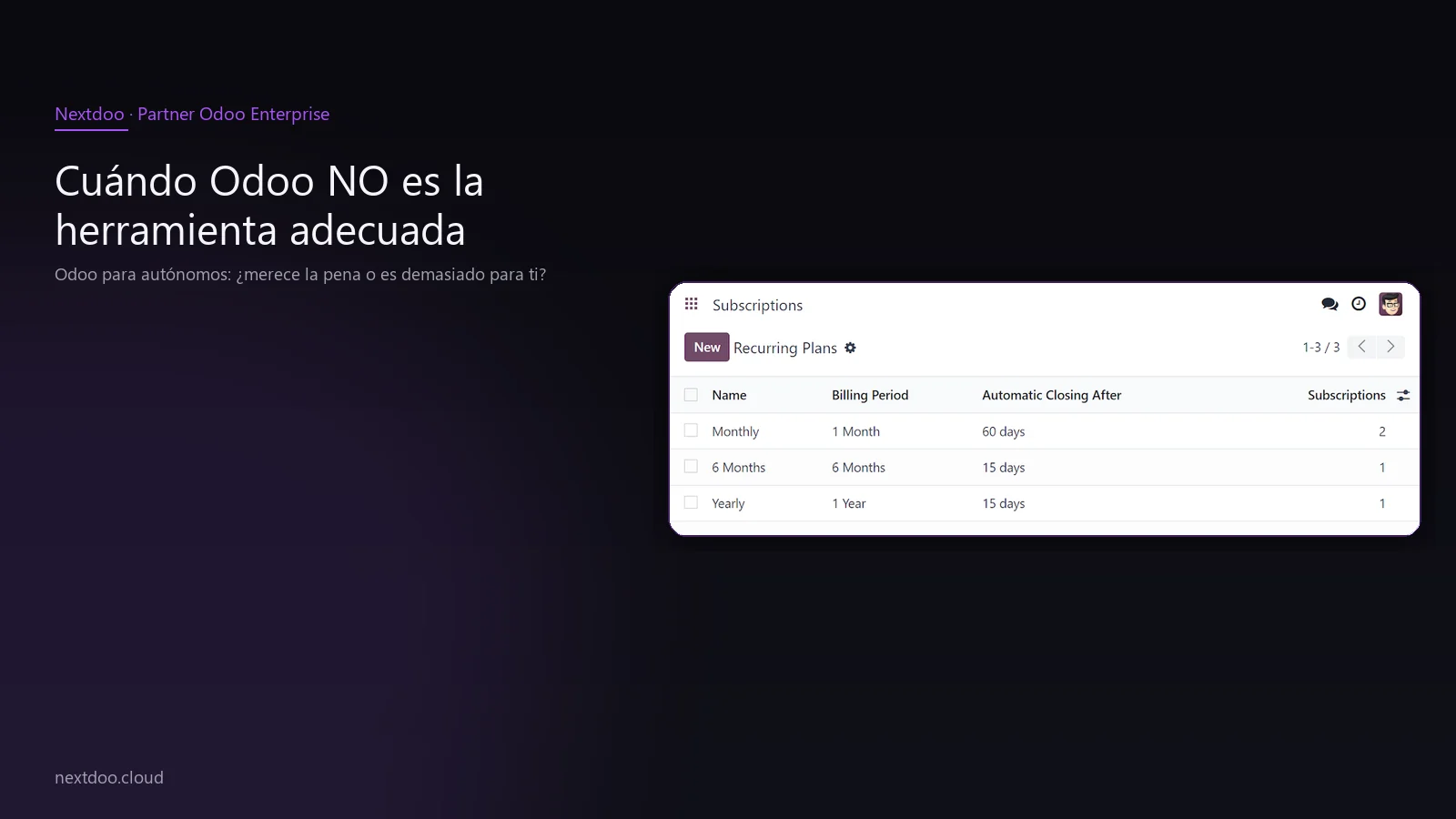
Odoo is a modular ERP. It's not an invoicing program, nor a CRM, nor an online store: it can be all three at once, and many more, if you need them. You can activate only what you use and leave the rest completely dormant. That modularity is its greatest advantage, but also the source of its bad reputation among freelancers.
The image problem Odoo has in that segment comes from comparing it with tools designed so that within fifteen minutes you're already issuing invoices. Odoo requires an initial implementation. Even if it's simple, that start-up has a time cost and, if you hire an official partner, a financial cost. That puts many off before they even assess whether the initial investment is recouped.
But there's another side that's not usually told. When your business has stock, multiple sales channels, collaborators or a client portfolio to manage, simple tools fall short sooner than it seems. And changing software halfway through, with scattered data and processes halfway migrated, turns out to be much more expensive than having chosen well from the beginning.
The decision isn't "Odoo yes or no". The decision is "what level of complexity do I have today and what will I have in two years?".
When is Odoo worthwhile for a freelancer?
There are specific profiles of freelancers for whom Odoo makes sense from day one. It's not a question of annual turnover or years in the market. It's a question of daily operations.
You should consider Odoo if you recognise your situation in any of these points:
- You sell physical products and need real stock control, not a spreadsheet you update manually.
- You manage an e-commerce and want inventory, invoicing and the warehouse to share data without exporting files between systems.
- You have collaborators or employees, even if few, and need to coordinate tasks or projects without losing track.
- You issue a high volume of invoices per month and manual accounting is already eating up hours you should be dedicating to selling or producing.
- You work in sectors such as retail, hospitality or distribution, where the volume of daily operations is high and errors have an immediate cost.
- You plan to grow in the coming years and don't want to change tools when your team grows or when you open a second point of sale.
That last point is worth highlighting. Odoo scales with you. There's no need to migrate data or learn a new system when the business takes a leap. You don't change tools: you expand what you already have. In the long term, that's a real saving of time, money and headaches.
There's also a freelancer profile that is often underestimated: one who invoices for services but to many clients with different conditions, different payment terms, prior quotes and necessary follow-up. That profile doesn't have stock, but has a commercial complexity that a basic invoicing tool doesn't manage well.
When is Odoo NOT the right tool?
Being direct here is important, because not everyone needs an ERP and selling one to someone who doesn't need it doesn't help anyone.
If you're a freelance with a handful of fixed clients, without inventory, and your biggest concern is issuing invoices and declaring quarterly VAT, Odoo is excessive. In that case, a basic invoicing tool will sort your life out for much less money and without initial configuration.
It also makes no sense if:
- Your business is completely solo, without complex operations: occasional consulting, communication services, occasional advice.
- You have no intention of dedicating initial hours to setup or adapting your processes to a new tool.
- You're looking for a free invoicing solution and don't foresee any growth or change in your business model in the short term.
- All your accounting is handled by an external consultancy and you only need to pass them documents: in that case, the consultancy already has its own software.
In those cases, there are lighter tools that perfectly fulfil their function. Nobody should use an excavator to plant a pot. The important thing is to be honest about the real complexity of your business, not the one you think you'll have someday.
Where to start: key areas for a freelancer in Odoo
If you recognise yourself in the first block, the next question is practical: where do I start and what do I activate?
Odoo has dozens of functional areas available. The key is not to activate anything you don't need right now. Start with the essentials and add more when the business demands it. A good official partner will guide you through that initial selection to ensure a clean start without unnecessary cost.
The essentials for most self-employed individuals
- Accounting and invoicing: It's the core. Management of issued and received invoices, VAT settlements, bank reconciliation and, from 2026, mandatory compliance with VeriFactu for self-employed individuals under the general regime.
- Sales management: For quotes, orders and commercial conditions in an organised way. It prevents a sale from getting lost in an email or on a paper note.
- Customer Relationship (CRM): If you have a multi-step sales cycle or manage commercial opportunities with follow-up, this area is indispensable. Simple to use and very effective for not losing any relevant contact.
- Inventory: Only if you sell physical products. If you offer services, you can omit it completely without affecting the rest.
What you can add when the business justifies it
- Project management: If you work by assignments or projects and need to control phases, deliveries or dedicated hours.
- Point of sale: If you have a physical shop and want a POS integrated with accounting and stock, without independent systems that don't synchronise.
- Online shop: If you want your e-commerce to share inventory and data with the rest of the system without exporting or importing anything manually.
The advantage of the gradual approach is that the cost grows with actual usage. You don't pay for what you don't need today.
What changes with VeriFactu and tax obligations in 2026?
This section deserves special attention because it directly affects the decision of which software to use, regardless of whether Odoo fits you or not.
The Tax Agency has established the obligation to use verifiable invoicing systems, known as VeriFactu, for self-employed individuals and companies under the general Income Tax and Corporate Tax regimes. The entry into force is planned for 2026. The exact deadlines and technical conditions are outlined in the provisions published in the BOE.
In practice, this means that your invoicing software must generate invoices with a QR code and a digital fingerprint that guarantees the integrity of the record. This is not a minor detail: if your current software is not adapted, you will not be able to use it legally for invoicing.
Not all cheap invoicing programmes will adapt in time or with the technical depth required by the regulations. Some small providers do not have the resources to do it correctly. If you use a basic invoicing solution, it's advisable to ask your provider what their roadmap for VeriFactu is before the deadline becomes urgent.
Odoo Enterprise is working on the implementation of VeriFactu for the Spanish market. If you use Odoo with an official partner, this adaptation comes via an update without you having to change tools or touch anything manually. It's one of the specific advantages of working with enterprise software backed by a technical team.
For self-employed individuals operating in the Basque Country or Navarre, there is also TicketBAI, a verifiable invoicing system specific to those territories with specific technical requirements. Odoo has adaptation for TicketBAI. If you are in these communities, it's important to confirm with your partner that the implementation includes that configuration from the outset.
How much does Odoo cost for a self-employed individual?
Talking about cost without knowing your specific case is always approximate, but there are some key points that help to get oriented.
The total cost of Odoo for a self-employed individual depends on three main variables: the edition you choose (Community or Enterprise), the number of users and whether you contract the implementation with a partner or try to set it up yourself.
Odoo Community is the open-source version and has no licence cost. The problem is that it does not include official support, nor automatic updates for Spanish tax adaptations like VeriFactu. For a self-employed individual without technical knowledge, implementing it well from scratch has a considerable time cost and the risk of incorrect configurations that are later difficult to correct.
Odoo Enterprise is the paid version, with official support, included updates and additional functionalities. For a self-employed individual with one or two users, the monthly licence cost is accessible when compared to what is paid for contracting separate cloud software tools: a CRM on one side, invoicing on another, inventory on another. Consolidating everything into a single platform usually makes economic sense beyond a certain operational complexity.
To that, you have to add the cost of the initial implementation with a partner. That cost varies according to the complexity of the business: a service-based self-employed individual without inventory is not the same as one with an online shop, warehouse and several collaborators. The implementation for a simple profile can be reasonably short. For more complex profiles, the scope grows.
The smartest thing to do is to ask an official partner for a detailed quote for your specific case. The variables matter too much to give generic figures that later do not correspond to reality.
How to take the first step without complicating your life?
If after reading this you are clear that Odoo can fit your business, the next step is simpler than it seems.
First: don't start installing anything yourself if you don't have experience with ERPs. The time you lose configuring something incorrectly is more expensive than the cost of an initial consultancy session with an official partner. And configuration errors in accounting have a cost that goes beyond time.
What you can do before contacting anyone:
- Define which processes you want to improve first: invoicing, stock, customers, projects.
- Note down how many users you will need in the first year of actual use.
- Find out if you have necessary integrations with other platforms: online shop, accounting firm, payment gateway, shipping platform.
- Consider if you operate in a 'foral' territory, because that conditions the tax requirements from the outset.
With that information on the table, a certified partner can tell you what makes sense to activate, what the real cost is for your profile and how long it would take you to be operational. An official partner in Spain knows the local tax regulations, can configure VeriFactu or TicketBAI from the beginning and ensures that the system is approved to operate with the AEAT. That's not a minor detail.
Conclusion: the right question is not whether Odoo is big, but whether your business needs it

Odoo is not for all self-employed individuals. But neither is it a tool reserved for medium or large companies with IT departments. That label does a disservice to many self-employed individuals who could benefit from it.
The real criterion is operational complexity, not business size. If your activity involves inventory, multiple customers with follow-up, a sales cycle or clear growth plans, Odoo gives you a solid base that scales with you and is already preparing for the tax changes of 2026.
If you only need to issue invoices and balance quarterly VAT, there are simpler and lower-startup-cost options that perfectly fulfil that function.
The right decision is neither the most expensive nor the cheapest. It's the one that adapts to what your business needs today and what you will need in two years. Making that decision with complete information, and not by quick elimination, is what makes the difference.
Guidance information. Actual timelines, costs and scope are confirmed after a personalised analysis. JLM Business Solutions SL · B16842831.
Frequently asked questions
Can a freelancer use Odoo Community without paying a licence fee?
Yes, Odoo Community is free and open source. The problem is that it does not include official support or automatic updates for Spanish tax adaptations, such as VeriFactu. For a freelancer without technical experience, implementing it correctly requires time or hiring someone to configure it. If your activity is simple, it can be a valid option. If you have more complex processes or need tax guarantees for 2026, Odoo Enterprise with an official partner is usually more cost-effective in the medium term.
What is VeriFactu and why does it affect my invoicing software?
VeriFactu is the verifiable invoicing system promoted by the Spanish Tax Agency. From 2026, freelancers and companies under the general regime must use software that generates invoices with a QR code and digital fingerprint to ensure the integrity of records. Not all invoicing programmes will be correctly adapted. Odoo Enterprise is working on this implementation for the Spanish market. Official timelines and technical requirements are published in the BOE and on the AEAT website.
How many users does it make sense to start Odoo with?
Odoo works perfectly with a single user. There is no minimum. What determines if the implementation makes sense is not the number of people, but operational complexity: if you manage stock, have a sales cycle with follow-up, issue a significant volume of invoices or plan to grow, one or two users already justify starting. The licence cost for a few users in the Enterprise version is affordable for most freelancers with regular activity.
Is Odoo suitable for freelancers in the Basque Country or Navarre?
Yes. In these territories, there is TicketBAI, a verifiable invoicing system with specific technical requirements different from VeriFactu. Odoo has an adaptation for TicketBAI. If you operate in the Basque Country or Navarre, it is essential to confirm with your official partner that the implementation includes this configuration from the outset, to comply with the regional tax obligations without incidents.
Is it better to start with Odoo now or wait until I have more invoicing?
Invoicing is not the right indicator. If you already have stock, several clients or processes that are getting out of hand, waiting has a real hidden cost: lost time, accumulated errors, scattered data in different tools. Migrating to an ERP when the business is already running at full capacity is more complicated and more expensive than starting well from the beginning. If your activity is still simple, wait. If you already notice that you lack control, don't let it pass any longer.
What is the difference between implementing Odoo with an official partner and doing it alone?
An official partner knows the Spanish tax regulations, configures adaptations such as VeriFactu or TicketBAI from the outset and ensures that the system is approved to operate with the AEAT. Doing it alone requires specific technical knowledge and considerable time. Configuration errors in accounting, in particular, can be difficult and costly to correct afterwards. For most freelancers without a technical profile, working with a partner from the beginning is the safest and most efficient option.
Frequently asked questions
Do I need Odoo if I only issue invoices and manage VAT?
No, Odoo is not the right tool for you. If your only requirement is invoicing and VAT, there are simpler and more economical solutions that better fit that specific need.
From when is it mandatory to use Odoo for VeriFactu?
From 2026, VeriFactu mandates the use of verifiable invoicing software. Odoo Enterprise is already adapting to comply with this regulation in Spain, which guarantees you continuity without changing tools.
What is the real criterion to know if Odoo is right for me?
It does not depend on the size of your business, but on operational complexity. If you have stock, several clients or real growth plans, Odoo is worthwhile. If your processes are disconnected from each other, it's a sign that you need to integrate it.
Can I use only some Odoo functions and leave the rest inactive?
Yes, Odoo is modular. You can activate only the modules you need and leave the rest completely parked, paying only for what you actually use.
Is Odoo too complicated for a self-employed person who works alone?
The complexity of Odoo depends on what you do, not whether you work alone or in a team. If your business has simple processes, it may be excessive; if you have complex operations, it is a scalable solution.