In summary. A Spanish fashion store manages hundreds of models with multiple sizes, colours, and seasons. Odoo centralises everything in a single system: product variants, automatic seasonal pricing, integrated POS, eCommerce with shared stock and omnichannel returns. It also complies with VeriFactu, Modelo 303 and Spanish tax localisation without custom developments. A discovery call with Nextdoo clarifies if it fits your case.
What is the real challenge of managing fashion in a management software?
An SME clothing store with 500 models in its catalogue does not manage 500 products: it manages thousands of combinations of size, colour, and season. If each combination is loaded as a separate item, inventory becomes unmanageable, model-specific reports are impossible, and the store team wastes time searching for references.
The second challenge is seasonality. The spring-summer collection arrives in January, goes on sale at full price in March, enters sales in July, and is liquidated in August. Prices must change automatically, without anyone having to touch each product card one by one.
The third challenge is omnichannel returns. The customer buys a size M t-shirt online, it's too big, and they bring it to the city centre store. The system must recognise the original purchase, update that store's stock, and issue the credit note without the customer having to explain anything or wait ten minutes.
Odoo solves these three challenges with standard functionality, without mandatory custom development. Below we see how, section by section.
How does Odoo manage size, colour, and season variants in a single product?
In Odoo, a product can have variants generated from attributes. Each attribute has values. When you combine two or more attributes in a product, Odoo automatically generates all possible combinations, each with its own code, stock, and differential price if necessary.
For a typical fashion store, the usual configuration includes:
- Attribute «Size» with values: XS, S, M, L, XL, XXL
- Attribute «Colour» with values: Black, White, Navy Blue, Beige, Green
- Attribute «Season» with values: Spring-Summer, Autumn-Winter, All-season
A model «Basic Cotton T-shirt» with the three attributes above automatically generates ninety variants. Each variant has its own barcode, differentiated stock, and the possibility of having its own image. The parent product, called a template, maintains the general description, categories, and taxes.
This system avoids the classic problem of loading each size and colour as a separate item. Sales reports, profitability analyses, and stock control are read at the model level or variant level, depending on what you need at any given moment.
Barcodes: one per variant, without ambiguity
Each variant can have its own EAN-13 or internal code. At the till, the assistant scans the garment and Odoo deducts the exact stock without intermediate steps. When a manufacturer provides its own codes per variant, they are imported in bulk from a CSV file. If the brand does not provide them, Odoo generates internal codes following a configurable pattern.
Always working with a scanner is the recommendation of Nextdoo for fashion stores with a high volume of references. It reduces errors and speeds up sales closing, especially during sales season.
Images per variant: conversion in eCommerce
Each variant can have its own photograph. In the online store, when the customer changes the selected colour on the product page, the image updates instantly. This visual consistency between the chosen colour and the displayed photo has a direct impact on the shopping experience and reduces surprise returns.
How do automatic seasonal prices work?
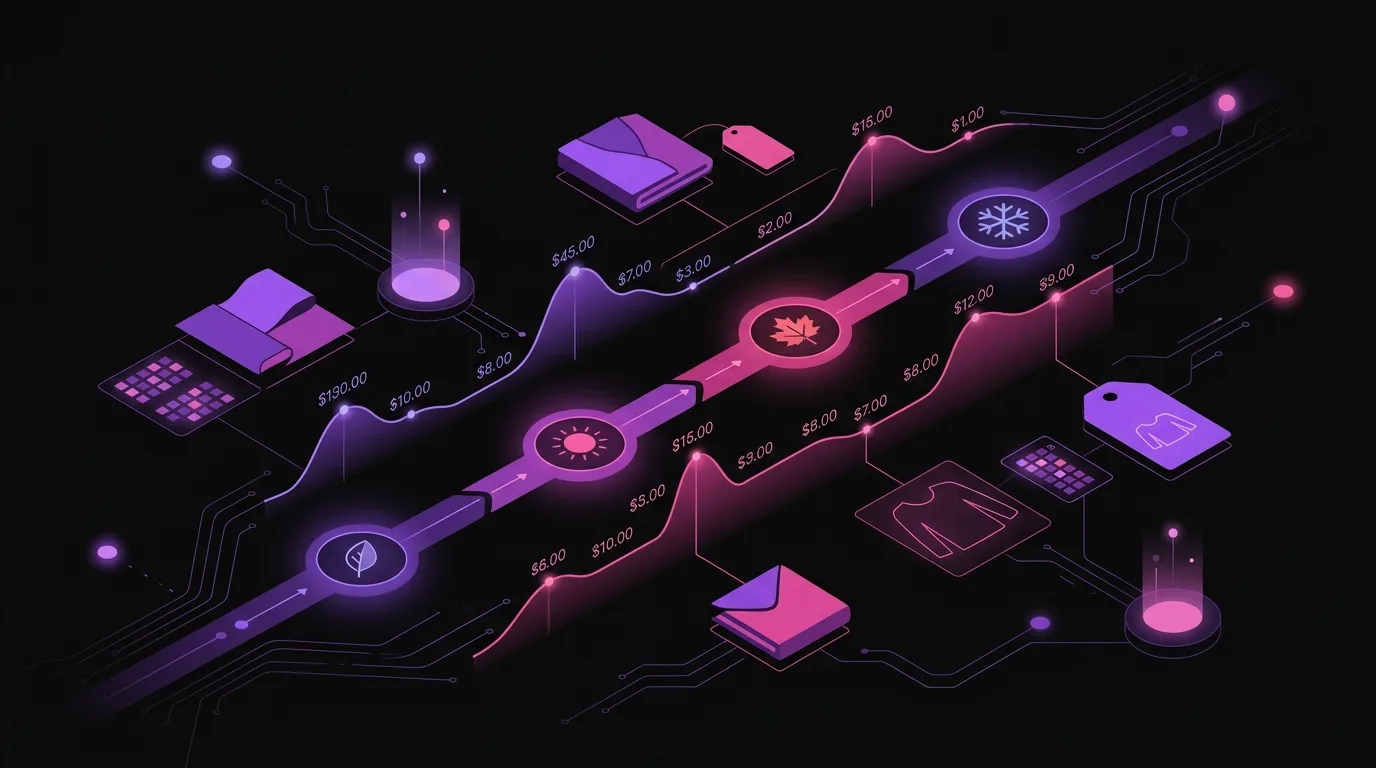
Odoo manages prices through pricelists that allow defining rules with validity dates, customer categories, and volume conditions. The system applies the correct price automatically, both in the store POS and in eCommerce.
For a fashion store with two seasons plus two sales periods, the standard configuration usually includes:
- A base pricelist with the standard RRP for the whole year
- A «Summer Sales» pricelist active during July and August with a discount on the spring-summer collection
- A «Winter Sales» pricelist active in January and February on the autumn-winter collection
- A «Loyalty Club» list with permanent conditions for customers registered in the points programme
The system automatically selects the applicable list based on a configurable hierarchy. The shop assistant doesn't have to remember which price to apply: Odoo calculates and displays it directly on screen.
An important advantage is that this logic is replicated exactly the same in the online store. There aren't two different prices for the same product depending on the channel. The price the customer sees on the website is the same as they see in-store, with the same conditions active at that moment.
POS in physical store: variants, stock, and cash register closing
In the Odoo point of sale, when the shop assistant searches for a model on screen, a visual variant selector appears: a size-by-colour matrix with the stock available in that store. Combinations out of stock are visually indicated to avoid errors.
If the barcode is scanned directly, Odoo identifies the exact variant without additional steps. This is the recommended operation: always use the scanner and reserve the visual selector for exceptions, such as when the label is damaged or the garment has no code.
The daily till closure shows sales broken down by model and by variant. This allows identifying which sizes remain unsold at the end of the day or at the end of the season, and adjusting the next purchase from the supplier accordingly. In mainstream fashion, extreme sizes often remain in storage: the system clearly shows this without the need to export data to a spreadsheet.
Loyalty from the till: registered customer vs. casual customer
In a fashion store with a loyalty programme, the shop assistant can ask for the email or phone number when closing the sale. Odoo allows configuring this step to be mandatory above a certain amount and optional below it. The purchase history is automatically fed and allows segmenting email or WhatsApp campaigns based on each customer's preferences.
This integration between POS and CRM is one of the most valued points by stores migrating to Odoo from basic till software without a customer database.
What is omnichannel in fashion: a single catalogue and a single stock?
If the physical store also sells online, Odoo eCommerce uses the same catalogue, the same stock, and the same accounting. There's no synchronisation between two different systems because it's the same system. When an item is sold in-store, the website's stock updates instantly. When it's sold on the website, the warehouse sees it immediately.
The customer who buys online can choose from several delivery options:
- Home delivery with common courier companies, via connectors published in the official Odoo app directory
- Click and Collect: collect at the preferred physical store, with the possibility of applying a special rate or condition
- Delivery from the nearest store with stock: optimises delivery time when the central warehouse does not have the variant available
The status of each order is visible in real-time both on the customer's website and on the screen of the store responsible for preparing it.
Marketplaces: more channels without more systems
To expand sales volume, Odoo connects with marketplaces like Amazon, Zalando, or outlet platforms via connectors available in the official app directory or through aggregators like Mirakl. Stock updates in real-time to avoid selling out-of-stock items, and invoicing is centralised in a single accounting system. There's no need to manually reconcile multiple channels at the end of the month.
How do omnichannel returns work in fashion?
The most common case in fashion: the customer buys a size S online, it's too small, and they want to exchange it for an M. If the system forces them to return via the website and buy again via the website, there's a high probability of losing that sale and also customer loyalty.
Odoo resolves this flow in an omnichannel way. The customer enters any physical store with the digital receipt on their mobile or the delivery note on paper. The shop assistant scans the ticket code, Odoo locates the original online order, validates the return, updates that store's stock, and issues the corresponding credit note. If the customer wants size M at that moment, it is processed as a new immediate sale at the current price.
This operation doesn't require the customer to explain anything or the shop assistant to call any internal phone number. The system has all the information and guides the process step by step. It's one of the flows where the difference between an integrated system and a collection of disconnected tools is most noticeable.
Spanish taxation in a clothing store: VeriFactu, VAT and AEAT models
A Spanish clothing store has, in addition to general obligations, specific tax requirements that Odoo covers with its Spanish localisation.
VeriFactu is mandatory in 2026 according to Royal Decree 1007/2023 published in the BOE. Every invoice or ticket issued must carry a verification record that guarantees its integrity before the AEAT. Odoo's Spanish localisation implements this requirement natively: every POS ticket and every eCommerce invoice is automatically signed and registered.
Modelo 303 quarterly VAT return. Odoo's accounting generates this model directly from recorded operations, without the need to export data to any other programme.
Modelo 347 annual return for third-party operations exceeding the threshold set by the AEAT. This typically affects brand suppliers and the logistics operator if the volume is sufficient. Odoo automatically generates it from the same tax reports module.
TicketBAI applies in the Basque Country and Navarre with its own requirements. Odoo's Spanish localisation also covers this obligation for stores located in those territories.
A practical warning: correct tax configuration requires review by a partner with experience in the Spanish localisation. An error in the VAT rate applied to a product variant or in the classification of a sales channel can generate issues in the quarterly return. This is one of the reasons why fashion stores with more complex eCommerce prefer to implement with an official partner.
What to expect from Odoo implementation in a fashion store?
A standard SME fashion store, with a physical store, active eCommerce, and a catalogue of hundreds of models, has an Odoo implementation of medium complexity. The usual scope includes inventory with variants, POS with peripherals, accounting with Spanish localisation, integrated eCommerce, and team training.
The typical phases of such a project are:
- Analysis of the current catalogue and definition of the attribute structure
- Configuration of inventory, variants, and warehouses
- POS with ticket printer, cash drawer, and barcode scanner
- Spanish accounting with VeriFactu and tax models
- eCommerce with catalogue upload and payment gateway
- Data migration from the previous system (Sage, Holded, Excel, or other)
- Differentiated training for the till team, warehouse team, and management
- Testing, client validation, and go-live
The timeframe and budget depend on the actual volume of references, the number of physical stores, the specific integrations required by the business, and the state of the initial data. What we can say is that a well-planned implementation with official Odoo methodology is considerably shorter and more predictable than a generic ERP migration without sector-specific experience.
At Nextdoo, we have implemented Odoo in fashion shops of different sizes and profiles. The initial discovery call, free and without obligation, allows us to estimate the real scope before signing anything.
Frequently asked questions
Can I migrate my Shopify catalogue to Odoo without losing the variants?
Yes. Shopify allows exporting products and variants in CSV format. Odoo natively imports that file, mapping columns to the corresponding fields. The complexity of the migration depends on the volume of references and the prior cleanliness of the exported data: the more organised the starting catalogue, the faster and cleaner the import. A partner with experience in migrations can carry out this process safely and without loss of information.
Does Odoo support electronic shelf labels?
Yes. Odoo has integration with electronic shelf label providers, which allows physically displayed prices in store to be updated automatically from the central system. When a sales price list is activated, the shelf labels are updated without any employee having to go through the store label by label. Especially useful during seasonal sales or with frequent price changes.
How does Odoo manage residual inventory at the end of the season?
Variants that are not sold at the end of the season remain registered in stock at their book value according to the chosen valuation method. They can be grouped under a liquidation price list that automatically applies a discount percentage during the defined period. If they remain unsold at the end of the financial year, they are included in the inventory balance and correctly reflected in the VAT return for the corresponding quarter.
What happens if I have several suppliers with catalogues in different languages?
Odoo is multi-language out of the box. You can import the supplier's catalogue in its original language and translate the descriptions to Spanish manually or with the assistance of integrated tools. International sizes (EU, UK, US, IT) are managed as separate attribute values or by mapping them on the product sheet, depending on how you want to show it to the end customer.
Does VeriFactu also affect eCommerce sales?
Yes. VeriFactu applies to every invoice or equivalent document issued by the company, regardless of the channel through which the sale originates. eCommerce sales generate invoices or simplified tickets which must also comply with the verifiable registration requirement. The Spanish localisation of Odoo covers this requirement in a unified way for all channels without additional configuration per channel.
Do I need a partner to implement Odoo in my fashion shop?
Technically, Odoo can be installed without a partner. In practice, a fashion shop with a complex catalogue, active eCommerce, and Spanish tax obligations has a level of configuration that goes beyond what general documentation covers. Errors made in the first few weeks of use, especially in the variant structure or tax configuration, are costly to correct once production data exists. An official partner reduces that risk from day one.
Conclusion: Odoo as the central system for a modern fashion store
Managing a fashion shop in 2026 without an integrated system means assuming a permanent hidden cost: team time reconciling data from several programmes, stock errors between online channel and shop, incorrect prices during sales, and difficulties in complying with Spanish tax obligations.
Odoo centralises all of that in a single system: well-structured product variants, automatic seasonal prices, POS with visual selector, eCommerce integrated with the same stock, and accounting with Spanish localisation ready for VeriFactu and AEAT models.
If you have a fashion shop and are evaluating if Odoo fits your business, the first step is a discovery call. Without obligation, no budget until we are clear about the real scope. At Nextdoo, we accompany retail shops of different sizes from analysis to production launch.
Indicative information. Real deadlines, costs, and scopes are confirmed after a personalised analysis. JLM Business Solutions SL · B16842831.
Frequently asked questions
Can I migrate my Shopify catalogue to Odoo without losing the variants?
Yes. Shopify allows exporting products and variants in CSV, and Odoo natively imports them. The complexity depends on the volume of references and the cleanliness status of the starting catalogue. The more organised the exported data, the faster and cleaner the import. A partner with experience in migrations can carry out this process safely and without loss of information.
How does Odoo manage residual inventory at the end of the season?
Unsold variants at the end of the season remain in stock at their book value according to the chosen valuation method. They can be grouped under a liquidation price list that applies an automatic discount during the defined period. If they remain unsold at the end of the financial year, they are included in the inventory balance and correctly reflected in the VAT return for the corresponding quarter.
Does VeriFactu also affect eCommerce sales?
Yes. VeriFactu applies to every invoice or equivalent document issued by the company, regardless of the sales channel. eCommerce sales generate invoices or simplified tickets which must also comply with the verifiable registration requirement according to Royal Decree 1007/2023. The Spanish localisation of Odoo covers this requirement in a unified way for all channels without additional configuration per channel.
What happens if I have suppliers with catalogues in different languages?
Odoo is multi-language out of the box. You can import the supplier's catalogue in its original language and translate the descriptions to Spanish manually or with integrated tools. International sizes such as EU, UK, US, or IT are managed as separate attribute values or by mapping them on the product sheet, depending on how you want to show it to the end customer in the shop or on the website.
Does Odoo support electronic shelf labels?
Yes. Odoo has integration with electronic shelf label providers, which allows physically displayed prices in store to be updated automatically from the central system. When a sales price list is activated, the labels are updated without any employee having to go through the shop one by one. Especially useful during seasonal sales periods.
Do I need a partner to implement Odoo in a fashion shop?
Technically Odoo can be installed without a partner. In practice, a shop with a complex catalogue, eCommerce, and Spanish tax obligations has a level of configuration that goes beyond what general documentation covers. Errors in the variant structure or tax configuration, if made at the beginning, are costly to correct once production data exists. An official partner like Nextdoo reduces that risk from day one.