In summary. Odoo is the most complete solution for a Spanish bookshop in 2026. It manages ISBN catalogue, editorial consignment with automatic settlement, returns to publishers, author signing events with online booking, B2B sales to schools, and full Spanish taxation, including VeriFactu mandatory from 2026. A single platform, without duplicating data across applications.
Managing a bookshop in 2026 goes far beyond selling books. You need to control a catalogue with thousands of ISBN-identified references, distinguish your own stock from consignment stock from the publisher, settle with each supplier promptly, comply with taxation (super-reduced VAT at 4%, VeriFactu mandatory from 2026), organise author signing events, and handle B2B orders from schools and libraries. Odoo brings all of this together in a single tool.
What is the real challenge of managing an independent bookshop?
A local bookshop in Spain is not just a shop. It's a business with a very specific logistical and tax particularity that most generic tools don't resolve well.
The catalogue can exceed five thousand active references, many of them with very low turnover. The ISBN is the universal identifier for a book, but it needs to be enriched with data such as publisher, author, subject, collection, and language to be truly useful in daily management.
Added to this is editorial consignment, which is standard practice in the sector. The publisher leaves books in the bookshop without charging for them. Only those that are sold are paid for. Those that aren't are returned. This system requires differentiated stock control that many solutions do not natively provide for.
And then there's the cultural component: events. Book launches, author signings, reading clubs, school visits. These are activities that generate community and loyalty, but they also require capacity management, communication, and, in some cases, the sale of tickets or the author's own book.
ISBN Catalogue: the database that truly works
Each book is a unique product identified by its ISBN-13, which matches the EAN-13 barcode on the back cover. In Odoo, each book is registered as a product with that code as the primary identifier.
This allows reading the barcode at the point of sale, upon goods receipt, or during inventory with a handheld scanner or a mobile phone. Without manually typing any data.
To upload the catalogue in bulk, there are import tools from CSV or Excel files. Some integrators complement this with connectors to public ISBN databases like DILVE (the database of books for sale in Spain, managed by the Federation of Publishers' Guilds) or Cegal, which allow auto-completion of title, author, publisher, synopsis, and cover from the ISBN.
The recommended attributes for each book in Odoo are:
- ISBN-13 as internal reference and EAN
- Author or authors
- Publisher
- Collection
- Subject (UDC or IBIC classification)
- Language
- Year of publication
- Binding type (hardcover, paperback, pocket)
- VAT type (super-reduced 4% for books, general 21% for stationery)
With this well-structured record, day-to-day filters and searches work quickly. A customer asks for new releases by a specific author in paperback, and the result appears in seconds.
Editorial consignment: the heart of bookshop management
Editorial consignment is the mechanism that distinguishes a bookshop's accounting from any other retail store. The publisher delivers the book but does not charge for it. The book is in the shop, takes up shelf space, and can be sold. But accounting-wise, it is not a cost until it is sold.
Odoo manages this by separating consignment stock from firm-purchase stock. Each publisher working under a consignment arrangement has its own differentiated warehouse or location. The cost of the product in that warehouse is zero until the point of sale.
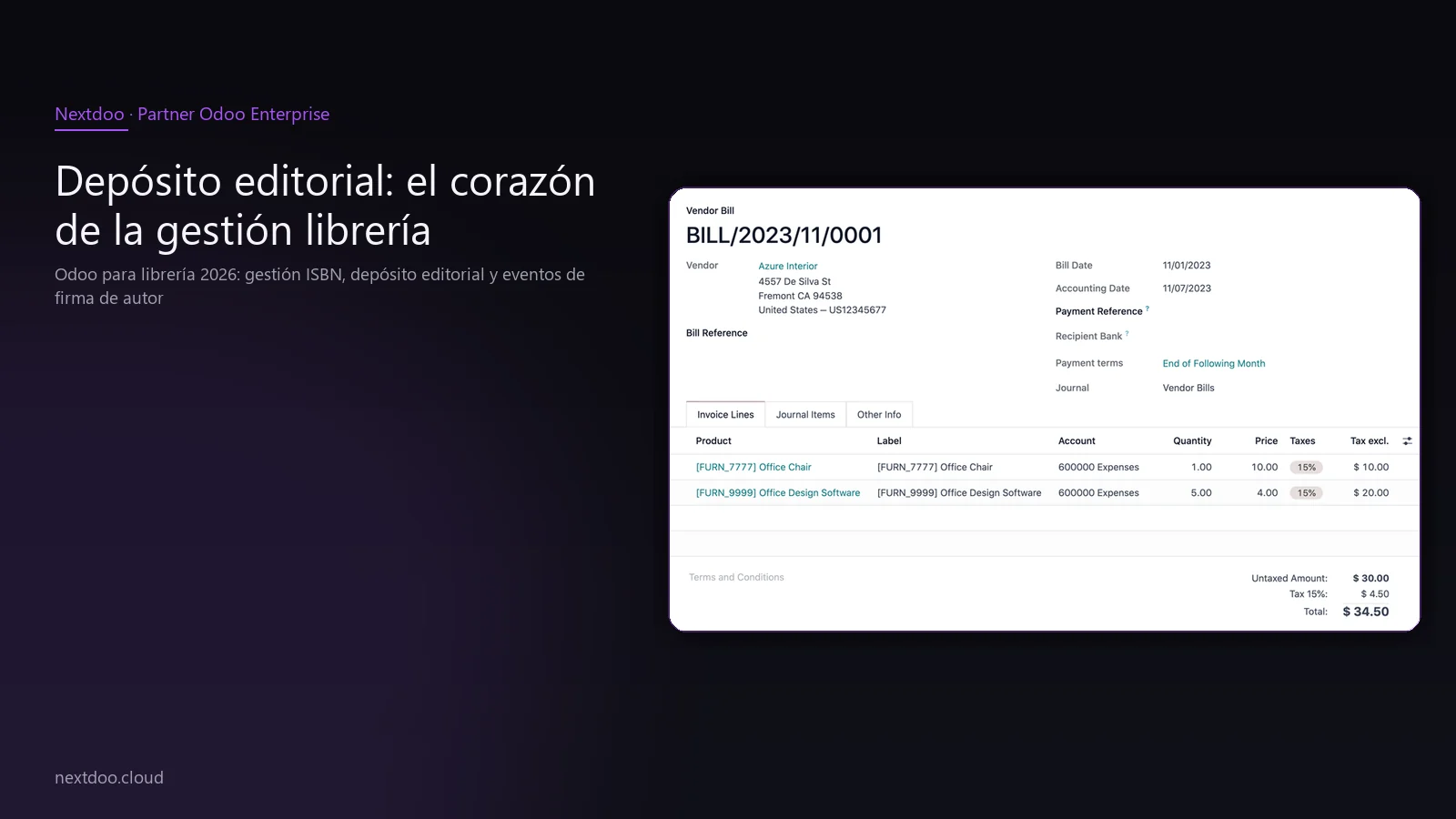
When a book on consignment is sold, Odoo automatically records the payment obligation to the supplier for the price agreed with the publisher. At the end of the agreed period (monthly, quarterly, bi-annual according to the agreement), Odoo generates the consolidated settlement with each publisher: how many copies were sold, at what price, and what is owed.
This avoids manual errors in spreadsheets and greatly facilitates the relationship with editorial representatives. Everything is documented.
The steps of the flow are:
- Receipt of books on consignment (cost-free goods receipt note)
- Availability for in-store sale
- Automatic cost registration upon sale
- Generation of periodic settlement to the publisher
- Supplier invoice based on the approved settlement
How do returns to publishers work in the consignment cycle?
Each batch of books on consignment has a return deadline agreed with the publisher. After this date, unsold copies must be returned to the supplier. If not properly controlled, the bookshop ends up paying for books it didn't sell or returning them late with penalties.
Odoo allows filtering consignment stock by publisher and return deadline. With that filter active, the consolidated return note to each publisher is generated with a couple of clicks.
The process cancels the payment obligation for the returned copies and updates the stock. The publisher receives the delivery note and can cross-reference it with their own system. No phone calls, no emails with manual lists.
This is especially relevant at the end of the school campaign in summer and in January, when returns of Christmas novelties are massive. Managing this without an adequate system is a source of errors and tension with publishers.
Furthermore, Odoo maintains a complete history for each publisher: what was received on consignment, what was sold, what was returned and on what dates. A history that helps negotiate better conditions for the next season.
Events: author signings, presentations, and reading clubs
The independent bookshop thrives on its community. Events are a fundamental tool to differentiate themselves from online sales and large warehouses. But organising an author signing event involves work: it needs to be announced, capacity managed, attendees confirmed, reminders communicated and, in many cases, the author's book sold in that same context.
Odoo manages this with its events functionality, which allows creating a public page for each event with date, location, description and maximum capacity. Interested parties register directly from that page. If the capacity is full, Odoo manages an automatic waiting list.
Pre-event communications (e.g., a reminder the day before) and post-event communications (satisfaction survey, related recommendations) can be automated. No manual intervention once the flow is configured.
During the event, it is common to sell the author's book at a table. Odoo links it directly to the shop's point of sale. The book is sold, stock is deducted, the till balances.
The event possibilities that Odoo covers for a bookshop are:
- Author signings with or without an entry fee
- Presentations of new publications
- Reading clubs with prior registration
- Writing or illustration workshops
- Organised school visits
- Reading marathons or activities for children
B2B: schools, libraries, and school order management
For many local bookshops, the back-to-school campaign is the period of highest turnover of the year. Schools place consolidated orders for batches of textbooks, parents collect them in-store, and the bookshop has to manage dozens of references with tight deadlines.
Odoo treats schools and libraries as B2B customers with their own conditions: negotiated rates, instalment payment terms, batch orders, and grouped invoicing to the institution instead of to each family.
With Odoo, the following can be done for this channel:
- Create specific rates per B2B customer (school, library, company)
- Manage batch orders for textbooks with prior confirmation from the institution
- Prepare deliveries by year group or by classroom
- Issue grouped invoices to the institution with the agreed payment terms
- Control stock reserved for school orders versus stock available for free sale
Municipal libraries have a different profile: they purchase less frequently, value editorial advice, and usually pay by tender or under public administration conditions. Odoo seamlessly manages this type of customer with their specific invoicing requirements.
Taxation in 2026: super-reduced VAT, VeriFactu and AEAT compliance
Physical and electronic books are taxed at the super-reduced rate of 4% according to Article 91 of Law 37/1992 on VAT. This includes paper books, electronic books, and periodicals. Stationery products, diaries, notebooks, or pens sold in many bookshops are subject to the general rate of 21%.
Odoo applies the correct VAT rate to each product based on its configuration. The Spanish fiscal localisation, included in Odoo, provides the predefined rates and the Spanish chart of accounts. Nothing needs to be configured from scratch.
In 2026, compliance with VeriFactu is mandatory for most companies issuing invoices in Spain. VeriFactu is the verifiable invoicing registration system of the Spanish Tax Agency that guarantees the integrity and immutability of each invoice issued. Odoo, with its updated Spanish localisation, generates the required VeriFactu records without manual intervention.
Other relevant tax obligations for a bookshop:
- Modelo 303: quarterly VAT declaration, with 4% differentiated from 21%
- Modelo 390: annual VAT summary
- Modelo 347: operations with third parties exceeding 3,005 euros annually (consignment publishers generating periodic settlements fall here)
- TicketBAI: mandatory in the Basque Country and Navarre for bookshops in those communities
Odoo cross-references these obligations with sales and purchase data recorded throughout the year. Quarterly declarations are prepared using the data already consolidated in the system.
Point of sale in the bookshop: agility and control at the counter
A bookshop counter has a very specific dynamic. Customers arrive with the title in mind or with the ISBN noted on their phone. The sale needs to be fast, the search immediate, and the till receipt needs to comply with VeriFactu.
Odoo at the point of sale allows searching by ISBN by scanning the book's barcode, by partial title, by author or by subject. The result is immediate. If the book isn't in the shop, you can check if it's in the warehouse, on consignment, or if it needs to be ordered.
Odoo's point of sale also works in offline mode, which is useful if the internet connection fails at any point. Sales are recorded locally and synchronised when the connection returns.
For the bookshop that also has an online store, Odoo synchronises the catalogue and stock between the physical point of sale and the online store. A book sold in the shop reduces stock on the website. No discrepancies or overselling.
What to expect from the Odoo implementation process in a bookshop?
An Odoo implementation in a local bookshop with an ISBN catalogue, publisher consignment, events and a B2B channel is a project of reasonable duration for an SME. It's not an implementation for large corporations, but nor is it done in an afternoon.
The usual phases are business analysis and initial configuration, catalogue upload and migration of historical data if any, team training (manager, sales assistants, purchasing manager), a parallel running period with the previous system and project closure.
The team at Nextdoo, as an official Odoo Enterprise partner in Spain, undertakes these types of projects with experience in the retail sector and in the particularities of Spanish taxation. The investment depends on the actual scope of each project: number of publishers on consignment, catalogue volume, necessary integrations, online channel.
The budget is adjustable to the size of the bookshop. A family bookshop with a small team has very different needs to a chain with several points of sale. The preliminary analysis is the starting point for any specific proposal.
Frequently asked questions
Can I upload my complete catalogue from ISBNs without typing them in one by one?
Yes. Odoo allows importing products from a CSV or Excel file. With a file that includes the ISBNs, the mass upload process is fast. Additionally, there are connectors to databases such as DILVE or Cegal that autocomplete book data (title, author, publisher, cover) based on the ISBN. The upload time depends on the catalogue volume and the quality of the source data, but in no case does it involve typing in entry by entry.
How exactly does publisher consignment work in Odoo?
Books received on consignment enter the system at zero cost, in a stock location separate from stock purchased outright. When a book on consignment is sold, Odoo records the agreed publisher cost and generates the payment obligation to the supplier. At the end of the settlement period, Odoo consolidates all sales from that publisher and generates the corresponding settlement. The publisher receives the information, issues an invoice, and Odoo cross-references it with the generated settlement. The cycle is closed without additional manual intervention.
What happens if I don't return books on consignment on time?
Odoo allows you to configure alerts for the return deadline. Before the deadline expires, the system notifies you to prepare the return delivery note. If the date is passed without returning the items, the bookshop may be obliged to pay for the copies, according to the agreement with the publisher. Having this controlled in Odoo avoids unpleasant surprises at the end of the campaign.
Can Odoo manage online book sales in addition to the physical shop?
Yes. Odoo has its own online store integrated with the catalogue and stock of the physical shop. When a book is sold in the shop, the stock is also deducted on the website. When an online order is placed, the stock is reserved for that order. There's no need to manually update two different systems. For bookshops that want to venture into the online channel without making things complicated, this native integration is a real advantage.
Does Odoo comply with VeriFactu for a bookshop?
Yes. The Spanish localisation of Odoo, maintained and updated for the Spanish market, includes VeriFactu compliance, which is mandatory in 2026 for most companies issuing invoices in Spain. Each sales receipt and each invoice are registered with the integrity and inalterability requirements demanded by the Tax Agency. There's no need to configure anything additional if the implementation is done correctly with the Spanish localisation activated.
Does Odoo make sense for a small bookshop with a single employee?
It depends on the volume of operations and business complexity. A bookshop with active publisher consignment from several publishers, a B2B channel with schools and regular events already justifies a tool like Odoo, even if the team is small. The saving in manual management time and in settlement errors can be very significant from the first year. For a bookshop with very limited activity and no publisher consignment, the preliminary analysis will determine if the fit is appropriate.
Conclusion: Odoo as the central system for the modern bookshop

A bookshop in 2026 cannot afford to manage its catalogue in a spreadsheet, publisher consignment in another, events in a third-party application and accounting in a separate programme. Fragmentation generates errors, duplicates work, and makes it impossible to have a clear real-time view of the business.
Odoo centralises everything: ISBN catalogue, publisher consignment with automatic settlement, controlled returns, events with online booking, B2B sales to schools, point of sale at the counter and full tax compliance with VeriFactu and AEAT models.
If you own a bookshop and want to know if Odoo fits your specific situation, the starting point is always a no-obligation analysis call. The actual scope of each project is defined with the data on the table.
Indicative information. Actual timelines, costs and scopes are confirmed after a personalised analysis. JLM Business Solutions SL · B16842831.
Frequently asked questions
Can I upload my complete catalogue from ISBNs without typing them in one by one?
Yes. Odoo allows importing products from a CSV or Excel file. With a file that includes the ISBNs, the mass upload process is fast. Additionally, there are connectors to databases such as DILVE or Cegal that autocomplete book data based on the ISBN. The upload time depends on the catalogue volume and the quality of the source data.
How exactly does publisher consignment work in Odoo?
Books received on consignment enter the system at zero cost, in a location separate from stock purchased outright. When a book on consignment is sold, Odoo records the agreed publisher cost and generates the payment obligation to the supplier. At the end of the settlement period, Odoo consolidates all sales from that publisher and generates the settlement. The publisher issues an invoice, and Odoo cross-references it with the generated settlement. The cycle is closed without additional manual intervention.
What happens if I don't return books on consignment on time?
Odoo allows you to configure alerts for the return deadline. Before the deadline expires, the system notifies you to prepare the return delivery note. If the date is passed without returning the items, the bookshop may be obliged to pay for the copies according to the agreement with the publisher. Having that control in Odoo avoids surprises at the end of the campaign.
Can Odoo manage online book sales in addition to the physical shop?
Yes. Odoo has its own online store integrated with the catalogue and stock of the physical shop. When a book is sold in the shop, the stock is also deducted on the website. When an online order arrives, the stock is automatically reserved. There's no need to manually update two different systems.
Does Odoo comply with VeriFactu for a bookshop?
Yes. The Spanish localisation of Odoo includes VeriFactu compliance, mandatory in 2026 for most companies issuing invoices in Spain. Each sales receipt and each invoice are registered with the integrity and inalterability requirements demanded by the Tax Agency.
Does Odoo make sense for a small bookshop with a single employee?
It depends on the volume of operations and business complexity. A bookshop with active publisher consignment from several publishers, a B2B channel with schools and regular events already justifies Odoo even if the team is small. The saving in manual management time and in settlement errors can be very significant from the first year. The preliminary analysis determines if the fit is appropriate.