In summary. Five Spanish SMEs from different sectors —fashion retail, motorcycle dealership, stationery shop, online outlet, and B2B consultancy— migrated to Odoo with Nextdoo. In all cases, they reduced operational hours, improved financial control, and complied with current Spanish tax regulations. The common key: phased implementation, without trying to cover everything at once. The return on investment arrived within a reasonable timeframe in each case.
Managing a Spanish SME with several disconnected systems always ends the same way: lost hours reconciling data, inventory errors, and late accounting. These five real cases demonstrate that there is a way out, and that Odoo is the most direct path to it.
Five Spanish retail and distribution SMEs managed to reduce operational costs and improve their financial control by migrating to Odoo during 2025.
Why are success stories only valid if they are honest?
There are many 'success story' articles that say nothing. Round numbers, generic testimonials, warehouse photos. This is not one of those articles.
The five cases you will read below are real. Names are omitted for confidentiality, but the sectors, starting situations, and results are truthful. There is no inflated marketing.
What unites these five companies is simple: all had disconnected systems, all lost time and money on manual tasks, and all were looking for a solution that worked in Spain, with Spanish taxation, without relying on fragile integrations.
Odoo, implemented with methodology and without trying to do everything at once, was the answer in each of these cases.
Case 1: fashion chain with four shops and e-commerce
This fashion company operated with Shopify for the online store, Quickbooks for accounting, and spreadsheets for inventory. The result was predictable: twelve weekly hours reconciling stock between channels, frequent pricing errors, and accounting that was always behind reality.
After migrating to Odoo, everything was in a single system. The physical POS, the online store, and central inventory communicate with each other in real-time. The team went from twelve weekly hours of manual reconciliation to less than two.
The impact on daily operations was immediate. The warehouse manager stopped receiving urgent calls from the shop due to stock discrepancies. The financial team closed the month with the month's data, not the previous month's.
During implementation, inventory and POS were prioritised first. The e-commerce part was integrated in a second phase. This decision —to start with the minimum viable— is what allowed the team to adopt the system without blockages.
The return on investment arrived within a reasonable timeframe, consistent with the operational volume of a chain of this size.
What was done differently here
The usual mistake in retail implementations is wanting to migrate everything in parallel. In this case, a phased migration was chosen: first the physical shops, then e-commerce. The learning curve was much smoother and team adoption was almost natural.
Case 2: motorcycle dealership with a single point of sale
This dealership had been using an old vertical software that wasn't evolving for years. Without a real web presence, without email marketing, without CRM. Sales depended one hundred per cent on physical traffic and the salesperson's schedule.
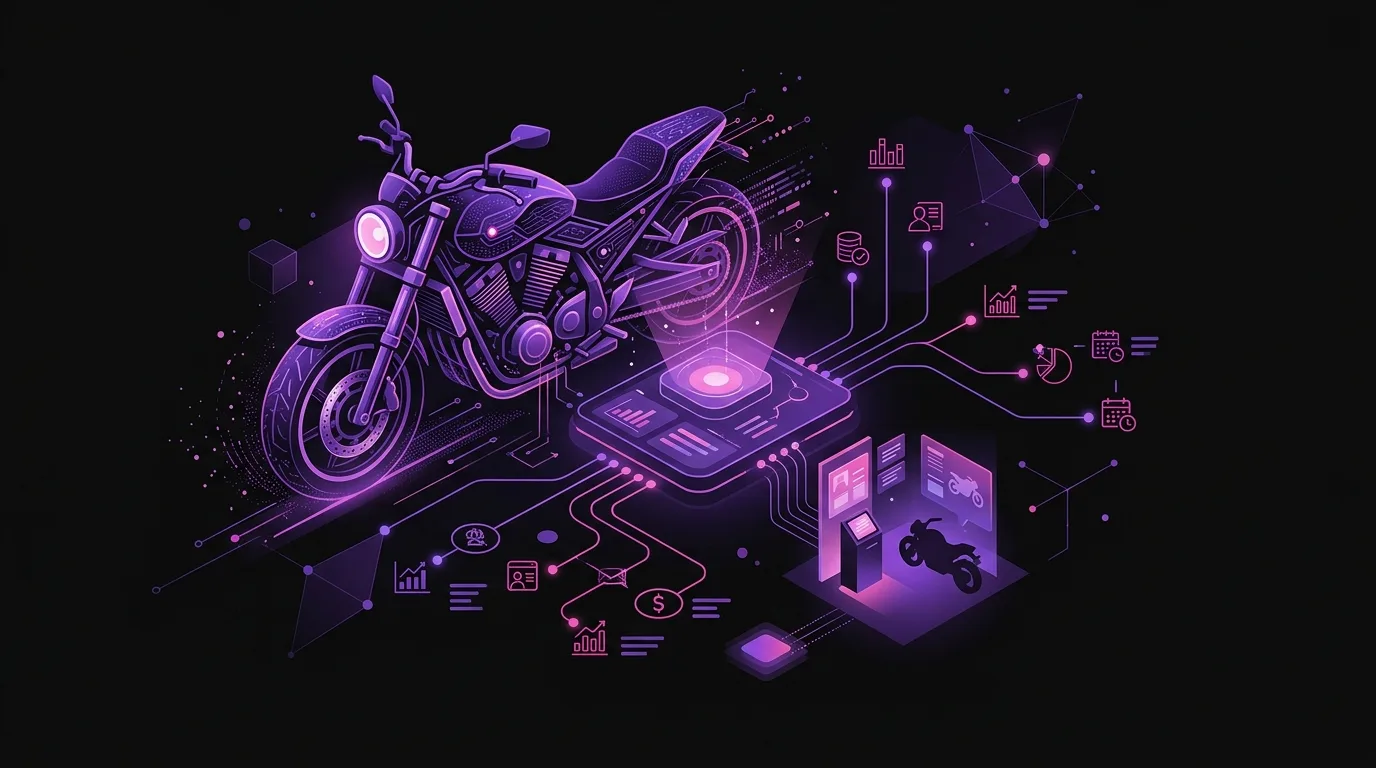
The implementation combined Odoo with Nextdoo SM, Nextdoo's own vertical for the motorcycle sector. The result was a unified platform that integrates sales, the workshop, CRM, and email campaigns.
The new website, connected directly to Odoo, started generating leads from the first month. The unified CRM allowed the workshop mechanic and the salesperson to view the complete customer history in the same place.
This case illustrates something important: in the motorcycle sector, aftersales is as relevant as sales. A customer who takes their motorcycle to the workshop and receives a personalised offer for accessories or insurance is a repeat customer. Without a system that links these points, that opportunity is lost.
The growth in online lead generation was significant in the first few months, without the need for large investments in additional advertising.
Case 3: stationery shop with a physical store
This is the smallest of the five cases, and also the most illustrative of what happens to thousands of small Spanish businesses. Cash register, paper or Word invoices, and accounting handled by an administrative agency with late and incorrect data.
With Odoo, the point-of-sale system, accounting adapted to the Spanish General Accounting Plan, and integration with VeriFactu were implemented to comply with the AEAT invoicing regulations that come into force in 2026.
The time to issue an invoice went from several minutes to seconds. It's not an exaggeration: when the process involves finding the template, filling it in manually, calculating VAT, and saving a copy, time flies. With Odoo, the POS generates the invoice directly and sends it to the AEAT system without intermediate steps.
For an SME of this size, the big gain was not only operational but also peace of mind. The self-employed individual who manages the shop knows that their accounting is up-to-date and that they comply with VeriFactu without having to understand the technical details.
VeriFactu and small businesses: an opportunity, not just an obligation
Many small businesses see VeriFactu as an administrative burden. In reality, for those who still invoice manually or with basic tools, it's the perfect excuse to make the leap to a modern system. The cost of complying with VeriFactu within Odoo is marginal if the implementation already includes the accounting module.
Case 4: pure e-commerce multi-brand outlet shop
This business operated exclusively online. PrestaShop for the shop and Holded for accounting and management. The central problem was stock synchronisation: every time new stock arrived or a product ran out, someone had to update the data in two systems. That meant two hours of manual work daily, with the constant risk of selling something that wasn't available.
After migrating to Odoo, stock is managed in a single place. The online shop reads the inventory in real-time. When an order comes in, stock automatically decreases. When a purchase arrives at the warehouse, stock increases. Without manual intervention.
The impact on the margin was notable. With real visibility into the cost of each reference at any given time, the team could make better pricing and stock clearance decisions. End-of-season sales stopped being intuition and became data.
This case is relevant for any business that combines a high volume of references with lean operations. The savings don't come from doing things faster, but from eliminating steps that shouldn't exist.
Case 5: B2B engineering consultancy
This is the only case out of the five that is not strictly retail, but it is relevant because many readers of this blog manage service companies with similar dynamics.
The consultancy worked with Excel for project tracking, email for internal coordination, and a task management tool disconnected from invoicing. The result: invoicing was weeks late, clients paid late, and the finance manager had no visibility into which projects were profitable.
With Odoo, project management, time tracking, and invoicing were connected. At the end of the week, recorded hours are automatically converted into invoices pending validation. The validation and sending to the client process was reduced to minutes.
The average collection period fell significantly. Not because clients changed their behaviour, but because invoices arrived earlier and were better documented. A client who receives a clear invoice, with the breakdown of hours and the referenced project, takes less time to approve it internally.
For a consultancy, time not invoiced on time is lost money. This case clearly demonstrates this.
What do these five cases have in common?
If you analyse the five cases from a distance, three recurring patterns emerge.
The starting point is always fragmentation. None of these companies had a terrible system. They had several good systems for specific things, but disconnected from each other. The inefficiency was not in each tool separately, but in the manual bridges between them.
Staged migration makes the difference. In all cases, the implementation started with the most critical area for the business. Inventory, invoicing, or project management, depending on the case. The rest was incorporated later, once the team was already proficient with the system.
Tax compliance was not a separate problem. In cases where it was relevant —especially in retail with VeriFactu and Spanish accounting—, tax adaptation was integrated from the beginning, not as a later add-on.
How to evaluate if your SME is ready to make the leap?
Not all SMEs are at the same point of maturity. Before considering a migration to Odoo, it's worth doing an honest diagnosis.
These signs indicate that now is the time:
- You have two or more tools that don't synchronise and someone spends time keeping them aligned.
- Your accounting is always behind real operations.
- You don't know, in real-time, how much stock you have or at what cost.
- You invoice late, you collect late and you don't know which projects or product lines are truly profitable.
- You have to comply with VeriFactu or TicketBAI and your current tool is not adapted.
If you identify with two or more of these points, the cost of not acting is greater than the cost of migrating.
Methodology matters as much as software
Odoo is a powerful tool, but an implementation without methodology can end badly. Projects that fail —and there are some— usually have a common cause: wanting to migrate everything at once without prioritising the minimum viable.
At Nextdoo, we work with a phased methodology. First the critical core, then the additional layers. The result is faster adoption and significantly lower operational risk during the transition.
Frequently asked questions
Are these cases applicable to my sector even if it's not exactly the same?
The principles are applicable: system fragmentation, time lost on manual tasks, delayed invoicing, or lack of stock visibility are cross-cutting problems. Implementation details vary by sector, but the initial diagnosis is often very similar. If your business has any of the symptoms described, it's worth exploring which part of the approach is applicable to your specific case.
How long does an Odoo implementation for a retail SME really take?
It depends on the scope and the complexity of existing data. A well-sized implementation for a small SME can be quite agile if the initial scope is appropriate. Implementations that drag on indefinitely usually have in common wanting to tackle too much from the beginning. With a phased methodology, the time to the first go-live is reasonable and the team starts benefiting from the system before it is one hundred per cent complete.
Does Odoo comply with VeriFactu and TicketBAI for the Spanish market?
Yes. Odoo Enterprise incorporates adaptations for Spanish tax regulations, including VeriFactu (mandatory for companies in the territory of application from 2026 according to the BOE) and TicketBAI for the chartered territories of the Basque Country and Navarre. The implementation with Nextdoo includes the necessary configuration for the company to comply from day one.
What happens to my data when I migrate from Holded, PrestaShop or another tool?
Data migration is one of the most critical points and also one of the most unnecessarily feared. In most cases, historical data of clients, suppliers, products, and accounting balances are migrated in an organised manner. The process requires planning and validation, but it doesn't mean starting from scratch. What we do recommend is to clean up data before migrating: less rubbish in, less rubbish out.
Can I start only with the POS part and expand later?
Yes, and in fact it's one of the most common approaches in small retail. The point of sale can be implemented independently and then connected with accounting, inventory, or ecommerce as the business requires. Odoo's architecture is designed to grow with the company.
What happens if my team isn't technical and has never used an ERP?
It's the most common situation. Odoo is designed for business users, not for technicians. The interface is intuitive and the training included in the implementation is aimed at making the team self-sufficient in their day-to-day tasks. The cases in this article include profiles without any prior ERP experience, and adoption was successful in all of them.
Conclusion: ROI is not magic, it's methodology
None of these five cases was a miracle. They were the result of an honest diagnosis, a well-prioritised implementation and a team willing to change their way of working.
The return on investment in well-executed implementations arrives within a reasonable timeframe. Those that fail —and it should be said— are usually the ones that want to do everything at once, without prioritising, without training and without a partner who knows the Spanish context.
If your SME shows symptoms of operational fragmentation, if you invoice late, if your accounting is not up to date or if VeriFactu generates doubts for you, the time to act is now. Not because Odoo is the only answer, but because every month that passes with disconnected systems has a real cost, even if it doesn't appear on any balance sheet line.
Take the first step: request a situation analysis and discover which implementation phase makes sense for your business.
Indicative information. Actual timelines, costs and scopes are confirmed after a personalised analysis. JLM Business Solutions SL · B16842831.
Frequently asked questions
Are these success stories applicable to my sector even if it's not exactly the same?
The principles are cross-cutting: system fragmentation, time lost on manual tasks, and lack of visibility of stock or invoicing are problems that affect very different sectors. Implementation details vary, but the initial diagnosis is usually very similar. If your business shows any of the symptoms described in the cases, it's worth exploring which part of the approach is applicable to your specific situation.
How long does an Odoo implementation take for a Spanish retail SME?
It depends on the scope and complexity of existing data. With a phased methodology and a well-dimensioned initial scope, the time until the first go-live is reasonable for most SMEs. Implementations that drag on usually have in common wanting to tackle too much from the start. Starting with the critical core of the business accelerates adoption and reduces operational risk during the transition.
Does Odoo comply with VeriFactu and TicketBAI for the Spanish market?
Yes. Odoo Enterprise incorporates the necessary adaptations for Spanish tax regulations, including VeriFactu —mandatorily applicable according to the BOE for companies in common territory from 2026— and TicketBAI for the chartered territories of the Basque Country and Navarre. Implementation with Nextdoo includes the necessary configuration for the company to comply with these obligations from the first day of use.
What happens to my data when I migrate from Holded, PrestaShop or another tool?
Data migration is one of the most feared points and, in practice, one of the most manageable with good planning. Historical data of customers, suppliers, products and accounting balances are migrated in an organised manner in the vast majority of cases. It does not mean starting from scratch. What is recommended, however, is to do a prior clean-up: clean data when migrating means a clean system when starting up.
Can I start with just the point of sale and expand later?
Yes, and it is one of the most common approaches in retail. The point of sale can be implemented independently and later connected with accounting, inventory or e-commerce when the business requires it. Odoo's architecture is designed to grow with the company without needing to change platforms.
What makes Nextdoo different from other Odoo partners in Spain?
Nextdoo is an official Odoo Enterprise partner in Spain, specialising in retail, hospitality and the motorcycle sector through Nextdoo SM, its own vertical. They know Spanish taxation —VeriFactu, TicketBAI, Models 303, 347 and 390— and work with SMEs operating in the peninsular market, which translates into implementations adapted to local reality without relying on generic configurations designed for other markets.
Frequently asked questions
How long does it take for an SME to see a return on investment after migrating to Odoo?
According to the cases analysed, the return on investment arrives within a reasonable timeframe when the implementation is done in phases and without trying to change everything at once. The exact time depends on the size and complexity of the company, but these five cases demonstrated that it is achievable without excessive waiting.
Is it necessary to change all systems at once or can I do it gradually?
Phased implementation is the key to success in these cases. Avoiding abrupt changes reduces risks and allows the team to adapt without operational trauma. All the cases analysed opted for this gradual methodology.
Does Odoo comply with current Spanish tax regulations?
Yes, the five SMEs migrated to Odoo and complied with current Spanish tax obligations, including VeriFactu and accounting before the AEAT. The system is prepared for Spanish regulations.
Which sectors can benefit from migrating to Odoo according to these cases?
The cases cover retail fashion, motorcycle dealerships, stationery, online outlet stores and B2B consulting. This demonstrates that companies from very different sectors can benefit from migration, provided they have disconnected systems that cause loss of operational hours.
What is the main problem Odoo solves in these SMEs?
The common problem is management with disconnected systems that leads to wasted hours reconciling data, inventory errors and delayed accounting. Odoo centralises all information and significantly reduces these operational inefficiencies.