
In summary. Odoo's fiscal localisation for Spain in 2026 covers all mandatory requirements: VeriFactu according to Royal Decree 1007/2023, TicketBAI in the Basque Country, and AEAT models 303, 347, 349 and 390. Properly configured by an Enterprise partner like Nextdoo, it transforms tax obligations into automatic processes and eliminates manual errors at the end of the quarter.
Odoo automates all Spanish tax obligations in 2026: VeriFactu, Basque TicketBAI and quarterly AEAT models without manual errors.
Why is fiscal localisation the most critical part of your ERP?
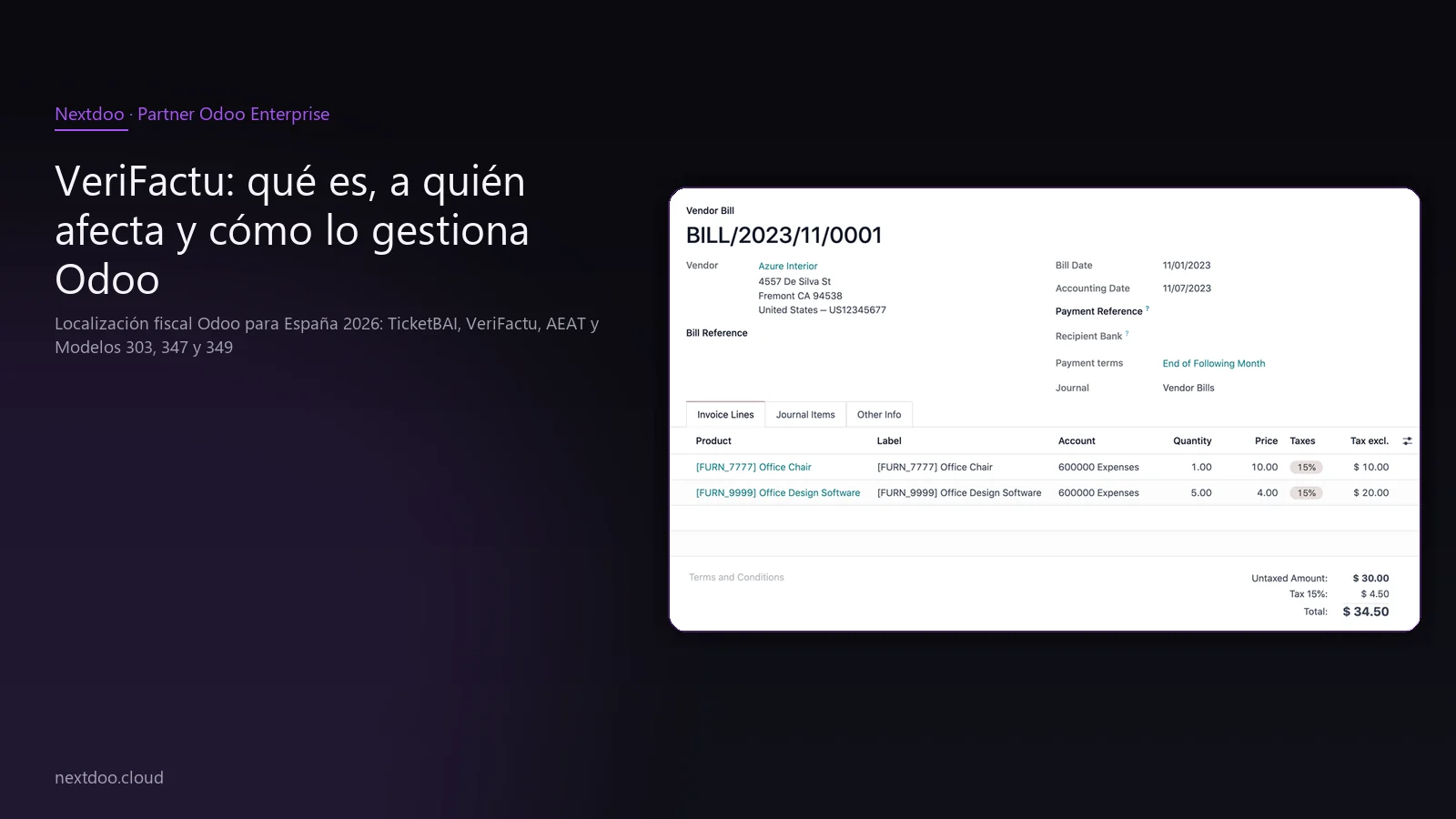
An ERP without correct fiscal localisation is not an ERP: it's a postponed problem. In Spain, tax obligations are demanding and change frequently. Royal Decree 1007/2023 introduced VeriFactu. The Foral Treasuries of the Basque Country maintain their own system, TicketBAI. The AEAT requires periodic models with specific telematic formats.
Many SMEs start with generic solutions or tools designed for other markets. The result is always the same: the administration team patches, the consultancy corrects, and the self-employed individual or director signs declarations that don't quite match the reality of the system.
Odoo solves this from the ground up. Spanish localisation is not an external add-on: it's part of the core of the solution for the Spanish market and is maintained by the official community together with certified partners. When you contract the implementation with an Enterprise partner like Nextdoo, you receive it configured and validated, not as an experiment.
What you will see in this guide is practical. Without unnecessary technical jargon. With the real fiscal concepts that affect your business in 2026.
The foundation of everything: the chart of accounts and general fiscal configuration
Before talking about VeriFactu or TicketBAI, it's essential to understand what underpins everything else. For Spain, Odoo includes an official chart of accounts adapted to the General Accounting Plan. It's not a generic scheme that then needs to be adapted manually: it comes structured with the accounts that your consultancy or tax advisor will immediately recognise.
On this chart of accounts rest the VAT types available in Spain: general, reduced, super-reduced, exempt, and special cases such as the equivalence surcharge or the agricultural regime. Every invoice your company issues or receives in Odoo automatically applies the correct type, provided the initial configuration is appropriate.
IRPF withholdings are also integrated. This is fundamental for self-employed individuals working with professionals or for any company receiving invoices with withholdings. Odoo reflects them in the accounting without anyone having to perform manual calculations.
Special regimes: equivalence surcharge and simplified
The equivalence surcharge regime primarily affects retail trade. Odoo manages it natively: when you configure a supplier under this regime, invoices automatically include the corresponding surcharge without the administration team having to remember it.
The simplified VAT regime, common in hospitality and small businesses, also has its specific treatment. The difference between one regime and another is not cosmetic: it completely changes how each operation is accounted for and what is declared to the AEAT. Incorrectly configuring the regime is one of the most common errors in implementations without a specialised partner.
VeriFactu: what it is, who it affects and how Odoo manages it
VeriFactu is the verifiable invoicing system required by Royal Decree 1007/2023. Its objective is to ensure that no issued invoice can be modified or deleted without leaving a trace. To achieve this, each invoice generates a verification code (hash) chained with the previous one, so that any alteration in the history becomes detectable.
From 2026, VeriFactu is mandatory for most companies and self-employed individuals in the common Spanish fiscal territory not subject to TicketBAI. It affects both those who issue paper invoices and those who do so electronically.
Odoo incorporates VeriFactu compatibility in its Enterprise edition. When activated, each invoice you issue is registered with its digital footprint, chained with the previous one, and can be sent in real time to the AEAT via its official API. The system also allows for deferred submission, within the deadlines set by the regulations.
What changes in your day-to-day with VeriFactu active
From an operational point of view, VeriFactu does not add steps to the invoicing process. You issue the invoice as usual. Odoo does the rest: it generates the hash, sends the information to the AEAT, and registers the confirmation. If there is any error in the submission, the system notifies you so you can resolve it before it causes a real problem.
The important thing is that active VeriFactu does not mean additional bureaucracy for your team. It means your invoicing has the traceability required by law, without anyone having to manage it manually.
TicketBAI: verifiable invoicing in the Basque Country
TicketBAI is the Basque equivalent of VeriFactu, with some relevant differences. It applies if your company has its fiscal domicile in Álava, Biscay or Gipuzkoa. If you invoice from the common territory but have clients in the Basque Country, TicketBAI does not directly affect you as an issuer.
The operation is similar to VeriFactu: each issued invoice includes a verification code and a QR code, and is sent in real time to the corresponding Foral Treasury. The difference lies in the fact that the three Basque provinces have their own telematic systems and their own digital certificate requirements.
Odoo supports TicketBAI for all three territories. Configuration requires having the company's digital certificate and correctly selecting the destination Foral Treasury. Once configured, the submission process is automatic for each invoice.
TicketBAI and Navarre: the current situation
Navarre has its own invoicing control system, known as TICKET-BAI Navarre or simply as the Navarre foral verifiable invoicing system. Although it shares its philosophy with the Basque TicketBAI, technically they are distinct systems. If you operate in Navarre, it is advisable to review the status of the current foral regulations at the time of implementation, as the timetable and requirements may differ from those of the Basque Country.
AEAT Models integrated into Odoo: 303, 347 and 349
The connection between daily accounting and periodic declarative obligations is one of the points where Odoo adds most value to a Spanish SME. When all invoices pass through Odoo with the correct configuration, AEAT models are generated almost automatically.
Model 303 (Quarterly VAT): Odoo collects all invoices issued and received during the quarter, applies the corresponding VAT types, and generates Model 303 ready for review and submission. The exported file is compatible with the AEAT's telematic format.
Modelo 347 (transactions with third parties): This model compiles annual transactions exceeding 3,005.06 euros with the same customer or supplier. It is one of the models that generates the most errors when accounting is not well integrated with invoicing. In Odoo, as both areas share the same database, the information is consistent and the model is generated without cross-referencing data from different systems.
Modelo 349 (intra-community transactions): If your company buys from or sells to businesses in other European Union countries, Modelo 349 is mandatory. Odoo automatically identifies intra-community transactions based on the customer's or supplier's VAT ID and includes them in the corresponding model.
Modelo 390: annual VAT summary
Modelo 390 is the annual VAT summary. Although its submission has been suspended since 2024 for those in the Immediate Information Supply (SII) system, it remains relevant for those not in that regime. Odoo can generate the annual summary with the same data that feeds the quarterly returns, which guarantees consistency between the annual and quarterly declarations.
What are the common errors in tax localisation and how to avoid them?
Odoo's localisation for Spain is robust, but it only works well if configured correctly from the start. These are the most frequent errors we see in SMEs that come to Nextdoo after attempting implementation on their own or with less specialised partners.
Incorrect tax regime assigned. Assigning the general regime to a company that pays VAT surcharge, or vice versa, generates errors in every invoice. Correcting it retrospectively involves reviewing the accounting history.
Digital certificate not configured before issuing real invoices. VeriFactu and TicketBAI require a digital certificate to send data to the administration. If you start issuing invoices in production without having it configured, those invoices will not have been communicated to the AEAT or the Foral Tax Agency. Rectifying it after the fact is complex.
Duplicated or incorrectly labelled VAT rates. When someone modifies standard VAT rates or creates new ones without proper criteria, Modelo 303 stops balancing. The VAT rates must correspond exactly with what the AEAT expects in its models.
Not distinguishing between simplified and full invoices. In retail and hospitality, the simplified invoice (receipt) is treated differently from a full invoice. Mixing them affects both accounting and VAT models.
Intra-community suppliers without correct VAT ID. If a European supplier's VAT ID is not correctly registered, Odoo will not identify the operation as intra-community and will not include it in Modelo 349. It's a silent error that only appears when the AEAT cross-references data.
Implementation with Nextdoo: what it includes in the fiscal section
At Nextdoo, we work with a tax advisor on every implementation project. It's not an extra: it's part of the standard process. The reason is simple: the tax configuration of an ERP is not a purely technical decision. It requires understanding the company's VAT regime, its situation with the AEAT, whether it's in SII or not, whether it operates in the Basque Country or common territory, and which models it submits each period.
The result is a configuration validated by someone who understands both the system and the regulations. Not a generic configuration that then needs to be adjusted.
We also assist with migration from other systems. Many SMEs arrive with their accounting in Sage, Holded, or a spreadsheet. The migration of historical data requires care to ensure that opening balances are correct and that the models for the current financial year balance from day one.
The implementation period varies according to the complexity of each company. A small SME with simple accounting can have the system operational within a reasonable timeframe. A company with multiple cost centres, several VAT regimes, or online store integration requires more upfront analysis time. The important thing is to do it well, not quickly.
Conclusion: taxation is not an option, the tool is
Complying with VeriFactu, TicketBAI, Modelo 303, 347, and 349 is not optional. They are legal obligations with deadlines and real consequences. The question is not whether to do it, but with what tool and with what level of automation.
Odoo, properly configured by a specialised partner, turns these obligations into automatic processes. Your administration team stops wasting time reconciling data between systems and starts reviewing results instead of building them manually.
If your SME does not yet have VeriFactu active or if you have doubts about how your tax localisation is configured in Odoo, now is the time to review it, before the AEAT detects inconsistencies or the next quarterly closing arrives.
At Nextdoo, we analyse your current situation without obligation. If configuration is needed, we migrate. If corrections are needed, we rectify them. Always with tax advice included in the project.
Indicative information. Actual deadlines, costs, and scopes are confirmed after a personalised analysis. JLM Business Solutions SL · B16842831.
Frequently asked questions

Is VeriFactu mandatory for all companies in 2026?
VeriFactu, regulated by Royal Decree 1007/2023, affects companies and self-employed individuals in the common Spanish tax territory who are obliged to issue invoices. Companies already in the AEAT's SII system have their own regime. Those operating in the Basque Country or Navarre are subject to their respective provincial tax systems. If you have doubts about whether your company is obliged and from what exact date, consult directly with the AEAT or your tax advisor.
Can I use Odoo Community to comply with VeriFactu?
Compatibility with VeriFactu is available in the Enterprise edition of Odoo. The Community version does not officially include this functionality. For an SME that needs to comply with VeriFactu in 2026, the Enterprise edition with a certified partner is the recommended route.
Does Odoo generate the Modelo 347 file ready for submission to the AEAT?
Yes. Odoo generates Modelo 347 in the telematic format accepted by the AEAT for online submission. The process requires that all invoices for the financial year are correctly registered in the system with the validated VAT ID of the customer or supplier. If there is incomplete data or incorrect VAT IDs, the model may contain errors. That is why the quality of master data is so important in implementation.
What is the difference between TicketBAI and VeriFactu?
Both are verifiable invoicing systems based on chained hash, but they are distinct initiatives. TicketBAI is a project promoted by the Provincial Tax Authorities of the Basque Country and Navarre, and it is mandatory in those territories. VeriFactu is the State's initiative for the rest of Spain, regulated by Royal Decree 1007/2023. A company operating exclusively in the Basque Country under TicketBAI is not additionally obliged to VeriFactu, although the technical principles are very similar.
If I come from Holded or Sage, do I lose my accounting history when migrating to Odoo?
Not necessarily. In a well-planned migration, the accounting opening balances are imported into Odoo so that the accounting for the current financial year starts with correct data. Historical invoices can be consulted in the source system or imported in read-only mode depending on the case. What does require attention is that the VAT models for the current financial year balance with previous periods submitted from the other system. This is one of the parts that requires the most care in migration.
Is Modelo 390 still mandatory in 2026?
Since the AEAT expanded the SII, Modelo 390 has been suspended for companies registered in that system. For the rest, it remains mandatory as an annual VAT summary. Your company's specific situation depends on whether you are in SII or not. Consult with the AEAT or your tax advisor to confirm your specific obligation for the 2026 financial year.
Frequently asked questions
Is VeriFactu mandatory for all companies in 2026?
VeriFactu, regulated by Royal Decree 1007/2023, affects companies and self-employed individuals in the common Spanish tax territory obliged to issue invoices. Companies in the AEAT's SII system have their own regime. Those operating in the Basque Country or Navarre are subject to their provincial tax systems. If you have doubts about whether your company is obliged and from what date, consult directly with the AEAT or your tax advisor before taking action.
Can I use Odoo Community to comply with VeriFactu?
Compatibility with VeriFactu is available in the Enterprise edition of Odoo. The Community version does not officially include this functionality. For an SME that needs to comply with VeriFactu in 2026, the Enterprise edition with a certified partner like Nextdoo is the appropriate route to ensure regulatory compliance and the necessary technical support.
Does Odoo generate the Modelo 347 file ready for submission to the AEAT?
Yes. Odoo generates Modelo 347 in the telematic format accepted by the AEAT. The process requires that all invoices for the financial year are correctly registered with the validated VAT ID of the customer or supplier. If there is incomplete data or incorrect VAT IDs, the model may contain errors. That is why the quality of master data is so important during implementation.
What is the difference between TicketBAI and VeriFactu?
Both are verifiable invoicing systems based on chained hash, but they are distinct initiatives. TicketBAI is a project of the Regional Tax Authorities (Haciendas Forales) of the Basque Country and Navarre, mandatory in those territories. VeriFactu is the state initiative for the rest of Spain, regulated by Royal Decree (RD) 1007/2023. A company operating exclusively in the Basque Country under TicketBAI is not additionally obliged to VeriFactu.
If I come from Holded or Sage, do I lose my accounting history when migrating to Odoo?
Not necessarily. In a well-planned migration, the accounting opening balances are imported into Odoo so that the current financial year's accounting starts with correct data. Historical previous invoices can be consulted in the source system or imported in read-only mode, depending on the case. The trickiest part is ensuring that the VAT models for the financial year reconcile with previous periods submitted from the other system.
Is Modelo 390 still mandatory in 2026?
Since the AEAT expanded the SII, Modelo 390 has been suspended for companies registered in that system. For the rest, it remains mandatory as an annual VAT summary. Your company's specific situation depends on whether you are in SII or not. Consult with the AEAT or your tax advisor to confirm your specific obligation for the 2026 financial year.