In summary. Caja Mágica is a specialised POS system of Spanish origin, suitable for businesses with simple operations and no need for an online channel. Odoo POS is the point of sale integrated into a complete ERP: it connects till, accounting, eCommerce, and inventory in a single system. If your business needs to grow or integrate several channels, Odoo offers a far superior value proposition to any isolated POS solution.
Choosing the right POS for your business in 2026 is not just a software decision: it's an infrastructure decision. Both Odoo POS and Caja Mágica handle till payments, but they do so from very different philosophies. This comparison helps you understand which one fits best according to your company's size, sector, and growth plans.
Odoo POS and Caja Mágica are the two most demanded POS solutions by Spanish businesses, but they differ in scope and integration with other business processes.
What is Caja Mágica and who is it aimed at?
Caja Mágica is a POS solution developed in Spain, with a clear focus on local tax compliance. It covers the basic needs of a physical store: till payments, basic inventory management, ticket issuance, and invoicing adapted to AEAT regulations.
Its strong point is specialisation. As a product built specifically for the Spanish market, it incorporates compatibility with TicketBAI in the Basque Country and Navarre from the outset, and has been adapting to the requirements of the Invoicing Regulation (RD 1007/2023, known as VeriFactu) which comes into force gradually for companies and self-employed individuals.
It is a reasonable option for traditional retail that does not need to connect its till with an online shop, that manages accounting with its usual consultancy and does not foresee significant expansion in the short term. The learning curve is short, and the target user profile does not require technical knowledge.
That said, its functional scope has a clear ceiling. As soon as a business wants to integrate the online channel, manage several shops from the same panel, or connect sales directly with accounting in real-time, Caja Mágica needs external integrations that add friction and cost.
What is Odoo POS and how it fits into the Odoo ecosystem?
Odoo POS is the point of sale system of the Odoo ERP, documented in the official Odoo documentation. It is not an independent product: it is a piece of a broader system that covers accounting, sales, purchasing, inventory, eCommerce, CRM, HR, and many other business areas.
This has a direct implication: when you take payment at the till with Odoo, that transaction updates the stock in real-time, automatically generates the accounting entry, and feeds the business's sales reports. There's no need to export data or synchronise systems. Everything happens in the same place.
For an SME already using Odoo for other areas, adding the POS is a natural extension. For a company starting from scratch and wanting to grow, it's a platform bet: you invest once in the system and activate capabilities as you need them.
From Nextdoo, as an official Odoo Enterprise partner in Spain, we support retail, hospitality, and other sector businesses in the implementation and deployment of Odoo POS adapted to Spanish tax regulations.
Functional comparison: where they truly differ
Beyond till payments, which both handle well, differences emerge when the business grows or becomes more complex.
Inventory management
Caja Mágica offers basic stock control oriented towards retail. It works for businesses with a simple warehouse and a single point of sale. Odoo, on the other hand, has a complete inventory system: management of multiple warehouses, automatic replenishment rules, batch and serial number traceability, and real-time stock valuation connected directly with accounting.
For a local shop or a bar, the difference might be irrelevant. For a chain of shops or a business with its own warehouse, the gap is significant.
eCommerce and omnichannel
Caja Mágica does not have native eCommerce. If you want to sell online, you need to integrate an external platform, which involves managing two different systems, synchronising catalogues and prices, and reconciling online orders with store inventory.
Odoo has its own integrated eCommerce platform. The catalogue, prices, stock, and orders are the same for both the physical store and the website. This unification is especially relevant for retail businesses that want to grow in the digital channel without duplicating administrative work.
Accounting and treasury
With Caja Mágica, accounting is managed externally, usually with the consultancy. The usual flow is: export sales data, send it to the accountant or manager, and wait for them to do the work. This creates delays and the possibility of errors.
Odoo has fully integrated accounting. Till closures automatically generate entries. Bank reconciliations are done within the same system. The result is that at any time you have a real picture of the business's financial status, without waiting until the end of the month.
CRM and loyalty
Caja Mágica offers basic customer and ticket functionality. Odoo includes a comprehensive CRM that allows you to segment customers, create loyalty programmes, automate communications, and track sales opportunities. For retailers who want to build customer recurrence, this difference matters.
How does 2026 tax compliance with VeriFactu and TicketBAI affect?
This is a point where both solutions absolutely must be up to date, and in 2026, regulatory pressure is real.
VeriFactu (Royal Decree 1007/2023)
Royal Decree 1007/2023, published in the BOE, establishes the technical requirements that invoicing IT systems must meet. The objective is to guarantee the integrity and traceability of sales records, with information sent to the AEAT in real-time or in verifiable mode.
Odoo incorporates the Spanish localisation with support for VeriFactu maintained by Odoo SA, which guarantees that regulatory updates are incorporated centrally. Caja Mágica, being a specialised Spanish product, has also adapted its solution to this regulation according to its official documentation.
What's relevant here is not so much who complies, but who guarantees you long-term maintenance if the regulation changes. An ERP backed by an internationally scaled company like Odoo SA offers guarantees of continuity that a smaller software may not provide with the same solidity.
TicketBAI
TicketBAI is mandatory for businesses operating in the Basque Country and Navarre. Both Odoo and Caja Mágica cover it. In Odoo's case, the Spanish tax localisation documented on its official website includes support for the Foral Territories.
If your business operates in several autonomous communities, including those with a foral regime, managing tax obligations from a single system is a real operational advantage compared to having to manage different configurations in separate tools.
Modelo 303, 390 and other AEAT obligations
VAT settlement, informational declarations, and Modelo 347 are recurring tasks for any Spanish company. With Odoo, these reports are generated directly from the integrated accounting, with sales data already processed. With Caja Mágica, the process goes through an accountancy firm or by exporting data to another accounting tool.
When is Caja Mágica suitable and when is Odoo suitable?
There isn't a single answer. The choice depends on the business's actual profile.
Caja Mágica may be sufficient if:
- Your business is a physical shop or a bar with a simple operation
- You don't have nor plan to have your own online channel
- Your accountancy firm handles all the accounting and you don't need real-time financial visibility
- The team is small and you value simplicity over functional power
- The software budget is tight and you don't foresee scaling
Odoo is the best option if:
- You have or want to have an online shop integrated with the physical point of sale
- You manage several shops or plan to open them in the coming years
- You want to control accounting in real-time without relying on the accountancy firm to make decisions
- You need visibility over inventory, purchases, and sales from a single place
- Your business has employees and you want to manage shifts, payroll, or time tracking in the same system
- You value having a system that grows with you without having to change platforms
What is the process for migrating from Caja Mágica to Odoo?
If you already use Caja Mágica and are considering the leap to Odoo, the good news is that migration is feasible and doesn't imply losing historical data.
The usual process involves exporting the product catalogue, customer base, and sales history from Caja Mágica, and loading them into Odoo with the correct structure. The difficulty varies according to the volume of data, the cleanliness of the catalogue, and the customisations of the source installation.
At Nextdoo, we regularly support these types of migrations. The preliminary analysis work is key to avoiding surprises: it's necessary to review how products are coded, if there are variants, how prices are structured, and what historical data really needs to be carried over.
The most important thing in a migration is not the tool: it's the order in which it's done. A clean and well-structured catalogue in Odoo from day one saves time and errors for months.
Once in Odoo, the learning curve for the TPV itself is short. The biggest training investment is in leveraging the system's additional capabilities: accounting, inventory, eCommerce. But that can be done progressively, without needing to activate everything at once.
What is the total cost beyond the licence?
Comparing licence prices between Caja Mágica and Odoo without considering the total cost of operation leads to mistaken conclusions.
The real cost of a management system includes:
- Software licence or subscription
- Implementation and initial configuration
- Team training
- Integrations with other systems (accounting, eCommerce, logistics)
- Maintenance and updates
- Support when something goes wrong
Caja Mágica may have a lower initial cost, but if you need to integrate it with an eCommerce platform, an accounting tool and a staff management system, the total cost grows with each added integration.
Odoo consolidates these layers into a single system. The initial implementation may require a greater investment, but the long-term operational cost is usually more contained because there are fewer systems to maintain and fewer points of failure between them.
At Nextdoo, we work with budgets adjustable to the reality of each SME. The initial scope can be modest and expand as the business needs it.
Support, updates and service continuity
A final factor that many companies don't evaluate until they have a problem: who resolves the issue for you when the POS fails during peak hours?
Odoo SA is a company with thousands of customers worldwide and a community of official partners in Spain, including Nextdoo. Security and regulatory updates arrive centrally. If there is a tax change in Spain, the official localisation is updated.
Caja Mágica, being a more local and smaller-scale product, relies more on the capacity of its own team to respond quickly to regulatory changes or technical incidents. That is not necessarily bad, but it is a risk to assess, especially if your business cannot afford downtime.
The decision about technological infrastructure is also a decision about with whom you share that risk.
Frequently asked questions
Is Caja Mágica specifically designed for Spain?
Yes. Caja Mágica is a Spanish-originated POS designed with a focus on local tax compliance: TicketBAI, VeriFactu and AEAT regulations. It is an advantage for businesses that prioritise adaptation to the national market without the need for additional configurations.
Why choose Odoo if Caja Mágica already complies with Spanish tax regulations?
Tax compliance is the minimum, not the differentiator. Odoo goes much further: it integrates the POS with accounting, eCommerce, CRM, inventory and staff management into a single system. If your business only needs a till and basic tax compliance, Caja Mágica may be sufficient. If you want to scale, integrate channels or have full real-time business visibility, Odoo offers a far superior value proposition.
Which is easier for the store team to learn?
Caja Mágica, being a specialised POS, has a shorter learning curve for till staff. Odoo requires a little more initial training because the system is broader, but the POS interface itself is intuitive. The investment in training quickly pays off when the team starts to take advantage of the system's additional capabilities.
Can I migrate Caja Mágica data to Odoo without losing the historical data?
Yes, it is possible to migrate the product catalogue, customer base and sales history. The complexity depends on the volume and quality of the source data. At Nextdoo, we perform these types of migrations with a preliminary analysis to ensure that the structure in Odoo is clean and operational from day one.
Does Odoo POS work without an internet connection?
Yes. Odoo POS has an offline mode that allows till operations to continue even if the connection drops. Data is automatically synchronised when connectivity is restored. It is an important functionality for businesses that cannot afford interruptions due to network problems.
Does Nextdoo implement Odoo for hospitality and retail with POS?
Yes. Nextdoo is an official Odoo Enterprise partner in Spain and has specific experience in retail, hospitality and distribution. We accompany you from the initial analysis to implementation and team training, with implementations adapted to the real operations of each business.
Conclusion: what you should do now
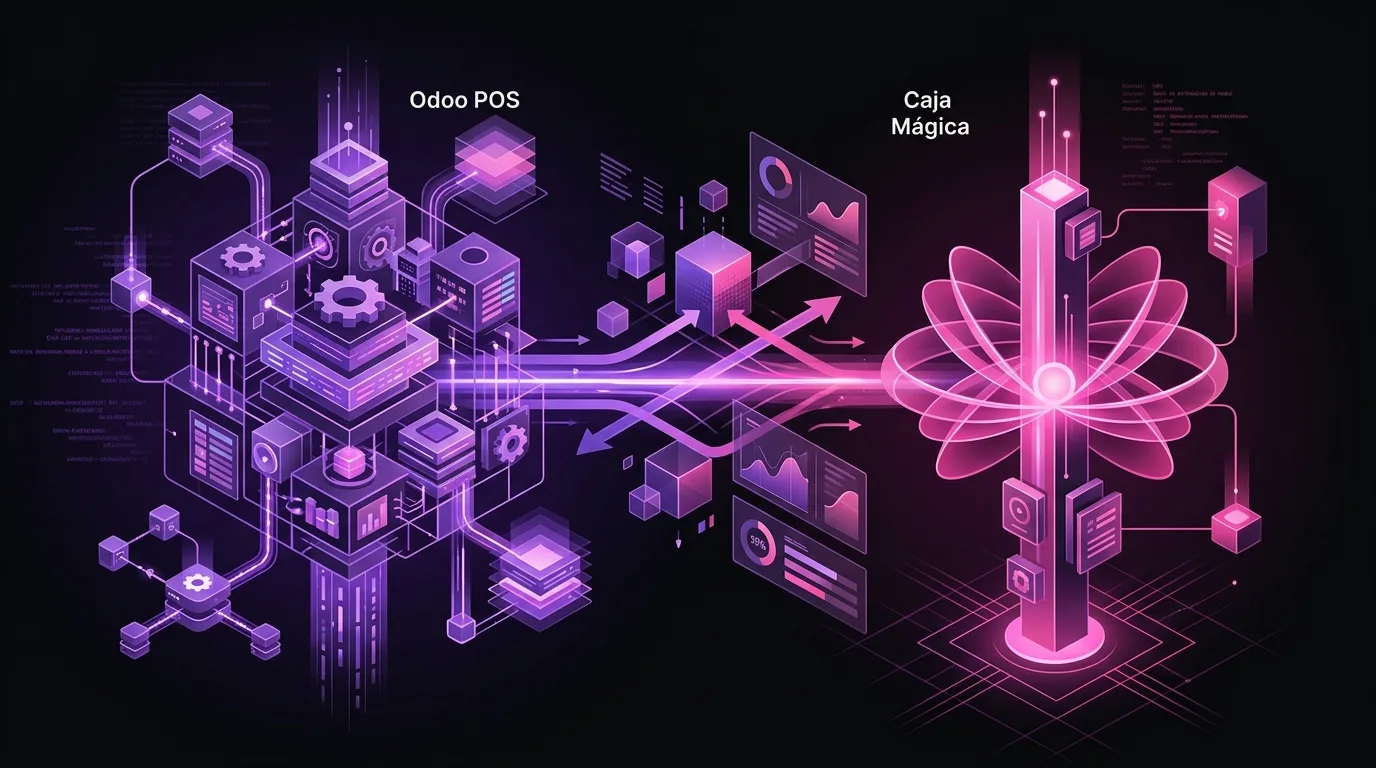
If you are evaluating between Caja Mágica and Odoo POS, the key question is not which is better in abstract. It is which fits the business you have today and the one you want to have in two or three years.
Caja Mágica solves the point of sale problem well for simple and local businesses. Odoo solves that same problem and also gives you the platform to grow without changing systems.
If you want to assess whether Odoo makes sense for your business, the best first step is a direct conversation. At Nextdoo, we perform an initial no-cost analysis to understand your real situation and provide you with a concrete proposal.
Sources consulted: - BOE · RD 1007/2023 VeriFactu - Odoo POS · Official documentation - Odoo · Spain Tax localisation - AEAT · Information on invoicing systems
Guidance information. Actual deadlines, costs and scopes are confirmed after a personalised analysis. JLM Business Solutions SL · B16842831.
Frequently asked questions
Is Caja Mágica specifically designed for Spain?
Yes. Caja Mágica is a Spanish-originated POS designed with a focus on local tax compliance: TicketBAI, VeriFactu and AEAT regulations. It is an advantage for businesses that prioritise adaptation to the national market without the need for additional configurations.
Why choose Odoo if Caja Mágica already complies with Spanish tax regulations?
Tax compliance is the minimum, not the differentiator. Odoo goes much further: it integrates the POS with accounting, eCommerce, CRM, inventory and staff management into a single system. If your business only needs a till and basic tax compliance, Caja Mágica may be sufficient. If you want to scale or have full real-time business visibility, Odoo offers a far superior value proposition.
Which is easier to learn for the store team?
Caja Mágica, being a specialised POS, has a shorter learning curve for till staff. Odoo requires a little more initial training because the system is broader, but the POS interface itself is intuitive. The investment in training quickly pays off when the team starts to take advantage of the system's additional capabilities.
Can I migrate Caja Mágica data to Odoo without losing the historical data?
Yes, it is possible to migrate the product catalogue, customer base and sales history. The complexity depends on the volume and quality of the source data. At Nextdoo, we perform these types of migrations with a preliminary analysis to ensure that the structure in Odoo is clean and operational from day one.
Does Odoo POS work without an internet connection?
Yes. Odoo POS has an offline mode that allows till operations to continue even if the connection drops. Data is automatically synchronised when connectivity is restored. It is an important functionality for businesses that cannot afford interruptions due to network problems.
Does Nextdoo implement Odoo for hospitality and retail with POS?
Yes. Nextdoo is an official Odoo Enterprise partner in Spain with specific experience in retail, hospitality and distribution. We accompany you from the initial analysis to implementation and team training, with deployments adapted to the real operations of each business.
Frequently asked questions
What is the main difference between Caja Mágica and Odoo POS?
Caja Mágica is a specialised Spanish POS for simple businesses without an online shop, whereas Odoo POS is a point of sale integrated into a complete system that connects till, accounting, inventory and eCommerce. Odoo offers a unified solution if you plan to grow or need multiple channels.
Is it mandatory to migrate from Caja Mágica to Odoo if my business grows?
It is not mandatory, but it is recommended if your business is going to open an online channel, needs advanced accounting management or plans to integrate other areas such as human resources or CRM. If your operation remains simple, Caja Mágica is still valid.
Does Caja Mágica comply with VeriFactu and TicketBAI in 2026?
Yes, Caja Mágica is specifically designed to comply with Spanish tax regulations, including VeriFactu and TicketBAI. It is one of its strong points as a specialised solution in the local market.
How much does it cost to choose Odoo over Caja Mágica?
The total cost does not only depend on the licence, but also on the infrastructure and functionalities you need. Odoo can be more expensive initially, but it offers superior value if you integrate multiple business processes into a single system.
Who would you recommend Caja Mágica to instead of Odoo?
Caja Mágica is ideal for businesses with basic operations, no online sales plans and that need simple tax compliance. If your physical shop is your only channel and you do not require integration with other areas of the business, Caja Mágica is sufficient and simpler.