In summary. Odoo enables a Spanish jewellery shop to manage unique pieces with serial number traceability, update prices according to gold quotations, comply with Law 10/2010 on money laundering prevention, manage the repair workshop, and cover all Spanish taxation in 2026, including the special regime for used goods and VeriFactu. A single platform for all business operations.
A jewellery shop is not an ordinary retail business. Each piece has a history, each gram of gold has a live price, and each purchase from a private individual can trigger legal obligations. The ERP managing a jewellery shop must understand this complexity without making life impossible for the jeweller.
Odoo understands this. And in 2026, with VeriFactu already in operation and regulatory pressure on precious metals increasing, choosing the right management software is no longer optional.
Unique pieces versus commodities: two realities in the same business
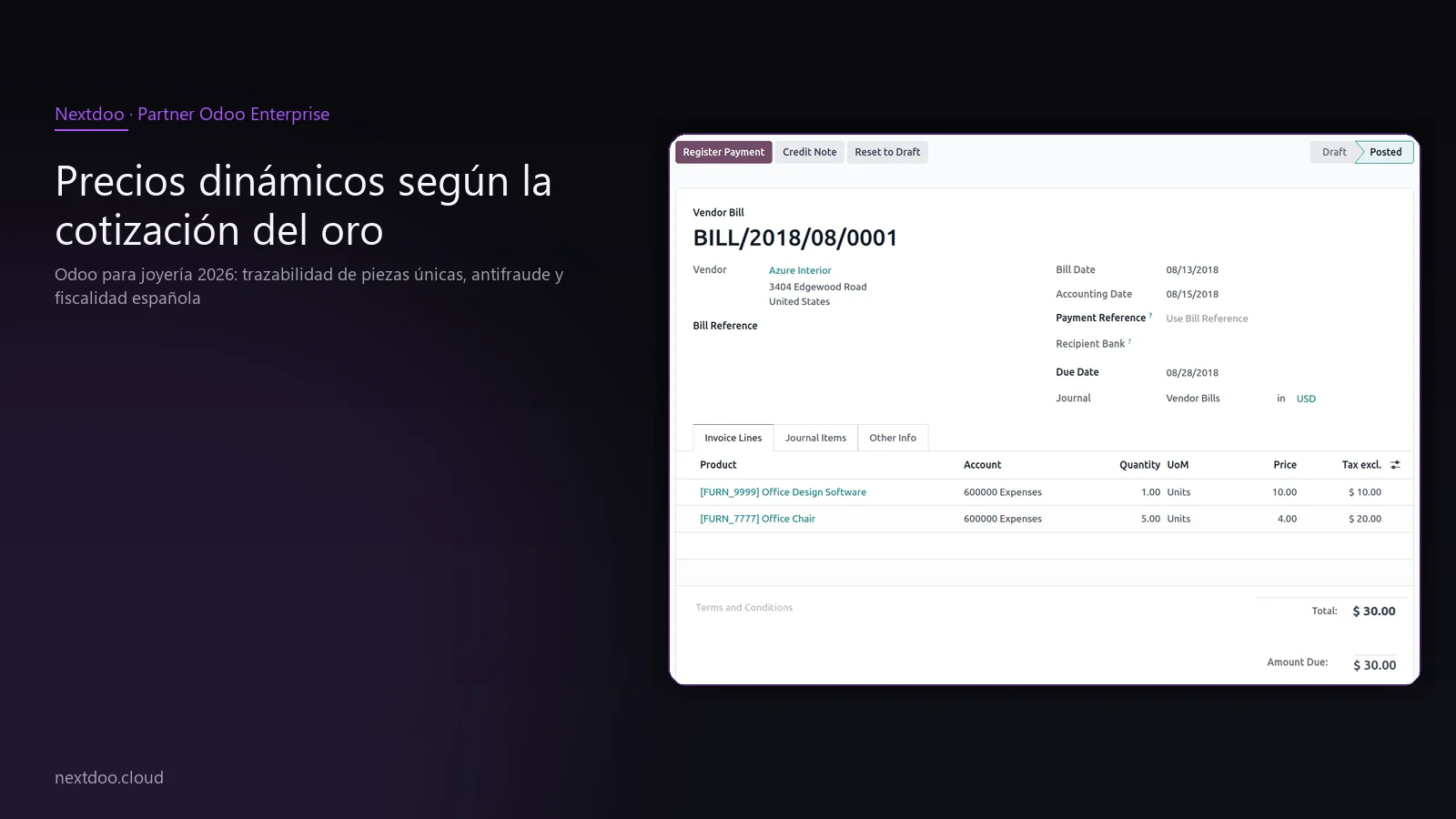
The biggest technical challenge for a jewellery shop is that two completely different types of inventory coexist. On the one hand, unique pieces: the engagement ring with a certified diamond, the high-end watch, the gold necklace manufactured in the workshop. On the other hand, commodities: 18k gold grams, 925 silver, chains sold by length.
Each unique piece requires individual tracking from when it enters the business until it leaves with the customer. Odoo allows a unique serial number to be assigned to each piece of jewellery. This number records the supplier reception date, the acquisition cost, the weight of the precious metal, the carats of the stones, the gemological certificate if it exists, and the photo of the piece.
When that piece is sold, the serial number travels with the transaction. If years later the customer brings it to the workshop for a repair, Odoo recognises it instantly. Complete history, no paper, no searching in filing cabinets.
For mass-produced product lines, such as standard wedding rings or collection earrings, the system manages stock by reference without individual tracking. Each product type has the granularity it needs, no more and no less.
Technical attributes per piece
Odoo allows the file for each piece of jewellery to be enriched with sector-specific attributes:
- Total weight of the piece in grams
- Metal fineness: 18k gold, 14k gold, 925 silver, platinum
- Net precious metal weight (excluding stones and setting)
- Type and caratage of the stones
- GIA, IGI or other gemological laboratory certificate number
- Supplier or originating workshop
- High-resolution photographs for the file
This information is not only useful for internal traceability. It also feeds into the repair budget, insurance valuation, and documentation for recording purchase operations from private individuals.
How does dynamic pricing according to gold quotations work?
The price of gold fluctuates daily. A jeweller who doesn't update their prices with the quotation is selling below cost or losing sales due to excessive margin. Both scenarios are bad.
Odoo has a pricing system that allows the price per gram of each metal to be defined as a central variable. When this variable changes, all associated products automatically recalculate their selling price according to the configured rules.
The practical process is simple: every morning, the responsible person updates the price per gram of gold by consulting the quotation from the Bank of Spain or any reference source. Odoo recalculates the selling price of each piece by applying the metal's weight, the cost of the stones, and the jeweller's margin. In a few minutes, the catalogue is updated.
For larger volume jewellery shops, the update can be automated through a scheduled connection to quotation data sources. In any case, the history of price changes is recorded with date and user, which facilitates any internal audit or tax inspection.
Differentiated pricing by channel and customer
Odoo also allows different pricing to be managed by sales channel. The price in a physical shop can be different from the price in the online shop or the price applied to wholesale customers who buy complete collections. All from the same platform, without double data entry.
Anti-fraud and compliance with Law 10/2010 on money laundering prevention
Any jewellery shop that buys precious metals or jewellery from private individuals has specific obligations under Law 10/2010 on the prevention of money laundering and the financing of terrorism, developed by Royal Decree 304/2014.
The basic obligations are clear:
- Identify the seller with DNI or NIE before carrying out the operation
- Register the description of the item, its weight, the metal's purity, and the amount paid
- Keep all documentation for ten years
- Declare operations that exceed the thresholds established by regulations
Odoo allows the configuration of the purchase-from-individual workflow to collect all this information in a structured way. The file for each purchase includes seller data, item data, and the amount. Everything is linked to the accounting transaction and stored with restricted access.
The key is that this documentation doesn't live on paper filed in a drawer. It's in the system, searchable, exportable, and available for any requirement from the competent authority. The digital archive complies with preservation requirements without taking up physical space or relying on anyone remembering where they saved the form.
Monitoring of cash operations
Spanish regulations limit cash payments between professionals and establish reporting thresholds. Odoo records the payment method for each operation. If the jewellery store manages its collections within the system, it has a complete record of cash operations, which facilitates compliance with Modelo 347 and any AEAT requirements.
How to manage the workshop: repairs and technical service?
For many jewellery stores, the repair workshop is a source of recurring income and customer loyalty. Operationally, it is also one of the most difficult processes to manage without a suitable system.
Odoo manages the complete repair cycle in an ordered workflow:
- The customer hands over the item with a description of the problem
- A repair order is created, linked to the customer and, if applicable, to the original item
- The workshop issues a quote with estimated materials and labour
- The customer approves or rejects. If rejected, the item is returned at no cost
- The workshop carries out the work, recording materials consumed and hours dedicated
- The invoice is generated, and the repaired item is delivered with a guarantee for the intervention
Each repair remains in the customer's history. If that customer returns five years later, the jeweller can see at a glance what was done to the item, when, and with what materials. This builds trust and differentiates a professional jewellery store from one that works from memory.
Workshop materials control
The workshop consumes materials: grams of solder, small quantities of gold for replacement, substitute stones. Odoo automatically deducts the materials used in each repair from inventory. The workshop stock is accurate at all times, which avoids surprises when taking inventory and facilitates business valuation.
What is a CRM for jewellery and how does it improve long-term loyalty?
The jewellery sector has one of the longest purchase cycles in retail. A customer might buy wedding rings today and not return for ten years for an anniversary. If there's no record, that customer is an unknown when they return.
With Odoo's CRM, each customer has a complete profile that gathers all their purchases, repairs, and communications. The jeweller can configure automatic reminders linked to relevant dates: the wedding anniversary, the customer's birthday, the date a watch under warranty was sold.
These reminders allow for launching specific and personalised marketing actions. Not a generic mass email, but a message directed at customers who bought two years ago, inviting them to have the item checked or to discover a new collection.
Practical CRM capabilities in jewellery include:
- Purchase and repair history per customer
- Segmentation by type of jewellery acquired, average amount, or date of last visit
- Email marketing campaigns with personalised content
- Opportunity tracking for high-end sales with a personalised quote
- Recording preferences and sizes to facilitate future purchases
Taxation: VAT, used goods regime and VeriFactu 2026
The taxation for a Spanish jewellery store has specificities that a generic ERP doesn't always handle well. Odoo with Spanish localisation covers them all.
The general VAT of 21% applies to the sale of new jewellery. So far, everything is standard. Complexity arises with the special scheme for second-hand goods, also known as REBU, regulated in articles 135 to 139 of VAT Law 37/1992.
Under REBU, when a jewellery store buys an item from an individual and resells it, VAT is not calculated on the total selling price but on the profit margin. This implies a different accounting mechanism that Odoo manages correctly when configured for it.
Regarding electronic invoicing, VeriFactu is mandatory in 2026 for companies not on the SII. For a Spanish jewellery store, this means that every invoice issued must be sent to the AEAT system at the moment of its generation. Odoo includes this functionality in its Spanish localisation.
Periodic tax obligations that Odoo covers:
- Modelo 303 for quarterly VAT settlement
- Modelo 390 for annual VAT summary
- Modelo 347 for operations with third parties, especially relevant for purchases of precious metals from individuals
- VeriFactu with automatic submission to AEAT
- REBU management with correct margin calculation
How to integrate the online store with the physical store's point of sale?
Many jewellers today operate through two channels: physical shop and online presence. Managing both separately generates duplications, stock errors, and unsynchronised prices.
Odoo unifies both channels. The physical point of sale and the online shop share the same catalogue, the same inventory, and the same CRM. When a unique piece is sold in-store, it immediately disappears from the online catalogue. When a customer buys online, the system records their data in the CRM just as if they had visited the counter.
For jewellers working with seasonal collections or publishing unique pieces on external platforms, Odoo can integrate with third-party tools via standard connectors. The catalogue is updated from a single control point.
What is the Odoo implementation process like in a jewellery business?
Before discussing timescales, it's worth understanding what makes Odoo implementation in a jewellery business different from a generic retail store. The catalogue is the critical point: each piece's data sheet must be migrated or created with its specific attributes, serial number tracking configured, dynamic pricing rules defined, and private purchase workflows established with the fields required by Law 10/2010.
The usual process for an independent jewellery business follows these phases:
- Business and existing catalogue analysis
- Inventory configuration with specific jewellery attributes
- Parameterisation of dynamic pricing for precious metal
- Adaptation of private purchase workflow with regulatory compliance fields
- Repair workshop configuration
- Implementation of Spanish accounting with REBU and VeriFactu
- Team training and go-live
The exact scope, timescale, and cost depend on the size of the jewellery business, the number of establishments, the catalogue volume, and the necessary integrations. A jewellery business with a single establishment has a very different scope from a chain with multiple points of sale and its own workshop.
The budget is always an indicative range that is finalised after the initial analysis. What is reasonable to expect is that a well-executed implementation quickly pays for itself: the time saved in inventory management, in preparing tax documentation, and in customer follow-up has a direct economic value.
Frequently asked questions
Can Odoo manage jewellery businesses with multiple establishments?
Yes. Odoo is multi-company and multi-warehouse. A chain of jewellery businesses can manage the stock of each establishment independently, with controlled transfers between shops, and consolidate accounting into a single view. The CRM is also shared, so a customer who bought from one shop can be served in another without loss of history.
How is supplier consignment stock managed?
Some jewellers work with consigned pieces: the supplier leaves stock in the shop, but it remains theirs until sold. Odoo allows configuring this flow with differentiated consignment warehouses, so that consignment inventory is not confused with own inventory, and settlement with the supplier is automatically generated when a sale occurs.
What happens to pieces that don't sell and are returned to the supplier or melted down?
Odoo manages returns to suppliers with automatic credit notes. If a piece is removed for melting or transformation in the workshop, the system records the inventory outflow with the corresponding reason. The piece's history remains complete even if it ceases to exist as a sellable product.
Is Odoo compliant with VeriFactu for 2026?
The Spanish localisation of Odoo includes VeriFactu functionality for companies required by AEAT regulations. Specific compliance with the production system depends on the implemented version and the configuration carried out by the partner. It is advisable to verify the certification status at the time of implementation.
Can insurance for inventory pieces be managed from Odoo?
Odoo is not an insurance platform, but it does maintain the necessary data for coverage: updated valuation of each piece, photographs, serial number, and acquisition price. This information can be exported in the format required by the insurer. Some jewellers integrate Odoo with specific claims management tools using connectors.
How long does it take to learn to use Odoo in a jewellery business?
It depends on the team's profile and the scope of the implementation. A jeweller without prior ERP experience can fluently handle daily operations within a reasonable timeframe after initial training. The learning curve for complex operations such as REBU or workshop management is somewhat steeper, but an experienced partner guides this process until the team works autonomously.
Conclusion: act before complexity accumulates
A jewellery business that grows without a suitable management system accumulates problems: imprecise inventory, outdated prices, scattered regulatory compliance documentation, customers without history. Each of these problems carries an economic cost and legal risk.
Odoo solves all these issues from a single platform. It is not the cheapest ERP on the market nor the fastest to implement, but it offers the greatest functional depth for a business with the specific complexity of Spanish jewellery in 2026.
If you are considering modernising your jewellery management, the first step is an analysis of the current state. Without this analysis, any budget is an estimate in a vacuum.
Indicative information. Actual timescales, costs, and scopes are confirmed after a personalised analysis. JLM Business Solutions SL · B16842831.
Frequently asked questions
Can Odoo manage jewellery businesses with multiple establishments?
Yes. Odoo is multi-company and multi-warehouse. A chain of jewellery businesses can manage the inventory of each establishment independently, control transfers between shops, and consolidate accounting into a single view. The CRM is shared, so a customer who bought from one shop can be served in another without loss of history or duplication of records.
How does Odoo manage the special scheme for second-hand goods in jewellery?
The special scheme for second-hand goods (REBU), regulated in articles 135 to 139 of Law 37/1992, establishes that VAT is calculated on the profit margin and not on the total sale price. Odoo with Spanish localisation supports this scheme when correctly configured, which allows for issuing invoices with the appropriate accounting mechanism and generating the corresponding tax models without double work.
Does Odoo comply with Law 10/2010 for the purchase of precious metals from individuals?
Law 10/2010 requires the identification of the seller, the registration of the operation with all its data, and the retention of documentation for ten years. Odoo allows the configuration of the purchase flow from individuals with the fields required by the regulations, linking them to the accounting transaction. The record is stored in digital format, searchable and available for any requirement from the competent authority. Specific compliance depends on the flow configured in each implementation.
Is Odoo compatible with VeriFactu for jewellery shops in 2026?
The Spanish localisation of Odoo includes VeriFactu functionality for companies mandated by AEAT regulations. This affects jewellery shops that are not part of the Immediate Supply of Information system. Specific compliance depends on the version implemented and the configuration carried out by the partner. It is advisable to verify the updated status at the moment of contracting the implementation.
Can consignment pieces from suppliers be managed?
Yes. Some jewellery shops work with consignment stock: the supplier leaves pieces in the shop but remains the owner until sold. Odoo allows the configuration of differentiated consignment warehouses, so that this inventory is not mixed with own stock and the settlement to the supplier is automatically generated when the sale occurs. It is a common flow in branded jewellery that Odoo manages precisely.
What happens to the inventory of a unique piece when it is melted down or transformed in the workshop?
When a piece is removed from inventory for melting down or for transformation in the workshop, Odoo records the outflow with the corresponding reason. The piece's history remains complete even if it ceases to exist as a sellable product. If a new piece is generated from the melted materials, it enters the system as a new product with its own serial number. The inventory reflects reality at all times.
Frequently asked questions
How does Odoo control the traceability of each piece of jewellery?
Odoo assigns a unique serial number to each piece and records its complete history: origin, characteristics, repairs, and sales. This allows identifying at any time where each item is and who owns it.
Does Odoo automatically update prices according to the price of gold?
Yes, Odoo allows dynamic pricing to be configured linked to the gold quotation. The system automatically recalculates the value of pieces according to market fluctuations without manual intervention.
Does Odoo comply with Law 10/2010 on the prevention of money laundering?
Yes, Odoo automatically records mandatory data for purchases from individuals and generates the necessary reports to comply with money laundering prevention regulations in Spain.
What happens with the taxation for 2026, VeriFactu, and second-hand goods?
Odoo includes the complete configuration for VeriFactu, the special scheme for second-hand goods, and the correct VAT calculation according to each operation. The system automatically issues the correct tax documentation.
Can Odoo also manage the jewellery repair workshop?
Yes, Odoo integrates the management of the repair workshop and technical service on the same platform, allowing work, materials used, and execution times to be recorded without changing systems.